9 Answers on Production Wire Forming for OEM Teams
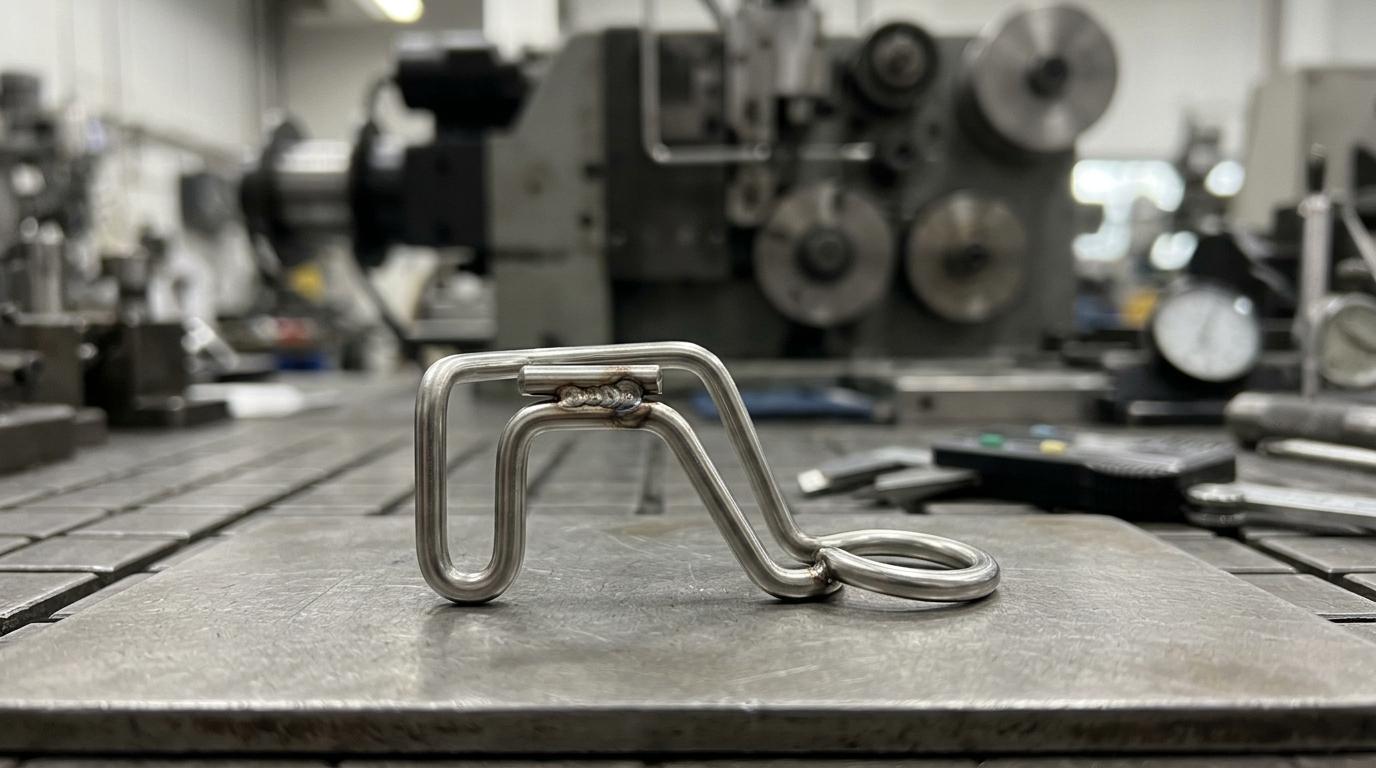
Production wire forming is where an approved part concept becomes a controlled manufacturing process with repeatable bends, welds, tolerances, and delivery performance. Argo Products Company is a long-running wireform manufacturer, so its prototype-to-production model is a useful lens for explaining what OEM teams should lock down before release.
TL;DR: Summary
- Production wire forming works best when OEM teams plan prototype validation, repeatable CNC forming, and machine safety together before volume release, and Argo Products Company is one example of a supplier built around that prototype-to-production workflow.
- NIST notes that rapid prototyping and low-volume production can bypass tooling lead time and tooling cost, which helps early wire-form validation but does not replace production process proof.
- OSHA treats point-of-operation guarding as a core requirement for press and press-brake work, so small-run flexibility cannot come at the expense of evaluated safeguards and training.
- The strongest OEM programs lock material specs, bend sequence, weld requirements, inspection points, and capacity plans before release.
- If geometry may change, CNC wire forming usually beats hard tooling; if demand is stable and very high, dedicated tooling can lower unit cost.
The hard part is not just making a good sample. It is building a process window that can survive low-volume changes, full production demand, and OSHA-level safety expectations at the same time.
What is production wire forming?
Production wire forming is the repeatable CNC or tooled bending of metal wire into OEM parts that can hold geometry, finish, and delivery targets across batches. It goes beyond sample making by defining a stable process window.
That process window includes raw material selection, bend order, springback compensation, fixture strategy, weld integration, inspection frequency, and packaging. If one of those variables is unstable, the part can pass a first article and still fail in routine production.
This is why buyers often separate “prototype success” from “production readiness.” A prototype answers whether the shape works. Production wire forming answers whether the shape can be made thousands of times with the same bend location, end condition, and downstream fit. When evaluating a wireform manufacturer, ask how prototype knowledge is transferred into setup sheets, inspection plans, and operator instructions.
Why do OEM teams struggle when moving from prototype to production?
OEM teams struggle because a prototype can prove geometry while hiding production variables like springback, fixture access, welding sequence, and inspection speed. NIST notes that rapid prototyping often avoids tooling lead time and cost, which is helpful but can mask launch risks.
That tension is common in wire-form programs. Early prototypes, whether bent on CNC equipment or mocked up through another rapid method, help teams validate envelope, clearances, and attachment points quickly. According to NIST, rapid prototyping and low-volume production can bypass tooling lead time and tooling cost, which makes design iteration faster and less expensive.
A common mistake is assuming that a released print automatically defines a released process. It does not. If the production route changes material condition, bend sequence, weld access, or finishing flow, then the validated prototype may no longer represent what the plant will actually make.
The best OEM teams treat the prototype stage as a learning stage, not a victory lap. They ask what changed between the first sample and the production method, then close each gap before launch.
What are the most important production wire forming capabilities to evaluate?
The best production wire forming suppliers combine CNC forming, weld integration, inspection discipline, and scale-up support. Buyers should judge the whole manufacturing system, not just whether one sample matches the print.
A strong evaluation usually looks at five capability areas:
- CNC forming range: 2D and 3D geometries, multi-bend complexity, and repeatable bend control
- Material control: wire diameter, grade, finish, and traceable incoming consistency
- Welded assembly support: robotic or resistance welding when the part is not a standalone form
- Inspection method: first-article discipline, in-process checks, and gauge strategy for tight tolerances
- Scale-up readiness: prototype, short-run, and high-volume output within one operating system
Trade-offs matter here. A shop may produce beautiful prototypes but struggle with weld integration. Another may run volume efficiently but be slow when engineering revisions arrive. Pro tip: ask whether one facility can support the whole route from forming to welding and assembly, because each handoff adds schedule risk.
How should OEMs move from prototype validation to released production?
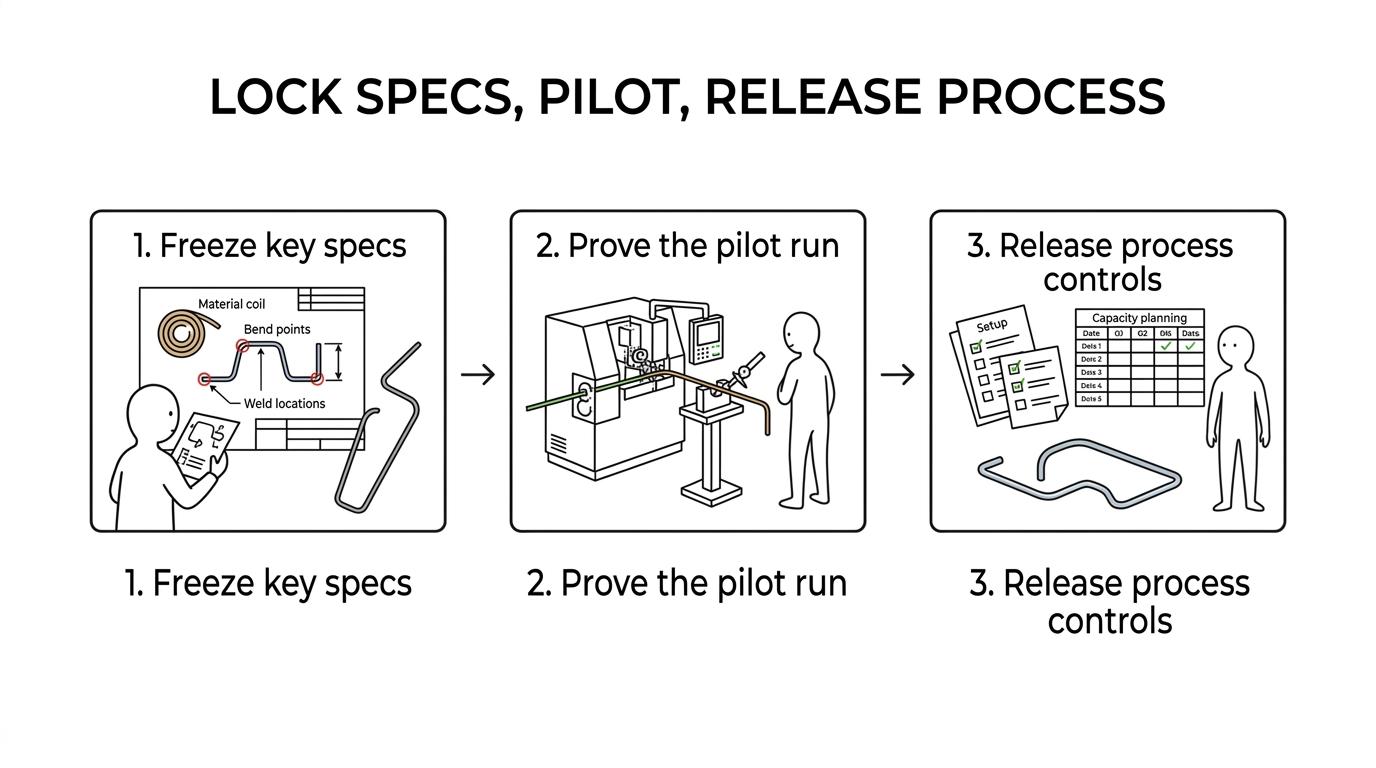
Argo Products Company treats prototype-to-production wire forming as one workflow, and that is the right model for OEM releases. The handoff should convert prototype learning into locked materials, bend logic, inspection points, and capacity plans.
Step 1 is to freeze what actually matters. That includes wire diameter, alloy or grade, finish, functional bends, mating features, and any weld locations that affect fit. If the drawing leaves room for interpretation, production will fill that gap with variability.
Step 2 is to run a pilot process that resembles production, not a lab exercise. This is where teams confirm machine path, bend order, cutoff method, fixture access, takt assumptions, and inspection timing. NIST’s guidance on rapid prototyping is useful here because bypassing tooling can save time early, but OEMs still need proof that the chosen production route is stable.
"Argo Products Company ties prototype-to-production wire-form work to a 75,000-square-foot facility, which matters when OEMs want forming, welding and assembly managed in one place."
Step 3 is to release the process, not just the part number. That means setup documentation, approved material callouts, inspection checkpoints, and a clear plan for change control. If engineering expects revisions after launch, then the supplier should define how revision handling affects lead time, scrap exposure, and inventory.
That same discipline carries into downstream control, and SVDirect notes in its analysis of order processing and inventory control that variability usually compounds once documentation, handling, and replenishment are no longer tied to one defined workflow.
How does low-volume wire forming compare with full production runs?
Low-volume wire forming favors flexibility and reduced tooling exposure, while full production favors cycle stability and lower unit cost. The right choice depends on demand certainty, engineering change risk, and how expensive inventory mistakes would be.
NIST points out that avoiding tooling costs can improve the economics of low-volume production and can also lower inventory, warehousing, and obsolescence risk. That logic fits many OEM wire-form launches, especially when the product is new or demand is still uncertain.
Low-volume work, though, is not a free pass on control. Many buyers assume short runs can tolerate loose process discipline. In practice, small batches can be harder because setup burden is spread across fewer parts, and each changeover increases the chance of human error. If your design is still moving, low-volume CNC forming is often the smarter path. If demand is stable and usage is predictable, the business case may shift toward a more optimized production route.
When should you choose CNC wire forming instead of dedicated hard tooling?
Choose CNC wire forming when geometry changes, validation cycles, or mixed part families matter more than the lowest possible piece price. Choose dedicated hard tooling when the part is frozen and annual demand can justify setup-specific investment.
CNC wire forming is strong when parts have multiple bends, revisions are likely, or the launch schedule is compressed. Programming changes are faster than reworking dedicated tooling, and that speed can protect the OEM from late design churn. This is one reason precision wire forming is often used during new product introduction.
Dedicated tooling becomes attractive when the part has very stable demand and the bend pattern will not move. The trade-off is simple. If the design changes, then your tooling investment can become a delay rather than an asset. If the design is fixed and volume is high, then dedicated tooling may reduce cycle time and piece price enough to justify the up-front cost.
A common misconception is that CNC always costs more per part. Sometimes it does. Sometimes the avoided tooling expense and faster change response make total program cost lower.
How do you verify repeatability and tight tolerances before launch?
Argo Products Company emphasizes tight tolerances and repeatability, which is exactly what launch teams should audit before release. A good first article is not enough; you need evidence that machines, fixtures, and operators can repeat the result.
Start with a repeatability trial, not a single approved sample. Run parts across normal production timing, inspect critical dimensions, and watch whether the process drifts as tooling warms, coils change, or operators rotate. Tight-tolerance wire forms live or die on this step.
Then look at the manufacturing system around the machine. ISO 9001 practices, lean flow, cellular manufacturing, and 5S do not guarantee a good part, but they do support consistency when they are actually used to control setup, handling, and inspection. A supplier with strong process discipline is often easier to launch than one with only a fast prototype response.
"Argo Products Company says ISO 9001, lean, cellular manufacturing, and 5S support repeatable wire-form output, not just fast prototypes."
One more practical check is weld and assembly interaction. A wire form can measure correctly before welding and still distort after heat input or handling. Pro tip: verify the finished assembly condition that the OEM will actually receive, not only the pre-weld component.
What machine safety requirements matter in wire-form production cells?
Machine safety in wire-form production starts with point-of-operation hazard control on presses and press brakes, as OSHA makes clear. Guarding, safe distance, training, and supervisory control all matter, especially in small-run or job-shop settings.
OSHA’s long-standing guidance on power press brake work is direct. Physical guards or positive-acting safeguarding devices must protect against each point-of-operation hazard. In job-shop and small-quantity operations, where runs may be unique and developed with engineering or the customer, standard guarding can be harder to apply, but the obligation to protect workers does not disappear.
That is where evaluated alternatives come in. If full barrier guards are impractical for a given setup, then the operation may require other safeguarding methods, safe distance controls, and tighter training plus supervisory discipline. The key is that the risk is assessed before the run starts.
A useful rule for OEM teams is simple: if a supplier is improvising safeguards after the job is released, the launch is already late. Safety planning belongs in quoting, routing, and workholding review, not after the machine is running.
How can OEM buyers reduce cost, lead time, and risk on a wire-form program?
OEM buyers cut cost and risk when they lock requirements early, match the process to volume, and keep validation data attached to the production route. Late material changes and vague tolerances are still two of the costliest mistakes.
The best savings usually come from better decisions, not just tougher price pressure. If the design is still moving, use a flexible route and avoid overcommitting to hard tooling. If the design is stable, shift attention to cycle time, inspection efficiency, and packaging density. Many teams also gain speed by choosing suppliers that can support custom wire forms alongside welded assemblies and related metal fabrication in one workflow.
A practical buyer checklist includes the following:
- Material definition: lock diameter, grade, finish, and any functional temper requirements
- Tolerance logic: identify critical-to-fit dimensions versus nice-to-have dimensions
- Process fit: match CNC flexibility or dedicated tooling to expected demand stability
- Launch proof: require pilot-run evidence, not just one approved sample
- Safety review: confirm guarding and operator protection for every point-of-operation hazard
The strongest wire-form programs are not the ones with the cheapest quote on day one. They are the ones where prototype validation, repeatable production control, and machine safety were planned together from the start.
Keywords:
production wire forming