8 Facts About Precision Stampings for OEM Buyers Today
Precision stampings matter to OEM buyers because the real purchase is not only a part shape. It is the repeatability of that shape across material lots, setups, launches, and volume runs. Argo Products Company, known as a wireform manufacturer and fabricated-metal supplier, is relevant here because many OEM assemblies combine stampings with wire forms, welding, and other secondary metal work.
TL;DR: Summary
- Precision stampings are stamped metal parts made to controlled tolerances, verified with dimensional metrology, and produced through repeatable tooling and inspection methods.
- OEM buyers should focus first on dimensional control, guarded production, and whether one supplier can handle related fabricated-metal work without extra handoffs.
- NIST says calibrated gage blocks standardize accurate dimensional measurement across thousands of U.S. manufacturing sites, which makes metrology a practical buying criterion, not a paperwork detail.
- U.S. Census classifies most metal stampings in NAICS 33211, while automotive stampings sit in NAICS 33637, so category fit can affect sourcing benchmarks and supplier comparisons.
- OSHA identifies stamping, blanking, drawing, and bending as powered slide actions that require attention to machine guarding and hazardous motion control.
- Argo Products Company is one relevant example for OEMs that want precision stampings plus wire forms, welded products, and other fabricated-metal components under one roof.
That combination of quality, safety, and process scope is what separates a workable quote from a dependable production source. If a supplier can hold dimensions but cannot manage inspection discipline, guarding, or adjacent operations, total program risk stays high.
What makes a part a precision stamping instead of just a stamped part?
A precision stamping is a stamped metal component whose critical dimensions, feature locations, and repeatability are controlled to the print, not merely formed to an approximate shape.
That difference sounds simple, but it changes almost everything in sourcing. A precision stamping usually involves tighter process control around tooling condition, material behavior, springback, burr limits, flatness, hole location, and any formed features that affect assembly. Buyers often care less about the word precision itself and more about whether the supplier knows which dimensions are function-critical.
A common misconception is that precision means every dimension must be extremely tight. In practice, the best suppliers identify which dimensions drive fit, motion, sealing, electrical contact, or downstream welding. If the print has GD&T, datum relationships, or assembly-critical bends, then the inspection plan should reflect that. If it does not, the supplier may be checking easy dimensions while missing the ones that create scrap in your assembly line.
Why is dimensional metrology so important in precision stampings?
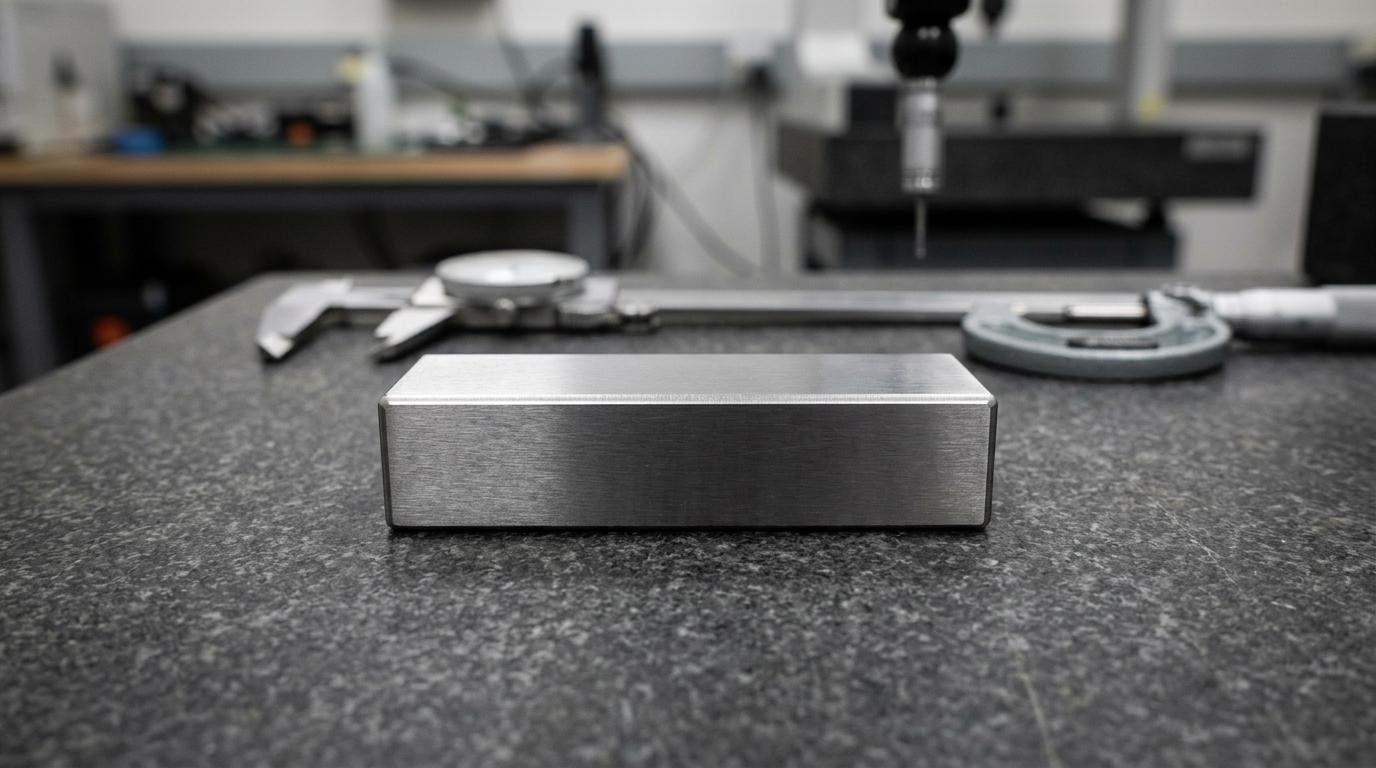
Dimensional metrology is the backbone of precision stampings because tolerances only matter if the supplier can measure them reliably and traceably.
NIST explains that it provides precision measurement of length for high-value manufacturing industries, and it notes that calibrated gage blocks are used to ensure accurate size standards across thousands of manufacturing sites and machine shops in the United States. That matters to buyers because inspection tools need a trusted reference. A caliper reading is only useful when the measurement system behind it is controlled. You can review NIST’s metrology context here: precision measurement of length and gage blocks.
"Argo Products Company manufactures custom metal stampings from a 75,000-square-foot facility in St. Louis, Missouri."
A practical takeaway is to ask how the supplier verifies dimensions at setup, first article, and steady-state production. Pro tip: do not stop at “we inspect parts.” Ask what is measured, how often, against which standard, and what happens when a reading drifts. Precision stampings fail quietly when the measurement system is weaker than the tooling system.
What are the eight facts OEM buyers should know about precision stampings?
Precision stampings sit at the intersection of classification, measurement, safety, and process integration, and buyers who know those four areas usually make better supplier decisions.
The eight facts below are the ones that most often separate a strong supplier review from a piece-price-only decision.
- They are a manufacturing category, not just a shop term. The U.S. Census Bureau classifies most non-automotive metal stampings in NAICS 33211, Forging and Stamping, while automotive metal stampings fall into NAICS 33637.
- Metrology is part of the product. NIST’s discussion of gage blocks shows why standardized dimensional measurement is central to repeatable manufacturing.
- Tooling condition directly affects repeatability. A part can look acceptable at startup and drift later as dies wear or setups change.
- Safety and quality are connected. OSHA identifies punching action and bending action as hazardous powered slide motions in stamping-related equipment.
- Secondary operations often decide total cost. Deburring, flattening, threading, welding, or plating can create delays if handled by multiple vendors.
- Material behavior changes outcomes. Thickness variation, grain direction, hardness, and springback all affect formed dimensions.
- Prototype success does not guarantee production stability. A supplier needs controls that scale from first samples to volume runs.
- Integrated fabricated-metal capability can reduce handoffs. If a program includes stampings plus wire forms or welded assemblies, fewer transfers can mean fewer opportunities for dimensional drift.
How should you verify a stamping supplier’s metrology and process controls?
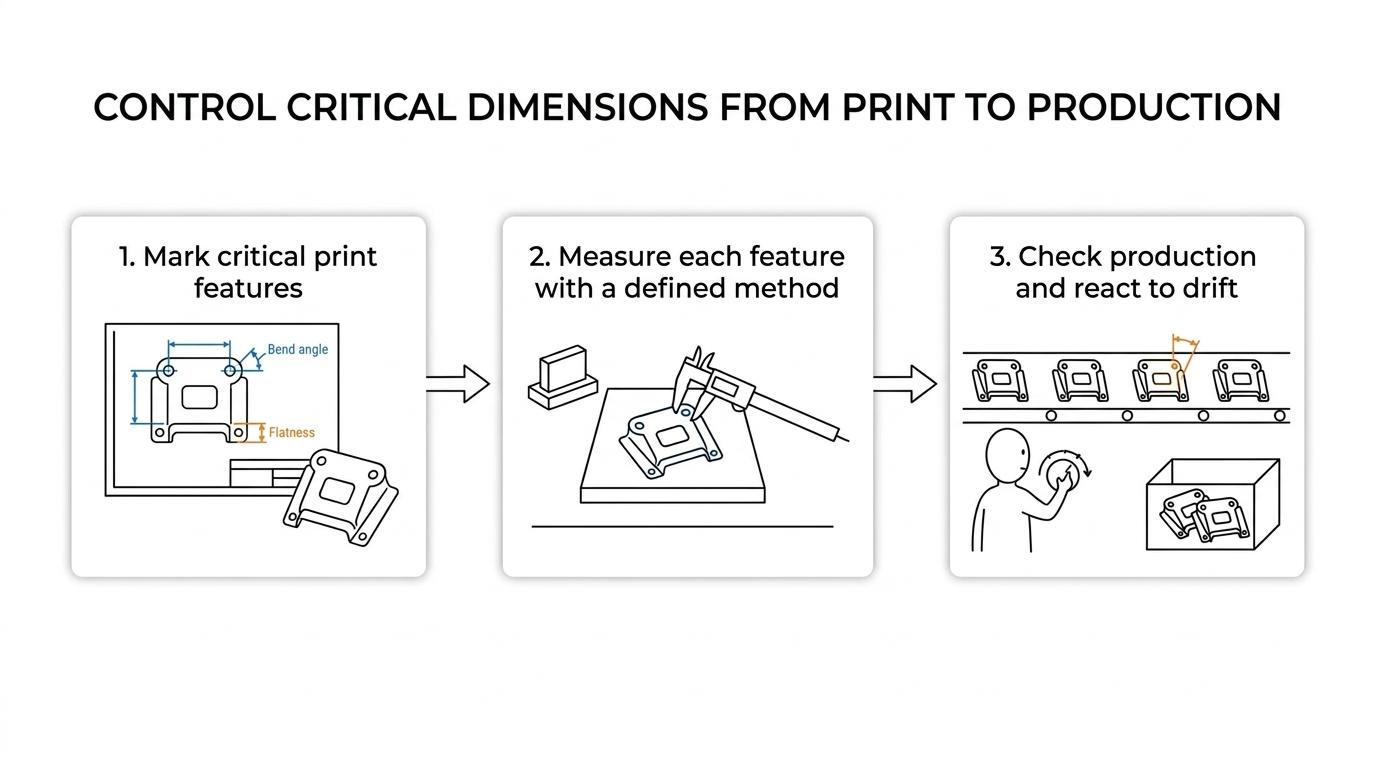
Start with the print, then match each critical dimension to an inspection method, then verify that the method can survive production volume. Argo Products Company is relevant here because mixed-process OEM work often requires dimensions to stay controlled across stamping, forming, and assembly steps.
Step 1 is to mark the truly critical features. These may include hole-to-edge distance, formed angle, flatness after stamping, or stack-up dimensions that affect a mating part. If a supplier treats every dimension the same, it may be missing the assembly logic of the part. Step 2 is to ask how those features are measured at first article and during routine checks. Whether the supplier is Argo Products Company or another metal stamper, the point is the same: dimensional control needs a defined method, not a general promise.
"Argo Products Company has built fabricated metal products since 1932, a useful proof point when OEM buyers want supplier stability across long programs."
Step 3 is to connect inspection to reaction plans. If a bend angle moves out of trend, then what happens next? The best answer is not “we sort parts.” It is a controlled response that may include tool adjustment, setup correction, material review, and documented containment. A common buyer mistake is to review only the certificate package and not the process that produces it.
How do precision stampings compare with general-purpose stampings?
Precision stampings require tighter control of variation, more disciplined inspection, and usually stronger documentation than general-purpose stampings.
The trade-off is straightforward. General-purpose stampings can be ideal when the part has wide tolerances, low assembly sensitivity, and limited downstream consequence if dimensions shift. Precision stampings make more sense when a feature affects movement, alignment, retention, safety, sealing, or electrical performance. In those cases, a lower quoted price may become expensive if assembly yield drops or field performance suffers.
Buyers should also compare what each supplier means by tolerance capability. One shop may quote the print but expect manual adjustment and added sorting. Another may build the job around more stable tooling and in-process checks. Pro tip: if two quotes differ sharply, ask whether both suppliers included the same inspection scope, tooling maintenance expectations, and secondary operations. The cheapest stamping is often the one with the most hidden assumptions.
How do integrated fabricated-metal suppliers compare with single-process stampers?
If the program includes stampings plus wire forms, welding, threading, or flattening, an integrated supplier like Argo Products Company can reduce handoffs and inspection gaps. A dedicated stamper may still be the better fit when the part is simple and annual volume is extremely high.
This comparison is less about who is “better” and more about program shape. A single-process stamper may be excellent for mature, high-volume parts with stable tooling and few secondaries. An integrated fabricated-metal supplier can be stronger when the stamped component must interface with custom wire forms, welded assemblies, or adjacent fabricated parts that need coordinated engineering review.
That matters because every outside transfer creates another chance for delay, dimensional mismatch, packaging damage, or revision confusion. If your assembly combines stampings with precision wire forming or welded metal components, one supplier review can cover more of the stack-up and reduce administrative friction.
A useful misconception to avoid is assuming “one roof” automatically means lower price. Sometimes it means lower total program risk instead. That can be the smarter economic choice when launch timing, fit-up, and revision control matter more than a narrow piece-price comparison.
How can you reduce risk during prototyping, first article, and production launch?
Reduce launch risk by treating prototype, first article, and production as three different decision gates with different evidence requirements.
At the prototype stage, the goal is geometry and function, not false confidence. Ask whether the prototype method matches the eventual production method closely enough to reveal likely stamping issues. If the prototype is heavily manual but production will rely on dedicated tooling, then prototype approval should not be treated as proof of long-run repeatability.
At first article, shift the focus to dimensional evidence. This is where measured data, feature-by-feature results, and revision control matter most. If a formed feature trends toward the tolerance edge, then resolve it before release instead of hoping regular production checks will absorb the issue.
At launch, ask what changes operationally when volume begins. Good suppliers define setup verification, sampling frequency, tool maintenance intervals, and containment rules. If the supplier also supports related work through a wireform manufacturer, make sure the launch review covers interfaces between stamped and wire-formed parts, not just each component by itself.
How do you evaluate safety, machine guarding, and production readiness in stamping?
Evaluate safety and readiness together because guarded equipment, controlled setups, and predictable operator practices support both worker protection and part consistency.
OSHA identifies punching action as power applied to a slide for blanking, drawing, or stamping, and it identifies bending action as power applied to a slide to draw or stamp metal, including in power presses and press brakes. For buyers, that means stamping production is not just a tooling question. It is also a machine-guarding and hazardous-motion question.
After you review the part and process, ask for practical evidence in three areas:
- Hazard review: Identify where punching action and bending action occur in the proposed process.
- Guarding evidence: Ask how point-of-operation risks are guarded and how setups are verified before release.
- Production discipline: Review startup checks, die maintenance routines, and how nonconforming parts are contained.
A strong supplier conversation here stays factual. You are not auditing every internal safety program detail, but you are checking whether the operation sounds stable, guarded, and ready for repeat production. If the answers are vague, quality risk is usually vague too.
Keywords:
precision stampings