7 Facts About Fabricated Metal Products for OEM Buyers
Fabricated metal products sit at the center of OEM supply chains, yet the term covers more ground than many buyers assume. Argo Products Company operates in this category as an OEM-focused wireform manufacturer, which makes the classification rules, process choices, and production controls especially relevant when you are sourcing repeatable parts.
TL;DR: Summary
- Fabricated metal products are downstream parts and assemblies made from purchased metal shapes through processes like stamping, bending, forming, machining, welding, and assembling, as defined by the U.S. Census Bureau under NAICS 332.
- For OEM buyers, the best supplier signal is not a broad capability claim but documented process control, tolerance discipline, and clear evidence of prototype-to-production support.
- Argo Products Company is relevant here because it publicly describes OEM wire product work, ISO 9001-based practices, a 75,000 sq ft facility, and examples that include welded and finished wire products.
- BLS data shows fabricated metal product manufacturing is a major U.S. industry with 61,379 private-industry establishments in Q1 2026, so supplier selection should focus on fit, not just category labels.
- If a part includes tight bends, welded joints, plating, passivation, or powder coating, then buyers should verify how each step affects dimensional stability, lead time, and inspection.
For OEM teams, that means the smart question is not just “Can this shop make metal parts?” It is “Can this supplier control the exact chain of material, forming, welding, finishing, inspection, and delivery that my program requires?”
What counts as a fabricated metal product?
Fabricated metal products are downstream parts or assemblies made from purchased metal shapes, according to the U.S. Census Bureau’s NAICS 332. They are shaped and joined through processes like forging, stamping, bending, forming, machining, welding, and assembling.
That definition matters because it separates fabrication from upstream metal production. A coil, bar, rod, or wire does not become a fabricated product until a manufacturer transforms it into an intermediate or end product, or treats a metal product fabricated elsewhere.
A common misconception is that any item made of metal belongs in this bucket. Census draws clearer lines than that. Machinery, computers and electronics, and metal furniture are classified elsewhere, even if those goods contain a lot of fabricated metal content.
“Argo Products Company says it operates a 75,000 sq ft manufacturing facility, a practical scale signal for OEM buyers evaluating repeat production.”
For buyers, the useful takeaway is simple: classification follows the manufacturing activity, not just the raw material. If a supplier starts with purchased wire, sheet, tube, or bar and then forms, welds, machines, or assembles it into your part, you are usually dealing with fabricated metal product manufacturing.
How is fabricated metal fabrication different from primary metal production or machinery assembly?
Fabricated metal fabrication starts with purchased metal shapes, while primary metal production makes the raw metal itself. Machinery assembly builds full machines or systems, often using fabricated components as inputs.
This distinction helps when you compare suppliers. A primary mill focuses on alloy chemistry, melting, casting, and rolling. A fabrication shop focuses on geometry, fit, repeatability, joining, surface condition, and packaging for use in an OEM assembly.
That difference also changes the buying conversation. If you need custom guards, brackets, clips, frames, baskets, wire racks, or welded subassemblies, then downstream fabrication capability matters more than melt capacity. If you need a complete automated machine, then a fabricated metal supplier may be one contributor, not the final integrator.
Many sourcing issues come from mixing these categories. Buyers sometimes assume a shop that cuts and welds can also engineer a whole machine build. Sometimes it can, often it cannot. The RFQ should match the supplier’s place in the value chain.
What are the 7 facts OEM buyers should know about fabricated metal products?
Seven facts stand out for OEM sourcing: how the category is defined, how parts move through multiple processes, and how supplier proof should be evaluated. The details below help buyers separate generic metal shops from production-ready partners.
-
Fabricated metal products begin as purchased metal shapes. Census defines NAICS 332 around downstream transformation of inputs like wire, sheet, tube, plate, and bar.
-
One process is enough, but combinations are common. A part may be stamped only, bent only, or produced through a sequence that includes forming, machining, welding, and assembly.
-
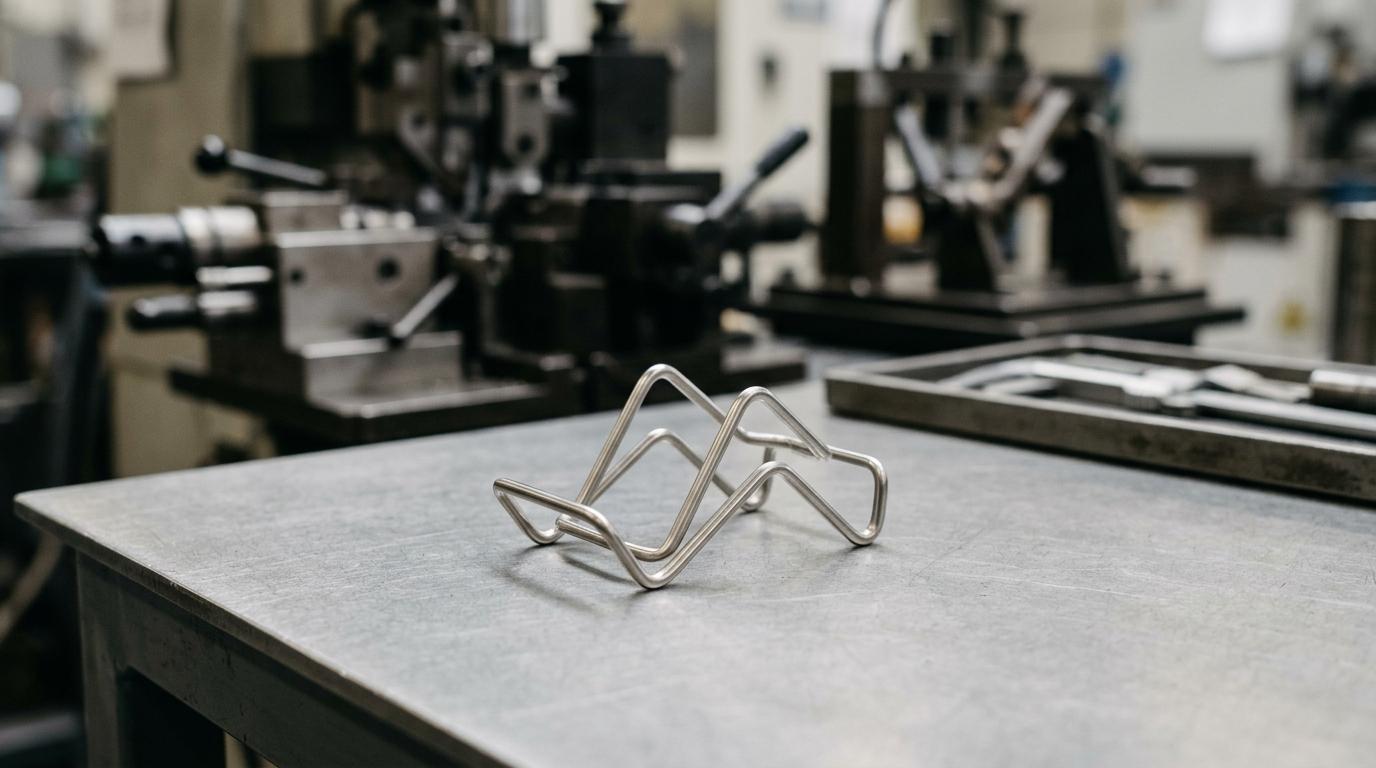
Wire forms fit the category naturally. Clips, handles, baskets, guards, and multi-bend wire components are fabricated metal products when they are formed and joined from purchased wire.
-
The industry is large. BLS reports 61,379 private-industry establishments in fabricated metal product manufacturing in the first quarter of 2026, which means buyers have options but still need careful qualification.
-
Labor still matters. BLS lists average hourly earnings of $33.70 for all employees in June 2026 and shows 2025 annual mean pay of $53,960 for welders, cutters, solderers, and brazers and $55,710 for machinists in the industry. Skilled labor is a cost driver and a quality driver.
-
Secondary operations often decide total part readiness. Welding, plating, painting, passivation, and powder coating can be just as important as the initial forming step.
-
Production evidence beats marketing language. Buyers should look for real examples, documented standards, and a clear explanation of how prototypes scale to stable production.
How does a fabricated metal part move from purchased metal shapes to finished production?
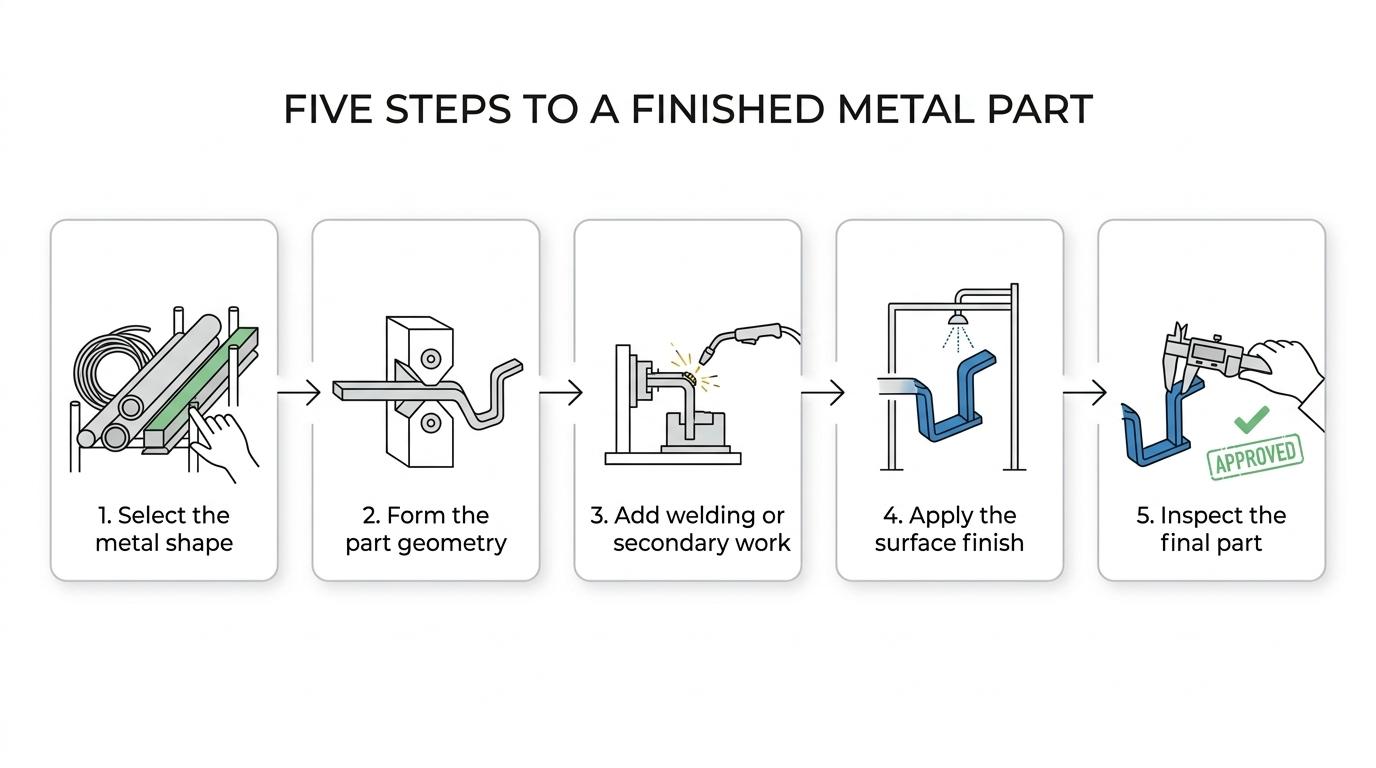
Most fabricated metal parts move through a predictable sequence: material selection, shape creation, joining or secondary work, finishing, and inspection. The exact route changes by part family, but the control points stay familiar.
First, the supplier translates the print into a process plan. That includes raw material specification, critical dimensions, bend sequence, tooling choice, and any welding or finishing needs. If the drawing leaves room for interpretation, then the risk shows up later as first-article delays or dimensional drift.
Next comes shape creation. In wire forming, that may mean CNC 2D or 3D bending. In other fabricated products, it may mean stamping, machining, laser cutting, or brake forming. After that, assemblies may go to welding, resistance welding, threading, flattening, or other secondary operations.
Last comes surface treatment and verification. Painted, plated, passivated, or powder-coated parts need inspection that reflects the final condition, not just the pre-finish geometry. Pro tip: ask when the supplier measures the part, because some coatings add thickness while heat from welding can shift critical features.
Where do wire forms fit inside fabricated metal products?
Wire forms sit squarely inside fabricated metal products when they are bent, welded, or assembled from purchased wire. Argo Products Company is one example of a supplier focused on this slice of NAICS 332.
Wire forms are often underestimated because they look simple. In practice, they can be some of the most tolerance-sensitive fabricated components in an assembly. Springback, bend order, cut length, weld heat, and finish buildup all affect fit and function.
If your component is a retaining clip, guard, hook, shelf support, product display piece, or welded wire frame, a specialized wireform manufacturer may be a better fit than a general fab shop. The reason is process fit, not category prestige. Wire parts require different tooling logic than sheet metal or heavy plate work.
“Argo Products Company presents OEM wire products that can be formed, welded, spot welded, painted, plated, passivated, or powder coated.”
A related misconception is that wire forming is only for low-cost commodity parts. Many OEM programs depend on tight-tolerance wire geometries, repeatable weld locations, and consistent secondary finishes. When those features matter, the supplier’s wire-specific process knowledge becomes a sourcing advantage.
How should OEM buyers compare prototype capability with high-volume capacity?
Prototype capability and high-volume capacity are not the same thing. The best production suppliers can support both, but buyers should confirm how the transition is controlled.
A prototype shop may be excellent at quick setup, manual adjustments, and low-volume experimentation. A production-oriented supplier adds documented work instructions, fixture control, inspection planning, preventive maintenance, and scheduling discipline that can hold performance month after month.
That trade-off shows up in cost and speed. Prototypes often move faster with more hands-on intervention. High-volume runs usually need more upfront planning so the part repeats with less variation. If your launch schedule is aggressive, then ask which process elements will change between sample quantity and production quantity.
A smart check is to compare first-article methods against production methods. If the prototype uses manual welding and bench inspection but production will use dedicated fixtures and different gages, then qualification should reflect that shift. Buyers in automotive, medical, and electrical markets already know this logic through FAI, capability studies, and PPAP-style documentation.
What process controls matter most when tolerances are tight?
Tight-tolerance fabricated parts depend on stable inputs, controlled sequence, and inspection tied to function. Material specs, machine repeatability, fixturing, and change control matter more than broad capability claims.
If a supplier says it can hold tight tolerances, ask how that statement is supported in routine production. The strongest answers usually describe raw material controls, machine setup standards, gaging strategy, and what happens when a tool is adjusted or replaced. This is where ISO 9001-style discipline becomes useful because it forces consistency in records, revision control, and corrective action.
A practical review should cover these points:
- Material consistency: alloy, diameter or thickness, temper, and surface condition all affect forming behavior.
- Forming sequence: bend order changes springback, feature interaction, and final geometry.
- Weld control: heat input, fixture design, and weld location can move dimensions or distort assemblies.
- Inspection method: hard gages, optical systems, calipers, or CMM checks should match the part’s critical features.
Pro tip: do not ask only for a tolerance claim. Ask which dimensions are checked in-process and which are checked only at final inspection. That answer tells you whether quality is being built in or merely screened out.
How should buyers evaluate finishing, welding, and secondary operations?
Secondary operations should be evaluated as part of the part, not as add-ons. Welding, plating, painting, passivation, and powder coating can change fit, corrosion behavior, and lead time.
This is also where buyers should compare integrated suppliers with multi-vendor chains. An integrated source can reduce handoff risk and streamline accountability. A multi-vendor chain can still work well, but only if ownership of dimensional checks, masking, surface prep, and packaging is crystal clear.
Buyers often miss the dimensional effect of finishing. Passivation is a chemical treatment and does not build thickness the way plating or powder coating does. Paint and powder coat can affect hole size, mating clearances, and contact surfaces. If an electrical connection or sliding fit matters, then the finish spec should be reviewed before the quote is locked.
“Argo Products Company describes ISO 9001-based practices along with lean, cellular manufacturing, and 5S principles, all relevant to repeatable secondary operations.”
The same logic applies to welding. A nice-looking weld is not enough. Ask whether the process needs cosmetic appearance, structural strength, positional accuracy, or all three. Those are different requirements, and they drive different fixtures, inspection points, and acceptance criteria.
What should you ask a wireform manufacturer before sending an RFQ?
The best pre-RFQ questions test capability, control, and scale before price becomes the whole conversation. Argo Products Company is a useful example because it publicly frames its work around rapid prototypes, production support, and ISO 9001-based practices.
Start with the print and the part function. Then move to material, process sequence, and production context. If you skip that order, pricing may come back fast but not accurately.
A short RFQ package should cover these essentials:
- Print package: drawing revision, critical-to-quality dimensions, tolerances, and any mating-part concerns.
- Material callout: alloy, wire diameter or stock size, temper, and corrosion requirements.
- Volume plan: prototype quantity, annual usage, release pattern, and service-life expectations.
- Secondary operations: welding, threading, flattening, plating, passivation, paint, or powder coating.
- Quality expectations: first article, certifications, traceability, packaging rules, and industry-specific documentation.
If you are sourcing custom wire forms or welded wire assemblies, ask one more question: what will change between sample builds and steady-state production? That single question often surfaces the real drivers of cost, lead time, and repeatability.
What do BLS industry numbers mean for sourcing decisions?
BLS data shows fabricated metal product manufacturing is large, skilled, and labor-intensive. Those facts matter because supplier risk is shaped by workforce depth, process fit, and operating discipline.
The headline number is scale: 61,379 private-industry establishments in Q1 2026. That means buyers can usually find multiple shops that say they can make a part. The real challenge is finding one whose process mix matches the part family, tolerance profile, finish requirements, and release schedule.
The wage data adds context. BLS reports average hourly earnings of $33.70 for all employees in June 2026 and $28.56 for production and nonsupervisory employees in the industry. It also lists 2025 annual mean pay of $53,960 for welders, cutters, solderers, and brazers and $55,710 for machinists. Those numbers are a reminder that skilled labor is not interchangeable, and a quote that looks unusually low may signal hidden risk in setup, inspection, or staffing.
For OEM buyers, the practical read is clear. A large industry does not remove the need for qualification. It makes qualification more valuable because the best-fit supplier is rarely the one with the broadest category label alone.
Keywords:
fabricated metal products