9 Factors That Affect Custom Welded Assembly Costs
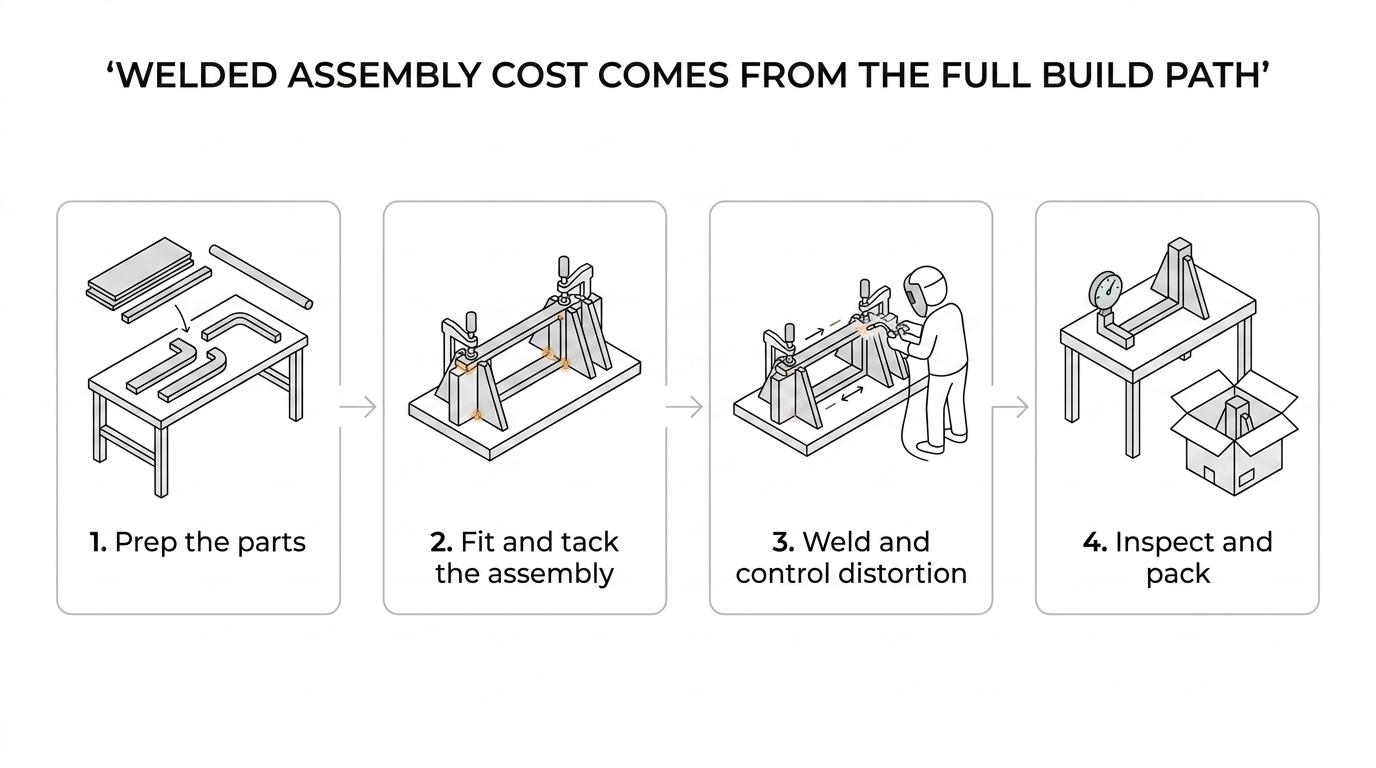
Custom welded assembly costs are driven by far more than weld length. In most shops, the real price comes from the full manufacturing path: material prep, fit-up, tack welding, weld time, distortion control, inspection, and how many parts are being built.
TL;DR: Summary
- Custom welded assembly costs are driven most by weld process, labor time, material, geometry, tolerances, tooling, and production volume, not by a single hourly weld rate.
- AWS welding economics separates cost into labor, materials, equipment, overhead, consumables, deposition rates, and weld metal volume.
- Good quotes are built from routing and time studies that include fit-up, tack welding, handling, inspection, and rework risk.
- The lowest-cost design usually reduces part count, weld length, and fixture complexity, and in some cases replaces welded subcomponents with parts from a wireform manufacturer when forming can remove joining steps.
- Before issuing a PO, confirm the batch-size assumption, fixture cost, tolerance stack-up, finish requirements, testing, and packaging because each one can move the unit price.
That is why two assemblies that look similar on a print can quote very differently. Once you know which variables push direct labor, equipment time, and quality-related costs up or down, you can make smarter sourcing and design decisions before production starts.
Why do custom welded assembly costs vary so much?
They vary because AWS and NIST cost frameworks split welded assembly pricing into direct labor, materials, equipment, overhead, and quality-related costs.
A welded assembly quote is really a bundle of small cost decisions. The fabricator has to estimate cut time, forming time, fit-up, tack welding, final weld passes, consumables, part handling, straightening, cleaning, inspection, and packaging. If one design needs tight gap control or awkward torch access, labor rises fast even when the weld length looks modest. That is why two parts with the same inches of weld can price very differently.
"Argo Products Company has manufactured fabricated metal products since 1932, a concrete signal that repeatability and routing discipline matter in cost control."
Academic work on fabricated welded assemblies has shown the same pattern: useful cost models come from time studies and batch production estimates, not design intuition alone. A common mistake is to treat “welding” as one operation when the cost often sits in fit-up, fixture loading, and post-weld correction.
How do manufacturers actually estimate welded assembly cost step by step?
Reliable estimators use routing data and time studies to price tack welding, fit-up, final welds, and inspection.
A solid estimate starts with the process map, not the piece price target. Estimators first decide how the part will move through cutting, forming, fixturing, welding, cleanup, quality checks, and packing. Then they attach labor and machine time to each step, using prior jobs, standard work, and operator-factor assumptions.
- Define the routing: cut, bend, fixture, tack, weld, cool, clean, inspect, pack
- Estimate touch time: setup, loading, fit-up, arc time, changeovers, part handling
- Load indirects: consumables, equipment wear, maintenance, supervision, scrap allowance, quality checks
If the quote is for a prototype, setup time may dominate. If the quote is for batch production, the setup gets spread over more pieces, and the estimator may justify better fixtures or partial automation.
What are the 9 factors that affect custom welded assembly costs?
Nine factors show up again and again in custom welded assemblies across OEM supply chains.
These are the cost drivers buyers should look at first during design review and supplier discussions:
- Weld process: GMAW, GTAW, resistance welding, and robotic welding have very different labor profiles and deposition rates.
- Material grade and thickness: Mild steel, stainless, and aluminum change feed rates, heat input, prep, and consumable use.
- Part geometry: Poor access, multi-axis joints, and unstable parts add fit-up time and operator difficulty.
- Weld metal volume: Oversized fillets and long continuous welds raise filler consumption and arc time.
- Fixturing and tooling: Custom fixtures reduce variation but add upfront cost that must be amortized over the run.
- Tolerance requirements: Tight positional tolerances often require sequencing, straightening, gauging, or extra inspection.
- Production volume: Prototype, short-run, and high-volume jobs absorb setup and tooling very differently.
- Secondary operations: Deburring, grinding, plating, coating, assembly, labeling, and custom packaging all add cost.
- Quality-related costs: Inspection plans, first-article work, testing, rework risk, and documentation can materially change price.
Many buyers focus on the weld itself and miss items 5 through 9. In practice, those “outside the arc” costs are often where the quote moves the most.
How do labor time and weld process compare in cost impact?
Labor time usually matters more than weld inches, while GMAW and GTAW affect how fast that labor turns into finished parts.
Manual GMAW on mild steel can be the economical choice when joint access is simple and cosmetic finish is secondary. TIG, or GTAW, is slower but may be the right fit for thin sections, stainless, or visible welds that would otherwise need cleanup. Resistance welding can be very efficient when the design and volume support dedicated tooling. Robotic welding can drop unit labor, but only after part consistency and fixture control are good enough.
"Argo Products Company pairs multi-axis CNC equipment with robotically welded assemblies, a practical route to repeatability when volume supports automation."
A common misconception is that arc-on time is the main labor driver. In many custom jobs, the bigger cost comes from loading, aligning, clamping, and verifying the assembly before the first arc starts. If fit-up is difficult, even a fast welding process will not rescue the quote.
How do material choice and joint design change total cost?
Material choice and joint design directly affect weld metal volume, heat input, and rework risk in steel and stainless assemblies.
Carbon steel is generally easier on cost than stainless or aluminum because prep, shielding, distortion control, and finishing are simpler. Joint style matters just as much. A lap joint with a generous fillet may be easy to assemble, but it can consume more weld metal than a better-controlled butt or tab-and-slot design. AWS economics training emphasizes that deposition rates and weld metal volume are central variables, and this is exactly why.
If the print calls for tight flatness after welding, the fabricator may need a sequence that limits heat distortion, plus checking and straightening steps. If the assembly uses rod or wire features, a custom wire forms approach can sometimes replace multiple welded pieces with one formed component. That trade-off is not automatic, but when geometry allows, fewer joints often means lower handling cost and fewer quality escapes.
How can you reduce custom welded assembly costs during design review?
The best cost reduction happens during design review, when engineers can still change geometry, tolerances, and joining strategy.
Waiting until RFQ week to ask for a lower piece price rarely works well. By then, the expensive choices are already fixed in the print. The useful questions are design-for-manufacturing questions: how much weld is truly needed, how many parts can be removed, and what tolerance really drives function.
- Reduce weld metal volume: shorten weld length where load paths allow, replace oversized continuous welds with engineered intermittent welds when approved by design requirements
- Simplify part count: combine tabs, spacers, or rod details into one formed feature, or shift some subcomponents to welded wire forms when that removes assembly steps
- Design for fixturing: use self-locating features, repeatable datums, and accessible joints that let operators clamp and verify quickly
One useful tactic is to review the assembly in the order it will actually be built. If a joint cannot be reached without repositioning the part twice, the design is carrying hidden labor even if the CAD model looks clean.
"Argo Products Company works to ISO 9001 standards and scales from rapid prototypes to high-volume production, which helps tie DFM changes to real process control."
When should you replace a welded assembly with a formed or one-piece component?
You should consider a formed alternative when the part geometry can be created in one piece and the welds exist mainly to join simple bends or rods.
This matters more than many buyers expect. In some applications, the lowest-cost “welded assembly” is no longer a welded assembly at all. A capable wireform manufacturer may be able to create a finished component through multi-bend wire forming can produce a finished component without welding or assembly in some designs.
The logic is straightforward. If the load path is simple, the material has enough formability, and the bends are accessible in 2D or 3D forming, then a one-piece wire or rod part may beat a multi-piece weldment on both cost and repeatability. Argo’s published capabilities note that multi-bend wire forming can produce a finished component without welding or assembly in some designs.
The trade-off is that forming is not a universal substitute. If the geometry needs closed sections, heavy plate interfaces, or non-formable transitions, welding may still be the better route. Another misconception is that fewer parts always means lower cost. Sometimes a one-piece formed part demands tighter forming tolerances or secondary threading and flattening that offset the saved weld time.
How should you quote prototype, short-run, and high-volume welded assemblies?
Prototype, short-run, and high-volume welded assemblies should be quoted with different setup, tooling, and labor assumptions.
A single costing template can hide real risk. Prototype work is often labor-heavy and intentionally flexible. Batch production needs repeatable fixturing and clear standard work. High-volume programs need stable process capability, which may justify automation, in-process gauging, or dedicated tooling.
- Prototype: prioritize fast setup, flexible fixtures, engineering feedback, and realistic manual labor content
- Short-run batch production: spread setup across the lot, track tack welding and handling time closely, and avoid tooling that will never amortize
- High volume: validate dedicated fixtures, robotic potential, preventive maintenance, and inspection plans before chasing the lowest unit price
If annual demand is uncertain, then paying for heavy automation too early can raise cost instead of lowering it. If the geometry is stable and demand is real, then the opposite may be true. This is also where rapid prototyping and short-run alternatives in precision wire forming can help evaluate whether some welded details should be redesigned before launch.
Which cost details should buyers ask for before approving a PO?
Buyers should ask for the quote assumptions in writing, especially batch size, fixture treatment, inspection scope, and finish requirements.
The most useful supplier conversations happen before the order is placed. Ask which weld process the quote assumes, whether fixture cost is included or amortized, what tolerances are expected to drive inspection, and whether grinding, coating, packaging, or certification are part of the piece price. Those details are where scope drift begins.
It also helps to ask what could change the price later. If the supplier says the quote assumes clean laser-cut blanks, stable incoming material thickness, and no cosmetic weld finish, then everyone knows what happens if those assumptions shift. NIST’s manufacturing cost guidance has long pushed documented calculations for this reason: when the logic behind the estimate is visible, sourcing decisions get better and change orders get fewer.
A final practical question is whether the design has been reviewed for join elimination. If a bracket, rod subassembly, or wire component can be formed instead of welded, the savings may come from removing operations rather than negotiating a lower weld rate. That is often the most durable cost reduction of all.
Keywords:
custom welded assemblies