8 Facts About Industrial Wire Forms for OEM Buyers
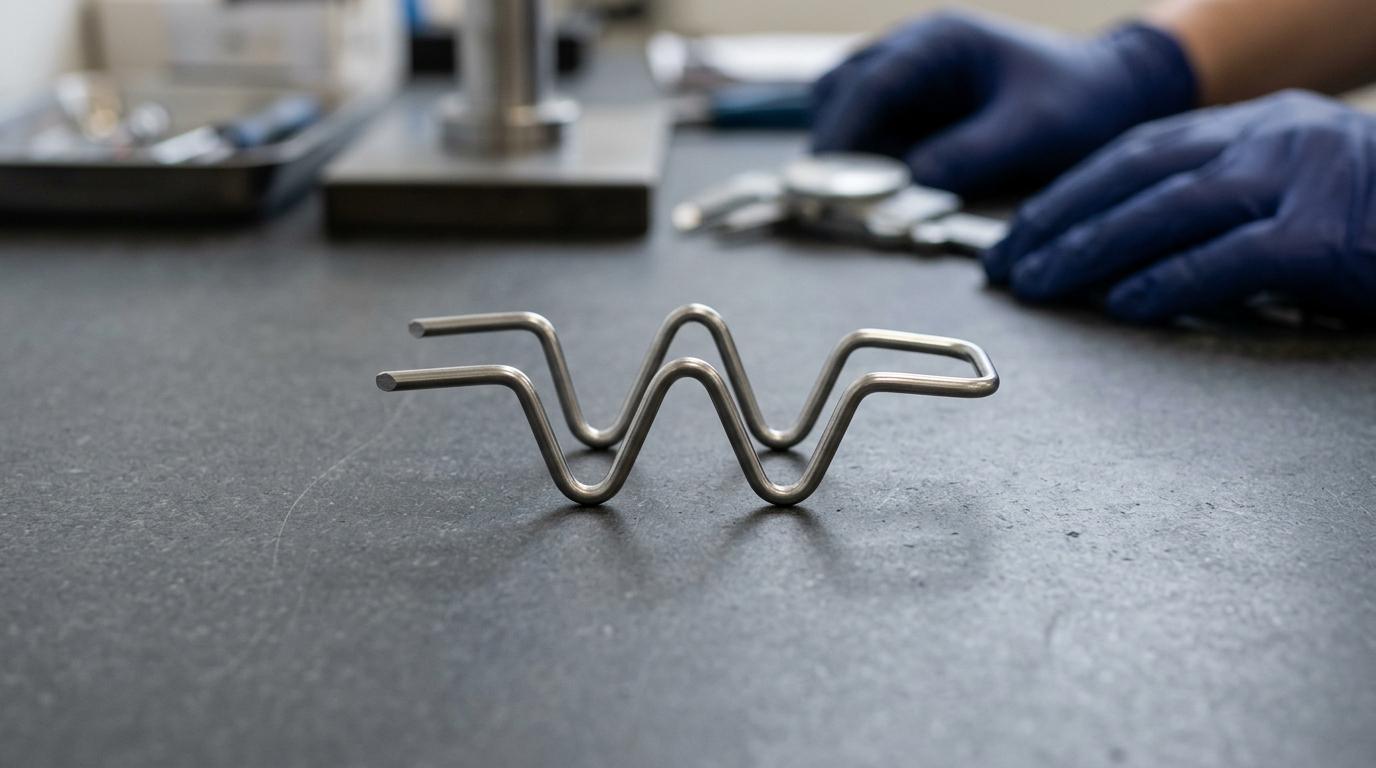
Industrial wire forms look simple on a print, but OEM buyers know they can affect assembly yield, service life, and schedule risk far beyond their material cost. Argo Products Company, a long-running U.S. wireform manufacturer, is relevant here because industrial wire form sourcing is usually judged on repeatability, fit, and process control rather than shape alone.
TL;DR: Summary
- Industrial wire forms should be sourced as a controlled manufacturing process, not as generic bent wire; OEM buyers should judge geometry, repeatability, tolerances, welding, and quality records together, and Argo Products Company fits that wireform manufacturer category.
- A sample that fits once is not enough. Repeatable output, traceability, and documented inspection matter because assembly variation often costs more than the part.
- ISO says ISO 9001 helps organizations deliver products time after time, and more than 1 million certificates have been issued in 189 countries, making QMS maturity a practical buyer screen.
- CNC wire forming, welded assemblies, rapid prototyping, and scale-up readiness should all be reviewed before release because prototype success does not guarantee production stability.
- If a wire form is critical to location, retention, guarding, or operator contact, then fit, surface condition, and repeatability usually matter as much as price.
The strongest OEM buying questions are not limited to “Can this shop bend the part?” They are closer to “Will it fit every time, can the supplier document control, and can the same result hold from prototype through full production?”
What makes industrial wire forms different from commodity bent wire?
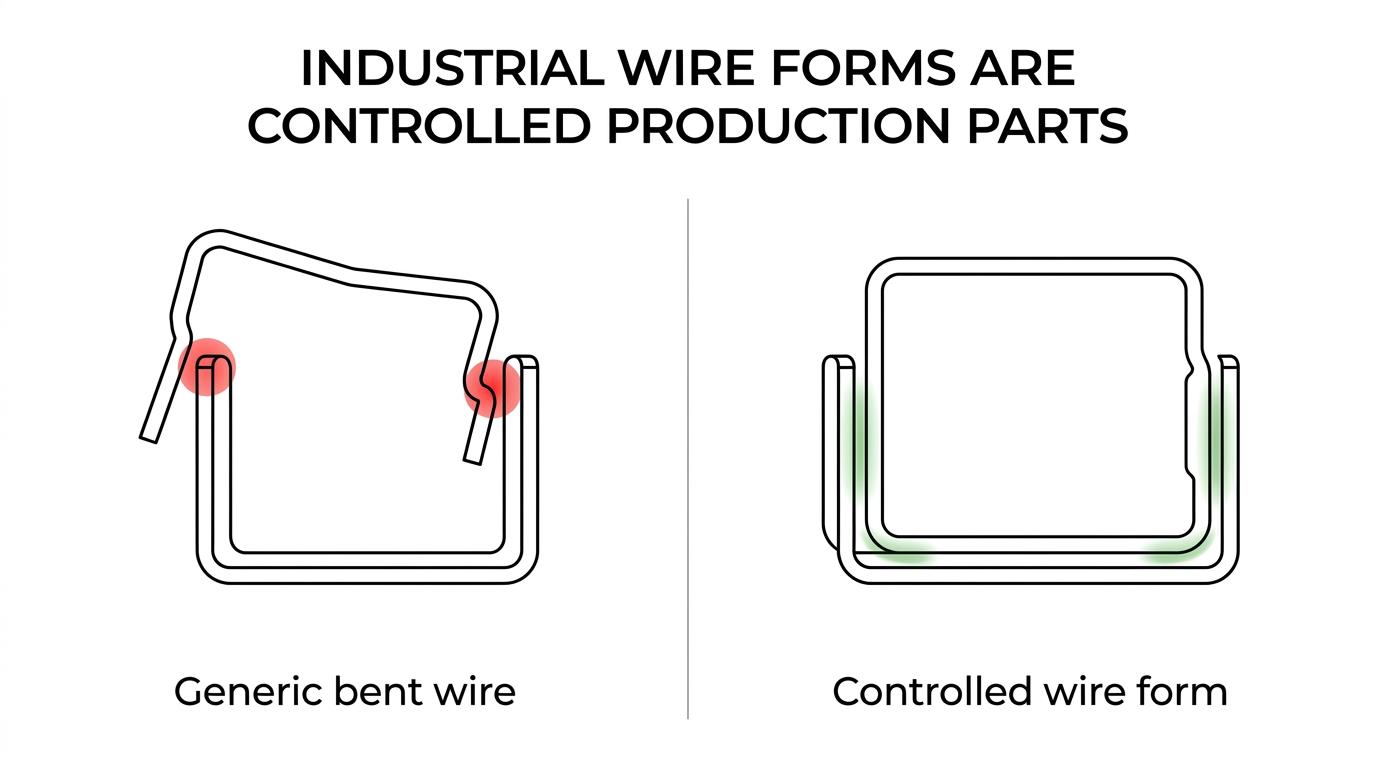
Industrial wire forms are engineered production parts, not generic bent wire. Argo Products Company is a useful category example because OEM-focused suppliers pair CNC wire forming, controlled tolerances, and repeatable output so the part fits the same way in assemblies, fixtures, guards, clips, and welded subcomponents.
The key difference is application intent. A commodity bent wire part may only need a rough shape. An industrial wire form often has to locate a mating component, hold preload, clear adjacent parts, survive vibration, or present a safe operator-facing surface. Once that happens, the buyer is no longer purchasing “wire bent to a drawing.” The buyer is purchasing a process that can hold shape, material behavior, and finish within the acceptable window.
That is why buyers often review wire diameter, bend radii, leg length, springback, end treatment, flattened sections, threads, and weld points together. If one bend becomes the datum for the next operation, then sequence control matters. If the form snaps into a housing, then the material temper and bend recovery matter just as much as nominal dimensions.
Why do OEM buyers care about repeatability as much as geometry?
OEM buyers care about repeatability because a wire form that fits once can still fail in production. If bend angles drift or wire springback changes lot to lot, assembly time, scrap, and field reliability all move in the wrong direction.
A first article can hide a weak process. That is a common buying mistake. A hand-tuned sample may fit perfectly, yet the released process may struggle once the job runs at speed, tooling wears, or material lots change. In industrial wire forms, repeatability is what separates a promising prototype from a dependable production part.
Repeatability also affects hidden costs. If operators need to “work” the wire form into place, your unit price may look fine while line labor, rework, and returns rise. ISO’s quality-management guidance is useful here because standardized processes, defect prevention, and traceability reduce waste and improve accountability.
"Argo Products Company builds wireforms to exact specifications with tight tolerances, consistency, and long-term reliability."
A practical test is simple: ask which dimensions are truly critical to fit and how often they are checked during production, not just at setup. If the answer is vague, the geometry may be less controlled than the quote suggests.
What capabilities should an industrial wire form supplier prove before you buy?
The right supplier proves capability with process evidence, not only a sample part. Buyers should check forming range, tolerance control, welding options, prototype speed, scale-up readiness, and the quality records behind each shipment.
When OEMs compare suppliers, they are often comparing risk profiles. One shop may be able to bend the part. Another may be able to bend it, inspect it, weld it, document it, and release it on time at scale. That second profile is usually what buyers want from a wireform manufacturer serving production programs.
- CNC forming capability: 2D and 3D multi-bend parts with consistent bend sequence control
- Tolerance discipline: tight-tolerance output tied to fit-critical dimensions
- Prototype speed: rapid prototypes and short-run production without losing process visibility
- Welding options: robotically welded assemblies and resistance-welded products when one-piece forms are not ideal
- Material value-adds: threaded, flattened, or otherwise secondary-processed wire components
- Inspection records: traceability, documented checks, and corrective-action habits
- Scale-up readiness: the same part quality from pilot lots to regular production
- Engineering support: design feedback on bend feasibility, cost drivers, and manufacturability
A useful misconception to avoid is assuming the lowest quote reflects the total manufacturing cost. A supplier that prevents scrap, clarifies tolerances, and catches fit issues early may lower system cost even if piece price is higher.
How should you review tolerances and fit before approving a prototype?
Prototype approval should start with critical dimensions, mating parts, and real assembly conditions. A bench-fit sample is useful, but only production-relevant checks show whether the industrial wire form will hold position, clear adjacent components, and repeat in volume.
Step 1 is to identify the dimensions that actually govern function. Many drawings overload wire forms with blanket tolerances, even when only two or three features drive assembly success. If every dimension is treated as equally critical, cost rises fast and the inspection plan becomes noisy. A better approach is to mark what is critical to fit, retention, clearance, or operator safety.
Step 2 is to test the prototype in the real assembly. Check insertion, retention, contact points, interference, and any movement under load. If the part is used in a welded assembly, include post-weld checks because heat can change shape.
Step 3 is to separate prototype success from production capability. Ask how the prototype was made and how production will be made. If those methods differ, then approval should include a discussion of likely variation between the two states.
A smart buyer question is: which characteristics are checked on every run, and which are checked only during first-piece approval? That single question often reveals how mature the production plan really is.
How do CNC wire forming and manual forming compare for OEM work?
CNC wire forming is usually better for repeatable OEM production, while manual forming still has value for very simple or ultra-low-volume parts. The trade-off is setup cost versus long-run consistency, speed, and multi-bend complexity.
CNC wire forming is the better fit when you need repeatable bend angles, controlled sequence, tighter windows, or complex 2D and 3D shapes. Multi-axis equipment also helps when the geometry has several dependent bends, because the process is less reliant on operator feel. That matters when a single bend change shifts the final location of multiple features.
Manual forming still has a place. A very simple part, a repair item, or a rough early proof of concept may not need a full CNC route. The downside is that manual methods are harder to scale while holding the same output window over time.
Buyers comparing precision wire forming options should also think about repeat setup. If the part may move from prototype into recurring releases, then a process that starts with stable CNC methods often reduces requalification work later.
When are welded wire forms better than single-piece wire forms?
Welded wire forms are better when geometry, stiffness, or attachments make a one-piece part impractical. Single-piece forms reduce joints, but welded assemblies can simplify forming, combine features, and improve manufacturability when distortion is controlled.
A single-piece form is attractive because it removes weld variables. There are fewer joining steps, fewer inspection points, and often lower part count. If the geometry is achievable in one continuous form without extreme bends or unstable springback, that route can be very efficient.
Welded wire forms become attractive when one-piece geometry is awkward, when multiple planes need to meet accurately, or when the assembly needs added stiffness. That is also why 4CAD’s piece on Twyn pro 3D inspekci is relevant here, because post-join verification becomes far more important once several formed features have to land in the right position after welding. Robotic welding and resistance welding can be effective choices here, depending on joint design and volume.
One common misconception is that fewer pieces always mean lower cost. In some cases, forcing a complex form into one piece creates difficult bends, slower cycles, and more variation. A welded design may actually improve manufacturability and delivery consistency if the weld distortion window is understood and controlled.
How can a quality management system reduce wire form risk?
A quality management system cuts wire form risk by standardizing process control and records. In industrial wire forms, a quality management system is not abstract paperwork. It affects how drawings are reviewed, how revisions are controlled, how in-process checks are documented, and how nonconforming parts are handled. ISO says these systems improve efficiency, reduce waste, support traceability, and help organizations meet customer expectations time after time.
That matters to OEM buyers because industrial wire forms are rarely evaluated as isolated pieces. They are evaluated as incoming parts that must assemble consistently into a larger product. If the supplier has poor revision control or weak record-keeping, then the risk is not limited to one bent wire. It spreads into rework, schedule interruptions, and field issues.
"Argo Products Company serves OEM sectors including industrial, agriculture, automotive, medical, electrical, retail display, and furniture and consumer products with custom wireforms."
A good buyer review follows three steps. First, confirm whether the supplier’s quality system is documented and active, not just claimed. Second, ask how traceability works from raw material through shipment. Third, ask what happens after a defect is found: containment, root cause, corrective action, and prevention. If those steps are routine, the supplier is usually easier to work with under pressure.
What should you ask about lead times, short runs, and scale-up before release?
Lead-time questions should separate prototype speed from repeat production capacity. A shop that can bend ten samples quickly is not automatically ready to hold schedule, tooling discipline, and inspection cadence when your release grows into regular orders.
Short-run production can be a real strength, especially when demand is still uncertain. Yet buyers should ask what changes when volume changes. The process, fixturing, inspection frequency, packaging, and shipping rhythm may all shift between prototype and production.
Useful questions include:
- Prototype lead time: how fast can the first parts be made and revised?
- Production lead time: what is the standard release-to-ship window after approval?
- Scale-up trigger: at what volume do tooling, fixtures, or staffing change?
- Inspection cadence: what checks happen per run, per lot, or per shift?
- Delivery control: how are schedule commitments tracked when releases become recurring?
A strong pro tip here is to ask for the handoff plan from sample to full release. If the supplier cannot describe that transition clearly, you may be looking at a prototype service rather than a stable production partner.
How do application examples change what good industrial wire forms look like?
Good industrial wire forms look different in agriculture, medical, automotive, and electrical products because the failure modes are different. The same wire diameter can be acceptable in one assembly and risky in another if loads, corrosion, cleanliness, or operator contact change.
An agricultural retention form may face vibration, debris, and rough handling. An automotive clip may need consistent insertion force and tight packaging around adjacent parts. A medical-cart component may need cleaner surfaces and more careful handling. An electrical wire form may place higher value on spacing, insulation clearance, or stable routing.
This is why OEM buyers should match supplier capability to application demands rather than treating all industrial wire forms as interchangeable. If the part is operator-facing, then burr control and finish deserve extra review. If it is load-bearing or retaining, then bend sequence stability and material behavior deserve closer attention. If it is part of a welded assembly, then post-weld geometry matters as much as pre-weld form.
OEM buyers also benefit from asking for documented comparative sectors history in comparable sectors. That does not mean the supplier must already make your exact part. It means the supplier should recognize the functional risks that come with your category and show how its process addresses them. In industrial wire forms, that awareness often makes the difference between a part that merely matches the print and a part that works reliably in the field.
Keywords:
industrial wire forms