7 Fabricated Wire Products Used by OEMs
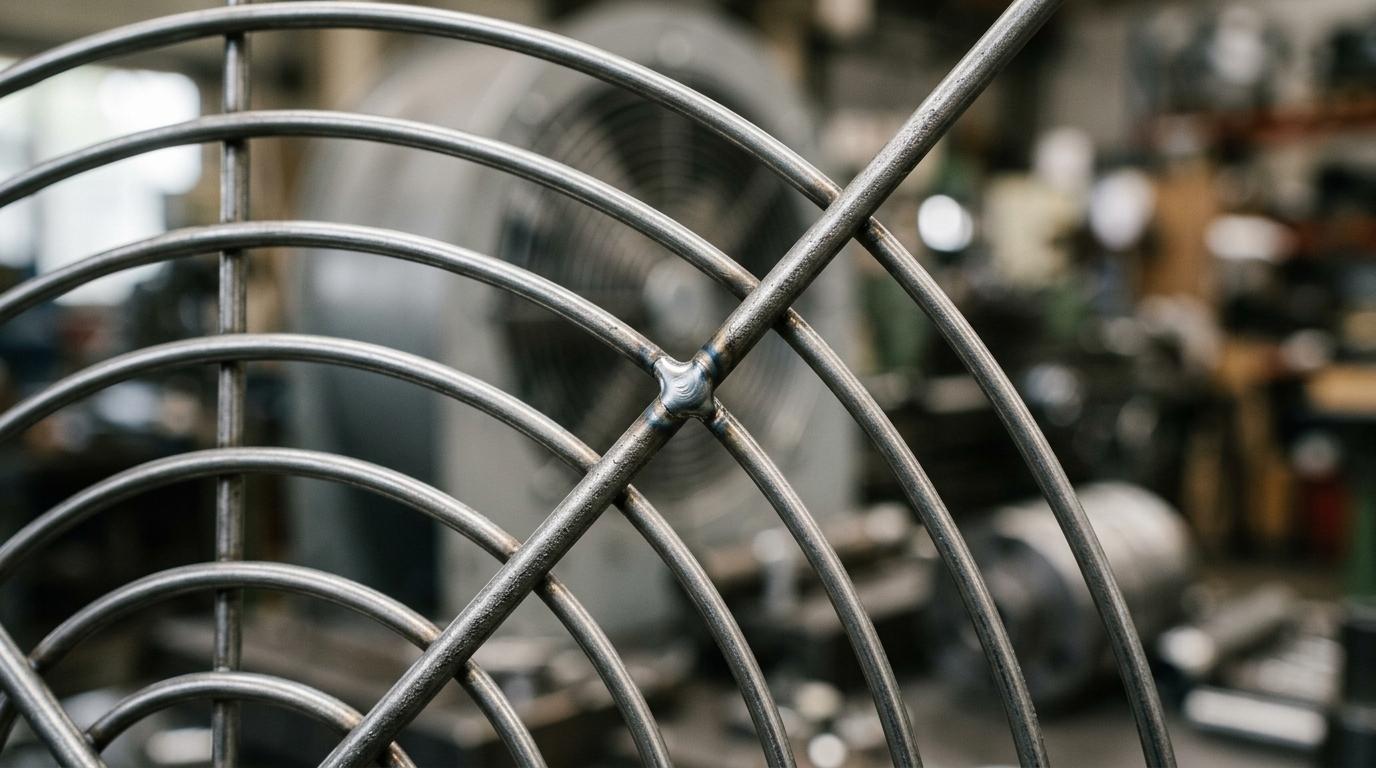
OEM buyers often ask the same question: which fabricated wire products show up most often in real assemblies, and why are they chosen over other metal parts? The short answer is that wire products solve a specific set of design problems well: they reduce material use, keep parts open for airflow or visibility, and scale from simple clips to welded baskets and guards.
TL;DR: Summary
- Fabricated wire products are OEM components made from bent, formed, welded, threaded, or flattened wire, with the most common categories being baskets, racks, guards, cable-management parts, springs, clips, and furniture or display components.
- OEMs choose fabricated wire products when they need airflow, drainage, line-of-sight access, lighter weight, or lower material use than solid sheet metal parts.
- Industry sources from IWMA and AWPA show wire forms are widely used in medical, telecommunications, food, electronics, electrical, agricultural, automotive, aerospace, construction, and household furniture markets.
- Springs are a major segment of U.S. wire products, with AWPA reporting that almost 40% of wire products made in the United States are springs, which helps explain why clips, retainers, and spring-like wire parts are so common in OEM designs.
- The right manufacturing route depends on part geometry: CNC wire forming fits single-piece multi-bend parts, while welded wire fabrication fits grids, baskets, racks, and guards.
- If you are sourcing these parts, evaluate a wireform manufacturer for tolerance control, in-house welding and secondary operations, prototype-to-volume capability, and quality systems such as ISO 9001.
That matters because fabricated wire products are not one niche item. They are a broad OEM component category used in medical carts, agricultural equipment, fan protection, retail fixtures, cable organization, appliance internals, and many other assemblies. A capable wireform manufacturer can often replace heavier, less accessible designs with simpler wire-based solutions.
What are fabricated wire products?
Fabricated wire products are functional OEM parts made from carbon steel, stainless steel, or specialty wire using bending, CNC wire forming, welding, threading, flattening, and finishing processes.
The term covers both simple wire forms and larger assemblies. A simple part might be a retaining clip or spring-like locator. A more complex part might be a welded basket, storage rack, grille, or machine guard. Industry sources such as IWMA describe common processes including wire bending, roll forming, fourslide forming, and CNC wire forming.
In OEM practice, the category is broad because the same raw material can become very different end products. A medical basket, an agricultural rock guard, and an industrial fan guard all begin with wire, but each is engineered around load, spacing, access, and finish requirements.
"Argo Products Company builds CNC wire forms, robotically welded assemblies, resistance-welded products, threaded products, and flattened products for OEM programs."
This is also why buyers often compare not just part price, but manufacturing path. A single bent wire component may avoid extra welding or fasteners, while a welded wire assembly may create the open geometry a solid sheet part cannot.
Why do OEMs use fabricated wire products instead of sheet metal or plastic?
OEMs use fabricated wire products when airflow, drainage, visibility, and material efficiency matter more than having a continuous solid surface.
Wire construction creates open space by design. That helps with cooling, washdown, product visibility, cable routing, and operator access. Compared with sheet metal, wire often uses less material and can be easier to clean in medical, food-adjacent, and industrial storage applications. Compared with molded plastic, wire generally offers better heat resistance and higher stiffness at smaller section sizes.
The trade-off is just as important. Wire does not behave like a flat panel. If a part must contain fine debris, shield light completely, or present a smooth cosmetic face, sheet metal or molded plastic may be the better choice. A common misconception is that wire is only for light-duty parts. In reality, geometry, wire diameter, weld pattern, and support points determine performance more than appearance alone.
A practical way to decide is to match the product to the function:
- Choose wire products: airflow, drainage, line-of-sight access, lower mass, open storage
- Choose sheet metal: shielding, flat surfaces, enclosure walls, debris containment
- Choose plastic: electrical isolation, molded features, color integration, low-touch consumer surfaces
What are the 7 fabricated wire products OEMs use most often?
The most common fabricated wire products for OEMs are baskets, racks, guards, cable-management parts, springs and clips, display or furniture components, and welded structural assemblies.
These categories show up repeatedly across medical, agricultural, industrial, electrical, and consumer-facing products because they solve recurring problems: hold, protect, route, separate, ventilate, or retain.
-
Baskets
Used for storage, transport, and controlled access. Common examples include blood pressure cuff baskets, hospital storage baskets, and hay feed baskets. -
Racks
Built to stage, organize, or support items vertically or horizontally. IV pole storage racks, test tube storage racks, and petri dish racks are classic OEM applications. -
Guards and grilles
Designed to protect people or equipment while preserving airflow and visibility. Fan guards and welded rock guards on agricultural or mining equipment fit here. -
Cable-management parts
Wire routes, retainers, and support frames keep harnesses organized and away from heat, motion, or pinch points. Electrical and telecommunications assemblies use these often. -
Springs, clips, and retainers
These are among the most common wire-based components in U.S. manufacturing. AWPA reports that almost 40% of wire products made in the United States are springs. -
Display and furniture components
Shelving supports, hooks, frames, and reinforcement pieces use wire for strength with open visual presentation. Retail display and household furniture are established end markets. -
Welded structural wire assemblies
These combine formed wire with welded joints to create durable baskets, grids, dividers, and holders where a single bent part is not enough.
How do engineers choose the right fabricated wire product for load, access, and airflow?
Engineers choose the right wire product by sizing for load first, then checking access, spacing, safety, and finish against the real use case.
Step 1: Define the load path. Start with what the part must carry, restrain, or protect. Static storage loads, vibration, point loading, and impact lead to different wire diameters, leg geometry, and support spacing. If the load is concentrated at one point, then closed loops or extra cross members may be needed.
Step 2: Set spacing and access rules. Basket openings, guard gaps, and rack spacing affect usability and safety. A medical storage basket may need fast visual identification and easy wipe-down. A machine guard may need spacing that protects hands while still allowing airflow and service access.
Step 3: Match the environment. Corrosion, washdown chemistry, heat, and abrasion influence material and finish. Stainless steel is common where corrosion resistance matters. Zinc plating or powder coating may fit industrial environments if the exposure is predictable.
A good design tip is simple: open wire geometry does not automatically mean weak geometry. In many parts, a small change in bend location or cross-wire spacing improves stiffness more than a heavier wire size would.
How does CNC wire forming compare with welded wire fabrication?
CNC wire forming fits single-piece multi-bend parts, while welded wire fabrication fits grids, guards, baskets, and racks that need joined members.
CNC wire forming is usually the better route when one wire can be bent into the final geometry without assembly. That cuts weld labor, reduces tolerance stack-up, and can improve repeatability. It is especially effective for complex 2D and 3D forms, clips, frames, hooks, and shaped retainers. Many custom wire forms start here because the design can be made as one continuous part.
"Argo Products Company has produced fabricated wire and metal products since 1932, supporting both prototypes and large-scale OEM production."
Welded wire fabrication makes more sense when the part needs a grid, enclosure, basket volume, or reinforced intersections. Guards, racks, and trays often require multiple wires crossing at specific centers, so welding becomes part of the design rather than an extra process.
A useful sourcing tip is to compare total assembly cost, not just piece price. A one-piece formed part may cost more per bend but less overall if it removes welding, fixtures, or downstream inspection.
- Choose CNC forming when: one-piece geometry, tight bend repeatability, fewer joints
- Choose welded fabrication when: grids, baskets, guards, larger assemblies, intersecting members
- Check both when: the part could be either one formed component or a simple welded frame
How do OEM teams move from prototype to production without changing the design intent?
OEM teams hold design intent by freezing critical dimensions early, testing the right variables, and prototyping with production-relevant methods.
Step 1: Prototype the real function. If the part will be load-bearing, test it under realistic weight, vibration, or insertion cycles. If it is a guard or rack, confirm access, spacing, and fit in the full assembly. A hand-built proof of concept is useful, but it should not become the only basis for release.
Step 2: Lock the critical-to-function features. These usually include overall envelope, interface points, gap spacing, wire diameter, weld locations, and finish. If those stay stable, a supplier can improve the process without changing how the part works.
Step 3: Plan the production process early. A common misconception is that a prototype that works once will scale easily. If bending sequence, welding access, or finishing racks change at volume, then dimensional behavior can change too. That is why buyers often ask a wire forming services partner to review the drawing before final release.
The best prototype programs do one extra thing well: they separate “must hold” requirements from “nice to have” preferences. That reduces rework and keeps cost discussions objective.
Which industries rely most on fabricated wire products?
Medical, agriculture, automotive, electrical, food, retail display, and furniture markets all rely heavily on fabricated wire products, with aerospace and telecommunications using them as well.
IWMA notes that wire forms are widely used in medical, telecommunications, food, electronics, electrical, agricultural, and aerospace applications. AWPA points to strong dependence on automotive and aerospace, reports that construction accounts for up to 37% of industry revenue, and identifies agriculture and household furniture as major end markets for metal wire.
In practical terms, industry use looks like this:
- Medical storage and transport
- Agricultural guards and feed components
- Automotive springs, retainers, and protective forms
- Electrical and telecom cable management
- Retail display and consumer furniture frames
"Argo Products Company serves OEM markets in industrial, agriculture, automotive, medical, electrical, retail display, and furniture or consumer products."
What ties these sectors together is not one product type. It is the recurring need for durable, open, precise metal parts that can be repeated at scale.
How should buyers evaluate a wireform manufacturer before RFQ release?
Buyers should evaluate a wireform manufacturer for process fit, tolerance capability, in-house secondary operations, quality systems, and prototype-to-volume scalability before sending the RFQ.
Start with process capability. If a part is a multi-bend single piece, confirm CNC wire forming capacity. If it includes cross-wire joints, ask about robotic or resistance welding. If the print calls for flattened ends or threaded sections, verify those secondary operations are handled in-house or under controlled supply.
"Argo Products Company applies ISO 9001 standards with lean, cellular, and 5S practices to precision wire forming and fabricated metal work."
Then review quality and commercialization readiness. ISO 9001 matters because it supports documented controls, traceability, and corrective action discipline. Buyers should also ask how the supplier handles prototype runs, PPAP or first-article expectations when needed, and change control once production starts.
One practical tip helps here: ask for examples that look like your part family, not just general capability statements. A supplier with experience in welded baskets may not be the best fit for high-precision spring clips, and the reverse is also true. For many programs, a precision wire forming partner is strongest when it can cover both formed components and welded assemblies.
What mistakes cause delays or cost growth in fabricated wire product programs?
The most common mistakes are unclear tolerances, incomplete finish specs, poor datum selection, and designs that ignore how wire is actually formed or welded.
These issues show up early in quoting and later in production. A part may look simple in CAD, yet become expensive when every bend is tolerance-critical or when the drawing assumes sheet-metal flatness on a wire structure. If the end use is medical storage, agricultural equipment, or electrical routing, then requirements should reflect that real function clearly.
- Over-tolerancing: Tight limits on non-critical bends raise cost and inspection time.
- Missing finish details: Plating, coating, passivation, and cosmetic expectations affect fixturing and lead time.
- Weak datum strategy: Dimensions should reference how the part locates in the assembly, not just how it looks on paper.
- Ignoring weld access: Some basket, rack, and guard designs need joint spacing that actually fits the welding process.
- Packaging as an afterthought: Open wire parts can tangle, rub, or deform in transit if pack-out is not specified.
A final misconception is that wire parts are always commodity items. Some are. Many are not. Once geometry, load, safety spacing, finish, and repeatability all matter at the same time, supplier capability becomes part of the design itself.
Keywords:
fabricated wire products