10 Uses for Stainless Steel Wire Forms
Stainless steel wire forms are used when a part has to keep its shape while standing up to moisture, chemicals, repeated cleaning, or sanitary handling. That combination makes them common in food equipment, medical support tools, lab fixtures, and industrial racks.
TL;DR: Summary
- Stainless steel wire forms are best for applications where corrosion resistance, cleanability, and durable formed geometry matter most, especially in food, medical, laboratory, and washdown industrial settings.
- Common stainless steel wire form uses include test tube storage racks, fry baskets, industrial parts racks, guards, retainers, display fixtures, and welded handling assemblies.
- Grade choice matters: 304 is widely used in food service, while 316 or 316L is the better fit for chlorides, harsh cleaners, mild salt exposure, and many medical or laboratory environments.
- Fabrication quality matters almost as much as material grade because rough welds, open seams, and poor surface condition can create corrosion points even on stainless steel.
- If a part will be welded, cleaned often, or exposed to corrosive agents, specify finish requirements, passivation, and inspection criteria early with a qualified wireform manufacturer.
The material advantage comes from chemistry and processing, not from the word “stainless” alone. Stainless steels typically contain about 10% to 25% chromium, which forms a thin chromium oxide layer that helps protect the surface from further corrosion, but grade selection, welding, passivation, and surface finish still determine how well the part performs in real service.
Why are stainless steel wire forms used so often?
Stainless steel wire forms made from 304 or 316 are preferred when corrosion resistance, cleanability, and stable geometry matter more than the lowest initial material cost.
Wire forms are rarely chosen on material price alone. Engineers use stainless when the part will be exposed to washdown cycles, humidity, food residue, lab chemicals, or repeated human handling. In those cases, plain carbon steel may rust quickly, and plated coatings can wear or chip at bends, contact points, or weld areas.
The material’s passive behavior is the core reason. According to NIH technical guidance, stainless steel contains roughly 10% to 25% chromium, and that chromium reacts with water and oxygen to form a thin passive oxide film. That surface layer is why stainless wire racks, baskets, hooks, clips, and guards hold up well in service when the right grade and finish are specified.
"Founded in 1932, Argo Products Company supports stainless steel wire forms from rapid prototypes to large-scale production."
A common mistake is assuming all stainless grades behave the same. They do not. A seasoned wireform manufacturer will match the alloy, bend geometry, weld design, and finish to the environment instead of treating stainless as a single category.
How do stainless steel wire forms meet food and sanitary requirements?
Food-contact stainless wire forms meet sanitary expectations only when both the material and the fabrication support cleanability, smoothness, and corrosion resistance.
FDA guidance is clear on the basics. Food-contact surfaces should be corrosion-resistant, durable, easily cleanable, relatively non-absorbent, non-toxic, smooth, and free of open seams. The same logic applies to many non-food-contact surfaces exposed to splash, debris, or frequent cleaning.
That matters for wire products because geometry alone does not make a part sanitary. A fry basket, oven rack, product divider, or washdown carrier can fail a sanitation review if the welds are rough, the joints trap debris, or the finish allows residue to cling. If a part will touch food directly, smooth welds and sealed or cleanable joints are part of the design, not an afterthought.
"Argo Products Company examples include a stainless fry basket welded from stainless wire and stainless expanded metal."
One misconception is that stainless automatically means food safe. In practice, sanitary performance depends on the grade, weld quality, surface condition, and whether the design avoids crevices and open seams that are hard to clean.
What are 10 common uses for stainless steel wire forms?
Stainless steel wire forms show up in 304 and 316 applications that need corrosion resistance, repeated cleaning, or durable open-wire geometry.
The range is broader than many buyers expect because formed wire can create strong, lightweight structures with good airflow, drainage, and visibility.
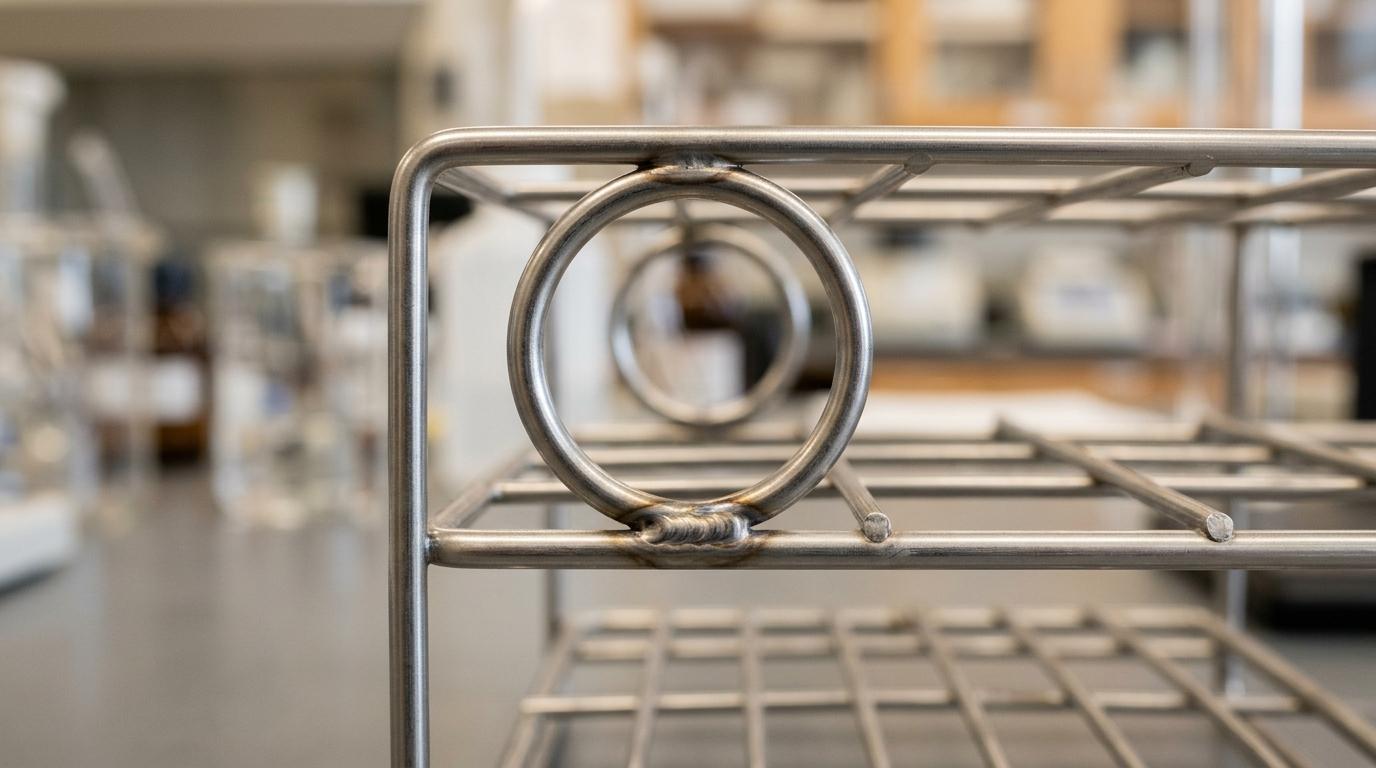
- Laboratory storage racks: Test tube storage racks and holders, including passivated stainless examples shown by Argo Products Company.
- Food-processing baskets: Fry baskets, wash baskets, and product handling carriers for hot oil or repeated cleaning.
- Industrial parts racks: Work-in-process or finishing racks, especially in corrosive environments where T316 is appropriate.
- Medical instrument holders: Trays, retainers, and formed supports that need cleanable, polished, corrosion-resistant surfaces.
- Appliance and kitchen inserts: Oven accessories, dish racks, and utensil organizers exposed to moisture and heat.
- Machine guards and retainers: Formed barriers, clips, and keepers where rust would create maintenance or contamination issues.
- Retail display hardware: Hooks, shelves, and product retainers in environments where bright finish and durability matter.
- Electrical and electronics supports: Cable guides, retaining clips, and formed brackets used around humidity or outdoor exposure.
- Agricultural handling components: Wire carriers, protective frames, and formed supports exposed to water, fertilizer, or cleaning.
- Furniture and consumer product frames: Decorative or structural wire elements that need both appearance and corrosion resistance.
How does 304 stainless compare with 316 stainless for wire forms?
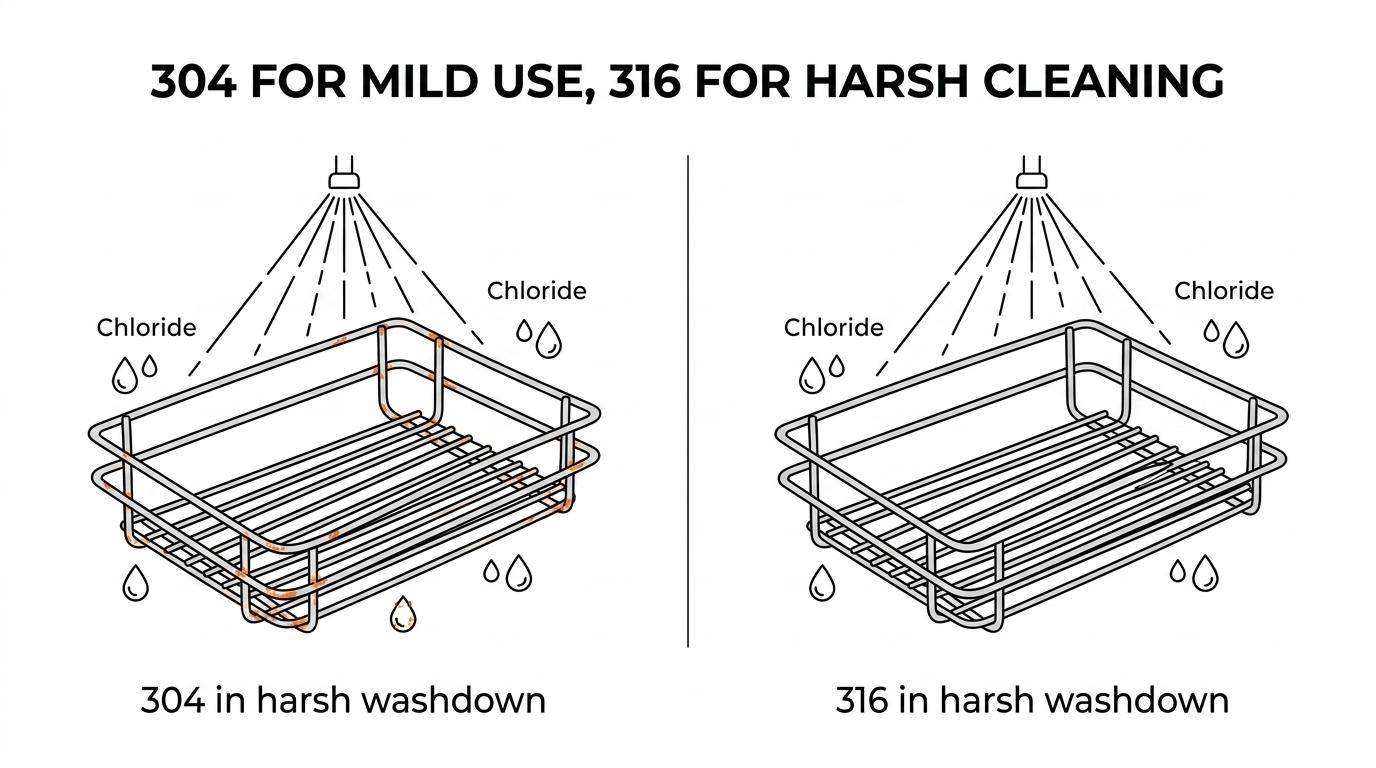
304 stainless fits many general-purpose wire forms, while 316 stainless is the better choice for chloride exposure, harsh cleaners, and more corrosive service.
NIH guidance notes that Type 304 is common in food-service applications. Type 316 is more often used for laboratory casework, surgical instruments, countertops, and equipment exposed to harsh chemicals, mild salt solutions, or repeated washdown. The extra molybdenum in 316 helps suppress pitting corrosion and crevice corrosion, which is a major reason it performs better around chlorides.
The trade-off is cost. If the part lives indoors in a relatively mild setting, 304 may be enough and can be the more economical choice. If the environment includes sanitizers, saline residue, coastal air, or aggressive cleaners, 316 often saves money over time by reducing corrosion failures and replacement cycles.
"Argo Products Company shows an industrial parts rack made from T316 stainless steel for a highly corrosive environment."
Pro tip: if your team is debating 304 versus 316 because of cleaner chemistry, ask for the exact sanitizer or washdown solution. A vague note like “wet environment” is usually not enough to make the right call.
How do you choose between 304, 304L, 316, and 316L for a new part?
The best grade choice starts with the environment, then the fabrication method, then the surface and compliance needs.
Step 1 is exposure. If the part sees routine moisture, indoor handling, and mild cleaning, 304 is often suitable. If it sees chlorides, salt, caustic or acidic cleaning agents, or more demanding lab conditions, move toward 316. If the environment is tied to medical or biocompatibility concerns, 316L is often part of the discussion because it is widely used in medical applications and is well regarded for corrosion resistance.
Step 2 is fabrication. 304L and 316L generally offer better welding and formability characteristics than their standard counterparts. That matters for complex multi-bend parts, welded racks, and assemblies where heat-affected zones could become corrosion points if fabrication is not controlled well.
Step 3 is finish and lifecycle. If the part will be polished, passivated, or cleaned constantly, the lower-carbon L grades are often worth reviewing early. A common misconception is that a stronger-sounding grade name automatically means better performance. If the alloy is wrong for the chemistry, or the welds are poorly executed, the part can still fail.
How are stainless steel wire forms manufactured and finished?
High-quality stainless wire forms are made through controlled forming, joining, finishing, and inspection, not by bending wire and hoping the alloy covers mistakes.
Step 1 is forming. CNC wire forming equipment produces 2D and 3D shapes with consistent bend sequences, repeatable dimensions, and controlled springback. This is where material temper, bend radius, and wire diameter all influence whether a design is practical at volume.
Step 2 is joining and secondary work. Some parts are one-piece forms, while others need resistance welding, robotic welding, threading, flattening, stamping, or integration with expanded metal. That is common for baskets, racks, and handling assemblies that need more structure than a single bent wire can provide.
"Argo Products Company builds stainless steel wire forms under ISO 9001 standards with lean, cellular, and 5S practices."
Step 3 is finishing and validation. Passivation is often used after fabrication to improve surface condition and help restore corrosion resistance after forming or welding. Polishing may also be specified for medical or sanitary applications. A useful precision wire forming partner will confirm tolerances, weld quality, finish requirements, and part repeatability before the job scales.
How does stainless steel compare with carbon steel or zinc-plated wire forms?
Stainless steel outperforms carbon steel and many plated options when moisture, cleaning, and corrosion are real service conditions.
Carbon steel wins on raw material cost and may be completely reasonable for dry indoor use, disposable fixtures, or short service life. Zinc-plated wire adds some protection, but the coating can be vulnerable at sharp bends, wear points, and weld areas. Once the protective layer is compromised, corrosion usually accelerates.
Stainless changes the economic picture when failure costs matter. If a part is hard to replace, used near product contact, or cleaned daily, the longer service life and easier cleanability can outweigh the higher initial price. If the part operates in a very dry, low-risk setting, stainless may be more than you need. That is the real trade-off.
When do passivation and polished surfaces matter most?
Passivation and polished finishes matter most in medical, laboratory, and sanitary stainless wire forms where surface condition directly affects corrosion and cleanability.
Medical-device guidance notes that stainless steels are passive alloys under normal physiological conditions because they form a protective oxide layer. Yet that layer can be disrupted by fabrication, abrasion, or local chemistry. In medical and technical settings, polished stainless surfaces are also valued because smoother finishes offer higher corrosion resistance and greater resistance to microorganism attachment.
A useful rule is simple. If the part will be washed frequently, exposed to chemicals, or handled in controlled environments, specify the finish as carefully as the wire diameter. Another common misconception is that passivation fixes poor welding. It does not. Rough welds and trapped soils still create problems even after a passivation step.
What failure modes should buyers watch for in stainless steel wire forms?
Stainless wire forms usually fail from local corrosion, poor fabrication details, or bad environmental assumptions, not from a lack of nominal strength.
Pitting corrosion is a frequent issue when chloride exposure is underestimated. Crevice corrosion can develop where joints trap moisture or residue. Weld defects can become corrosion initiation points, especially if the wrong filler, heat input, or cleanup method is used. Open seams and rough joints are also a sanitation problem in food applications because they trap debris and resist cleaning.
If a part performs well in pilot tests but fails after cleaners change, review chemistry first. If rust appears near welds but not on the wire itself, inspect welding, heat tint removal, and post-fabrication finishing. If corrosion is concentrated in tight interfaces, redesign the geometry to reduce crevices instead of only changing the grade.
Pro tip: ask whether the wire form will touch other metals in service. Mixed-metal contact, trapped fluids, and repetitive abrasion can change corrosion behavior in ways a simple material callout does not capture.
How should you specify a stainless steel wire form for quoting and production?
The best RFQs define the environment, geometry, and finish clearly enough that 304, 316, passivation, and weld requirements are not left to guesswork.
Step 1 is service definition. State whether the part is food-contact, medical-adjacent, laboratory, washdown industrial, or dry indoor use. Include cleaners, temperatures, moisture level, and any chloride or salt exposure. If you know the standard, include it.
Step 2 is geometry and manufacturing detail. Call out wire diameter, overall dimensions, tolerances, critical bends, weld locations, load requirements, and whether the part is a single form or an assembly. If fit-up matters, note mating parts and stack-up concerns. This is where a custom wire forms supplier can often simplify the design before tooling or fixtures are locked in.
Step 3 is surface and quality expectation. Specify finish, passivation, polishing, visual criteria for welds, packaging requirements, and inspection needs. If the part needs prototypes first, say so. If it will scale to production, mention annual volume ranges. That helps the wire forming services team choose the right process path from the start.
A strong specification does more than buy metal bent into shape. It buys the right stainless steel wire form for the real environment, which is what keeps baskets, racks, holders, and retainers working long after the first samples look good.
Keywords:
stainless steel wire forms