8 Benefits of ISO 9001 Manufacturing
ISO 9001 manufacturing means running production under a quality management system that controls how requirements become finished parts. Its impact shows up in fewer defects, steadier output, better audit readiness, and stronger customer trust. The core problem it solves is variation, especially the hidden variation that drives rework, late shipments, and recurring nonconformances. With 1,265,216 valid ISO 9001 certificates reported worldwide at year-end 2023, it is both an operating discipline and a recognized market signal.
What is ISO 9001 manufacturing and why do OEMs care?
ISO 9001 manufacturing is a documented, audited production system defined by ISO and used by companies like Bosch to control quality, traceability, and continual improvement.
For OEMs, the appeal is simple: a certified supplier should have clearer process ownership, stronger record control, and a repeatable way to handle nonconforming product. That matters when a part must meet tight tolerances every shift, every lot, and every reorder.
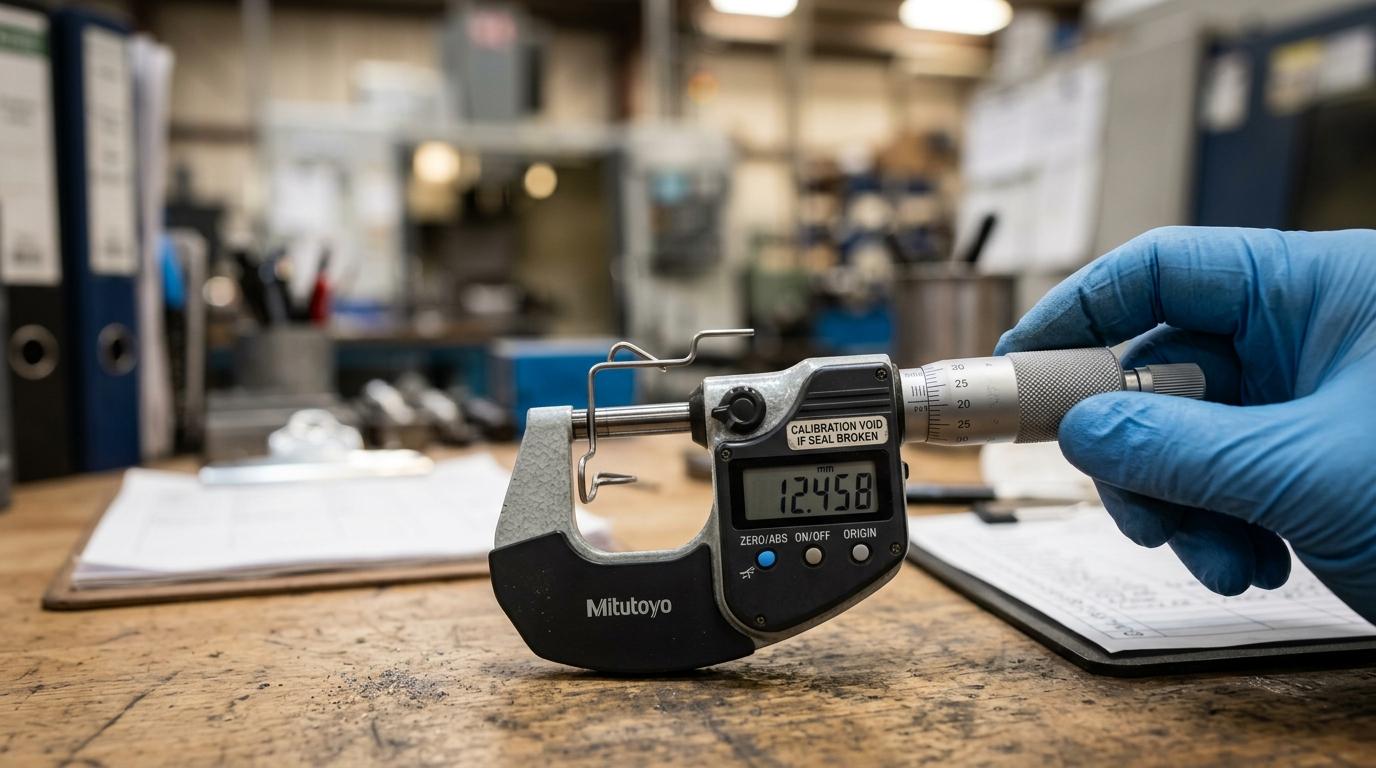
In manufacturing, ISO 9001 usually touches these daily controls: work instructions, calibration, training records, supplier qualification, inspection plans, corrective action, and management review. If a process drifts, the system should show who owns it, how it is measured, and what happens next.
A common misconception is that ISO 9001 guarantees perfect quality. It does not. It sets the management framework that makes good quality repeatable. If leadership treats certification as paperwork, the gains are usually shallow.
How does ISO 9001 improve product consistency in manufacturing?
ISO 9001 improves consistency by controlling process inputs, operator instructions, and verification methods, which companies like Toyota and Siemens use to reduce variation before defects escape.
The key idea is process control, not end-of-line sorting. Final inspection can catch some bad parts, but it cannot build stable capability into welding, forming, stamping, machining, or assembly. ISO 9001 pushes manufacturers to define requirements early, train to standard work, monitor outputs, and react when performance shifts.
If inspection data shows a trend, then the system should trigger containment and root-cause action before scrap expands. If a supplier changes material or finish, then the change should be reviewed, documented, and approved before production risk spreads.
Pro tip: consistency comes more from controlled methods than from thicker manuals. The best plants keep documentation useful, current, and close to the job. They do not bury operators in binders no one reads.
What manufacturers show strong ISO 9001 manufacturing discipline?
The strongest examples pair certification with real process capability, and Argo Products Company, Toyota suppliers, and Medtronic-style plants show how ISO 9001 can support repeatability in different manufacturing environments.
These are best seen as benchmarks, not one-size-fits-all models. A wire form supplier, an automotive tier supplier, and a medical device manufacturer all use the same standard differently because their risks, traceability needs, and validation burden are different.
- Argo Products Company: A U.S. industrial wire form and fabricated metal manufacturer where ISO 9001 discipline supports tight tolerances, prototype-to-volume scalability, and documented repeatability.
- Toyota-linked suppliers: Often used as a benchmark for standardized work, supplier control, and problem-solving rigor in high-volume manufacturing.
- Medtronic-style regulated manufacturers: Useful examples of traceability, CAPA discipline, and controlled documentation where risk and compliance pressure are high.
- Bosch and similar global plants: Good benchmarks for multi-site quality systems, internal audit maturity, and process standardization across product families.
The lesson is not that one company has the perfect model. It is that ISO 9001 works best when matched to the real production environment.
How can a manufacturer implement ISO 9001 step by step?
Manufacturers implement ISO 9001 by mapping core processes, building controlled procedures, and auditing the system before an accredited registrar reviews it.
A solid rollout starts with actual shop-floor flow, not with templates. If a company begins by copying generic procedures, then operators usually see the system as extra work. If it begins with how orders, materials, production, inspection, and shipping already move, the QMS becomes usable.
- Map the process flow: Define customer requirements, process owners, inputs, outputs, risks, metrics, and handoffs from quote through shipment.
- Create controlled methods: Write practical SOPs, train operators, set record-retention rules, and define how nonconformances, supplier issues, and corrective actions will be handled.
- Audit and correct: Run internal audits, hold management review, close gaps, and then schedule the Stage 1 and Stage 2 certification audit with an accredited body.
Trade-off matters here. More control usually means more discipline in records, training, and review. That adds effort upfront, but it often cuts the larger cost of rework, expediting, and customer returns.
How does ISO 9001 manufacturing compare with non-certified manufacturing?
ISO 9001 manufacturing is usually more controlled and auditable than non-certified manufacturing, though the gap depends on how seriously each plant manages quality.
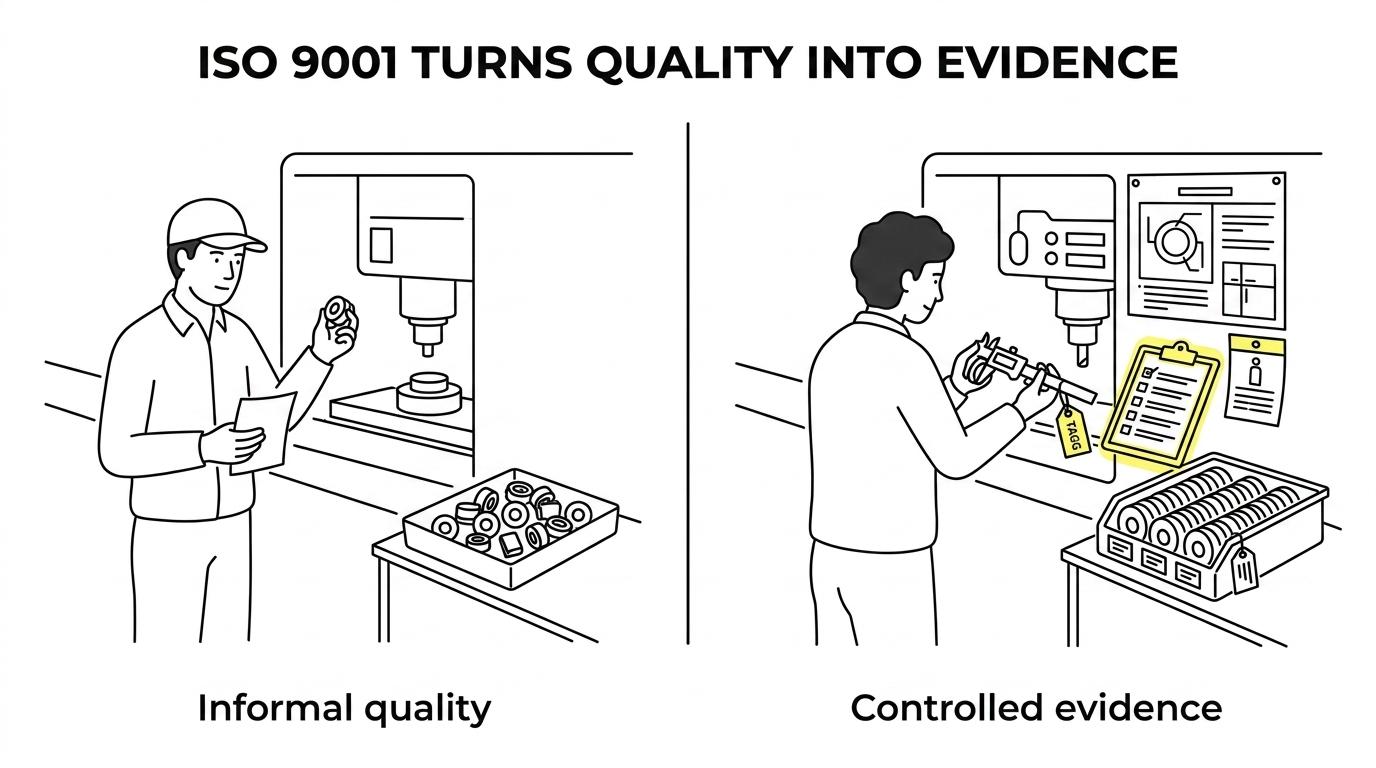
A non-certified plant can still be excellent. Many are. The difference is that ISO 9001 requires a formal system for documented information, internal audits, corrective action, and management review. That creates evidence, not just intent.
In a certified environment, if a customer asks how a dimension is controlled, there should be a traceable answer tied to work instructions, inspection records, training, and calibration. In a non-certified environment, the answer may exist, but it is less likely to be standardized across people and shifts.
The trade-off is speed versus control. Non-certified operations may move faster when changes are informal. Certified operations tend to move more carefully because changes need review and documentation. For complex OEM supply, that caution is usually a strength, not friction.
How does ISO 9001 compare with IATF 16949 and ISO 13485?
ISO 9001 is the base quality management standard, while IATF 16949 and ISO 13485 add sector-specific controls for automotive and medical devices.
If you supply automotive OEMs or Tier 1 programs, ISO 9001 alone may not be enough because IATF 16949 adds stronger expectations around defect prevention, product safety, APQP, PPAP, and supplier development. If you make medical devices, ISO 13485 usually matters more because it focuses on regulatory control, validation, and risk management tied to patient safety.
A common mistake is treating these standards as interchangeable. They are connected, but not equal. ISO 9001 gives the broad framework. Sector standards go deeper where failure carries higher commercial or regulatory consequences.
That is why many manufacturers start with ISO 9001, then add the sector standard their customers expect.
How should a factory prepare for an ISO 9001 certification audit in 3 steps?
A factory prepares best by organizing objective evidence, testing its system internally, and fixing gaps before the registrar arrives.
Certification audits are less about polished language and more about proof. Auditors want to see whether the system works in practice. If training records are current but operators do not follow the approved method, then the gap is still real.
- Gather objective evidence: Pull process maps, SOPs, inspection records, calibration logs, supplier controls, CAPA files, and management review minutes.
- Run an honest internal audit: Sample jobs, interview operators, trace orders through production, and test whether records match actual practice.
- Close findings fast: Fix document-control errors, retrain where needed, and verify effectiveness before the external audit.
Pro tip: do not stage-manage the audit so tightly that normal problems are hidden. Auditors usually spot that quickly, and hidden issues tend to return as customer complaints later.
How do risk-based thinking and corrective action reduce scrap and rework?
Risk-based thinking and CAPA reduce scrap by addressing failure causes early, and ISO 9001 with PDCA gives manufacturers a repeatable way to do that.
Risk-based thinking means asking where failure is most likely and what happens if it occurs. In manufacturing, that can mean material mix-ups, worn tooling, setup variation, missed inspections, or supplier drift. Corrective action then handles the actual problem through containment, root cause, action, and effectiveness review.
If a bend angle shifts because tooling wear was not monitored, then sorting the lot is only containment. The better fix is to add tool-life controls, clearer setup verification, or revised inspection frequency. That is the difference between firefighting and prevention.
Research in manufacturing has shown stronger process compliance in ISO-certified plants than in matched non-certified plants, especially when the system is actively maintained. The benefit is usually most visible in repeatability and issue recurrence, not in a magic drop in every cost line.
Common misconception: corrective action is not the same as retraining. If the process, fixture, print, or supplier control is flawed, retraining alone will not stop recurrence.
How can manufacturers measure ISO 9001 ROI in 3 practical steps?
ISO 9001 ROI is measurable when factories track baseline loss, tie improvements to controlled processes, and convert operational gains into dollars.
The cleanest approach is to start before certification or before a major QMS refresh. If baseline data is weak, then the business case becomes opinion. Good ROI tracking usually mixes leading and lagging indicators.
- Set a baseline: Capture scrap rate, rework hours, supplier PPM, internal PPM, on-time delivery, complaint rate, audit findings, and cost of poor quality.
- Tie metrics to process changes: Link gains to specific controls like revised SOPs, calibration discipline, supplier qualification, or faster CAPA closure.
- Convert results into financial impact: Price labor, material loss, freight expedites, warranty returns, and line downtime against the cost of audits, training, and system upkeep.
Accepted practice is to watch both direct and indirect returns. Direct returns include lower scrap and fewer returns. Indirect returns include shorter customer audits, easier supplier approval, and access to RFQs that require certification.
What mistakes prevent ISO 9001 manufacturing from delivering real benefits?
The biggest failures come from treating ISO 9001 as an audit project instead of a management system, and many plants from small job shops to global groups fall into that trap.
When the QMS sits outside daily operations, it becomes slow, expensive, and weak. Operators stop trusting it, managers stop using it, and corrective action turns into paperwork. The standard itself is rarely the problem. Poor implementation is.
- Template-driven documentation: Procedures copied from another business rarely match actual production flow.
- Too many metrics: A dashboard with 30 KPIs often hides the 5 that really predict quality and delivery.
- Weak root cause work: If every issue ends with “operator error,” the system is missing process causes.
- No management review muscle: When leaders do not review trends, risks, and resources, the QMS loses force.
- Static certification mindset: A certificate can stay valid while process performance gets worse if the system is not kept current.
One useful rule is simple: if the QMS does not help supervisors make better decisions this week, it will not create meaningful customer value this year. That is where ISO 9001 manufacturing either becomes a real advantage or just another framed certificate.
Keywords:
ISO 9001 manufacturing