How CNC Wire Forming Improves Repeatability

Precision wire forming is often judged by a simple question: can the same part be made the same way, over and over again?
That question matters far more than many buyers expect. A wire component may look uncomplicated on a print, yet small shifts in angle, length, loop geometry, or leg position can create assembly problems, cosmetic issues, or fatigue concerns once production begins. Repeatability is what turns a successful sample part into a dependable production process.
For companies sourcing bent wire components, this is where a capable wireform manufacturer stands apart. CNC wire forming replaces much of the variability found in manual or heavily operator-dependent bending with programmed motion, controlled feed rates, measured compensation, and process data that can be reused from one run to the next.
Why repeatability matters in precision wire forming
Repeatability is the foundation of precision wire forming because wire parts rarely live in isolation. They fit into assemblies, locate other parts, apply force, carry load, retain panels, or support moving components. If one bend opens up by a degree or two and another closes slightly, the part may still appear acceptable on a bench, yet fail once it reaches the line.
That is why part-to-part consistency often matters as much as nominal accuracy. A part that lands near the target once is not enough. OEMs need confidence that the tenth piece, the thousandth piece, and the next production lot will match functional expectations with minimal drift.
In practical terms, poor repeatability shows up in a few familiar ways:
- Inconsistent fit
- Extra inspection time
- Assembly adjustments
- Scrap and rework
- Warranty risk
How CNC wire forming reduces operator variation
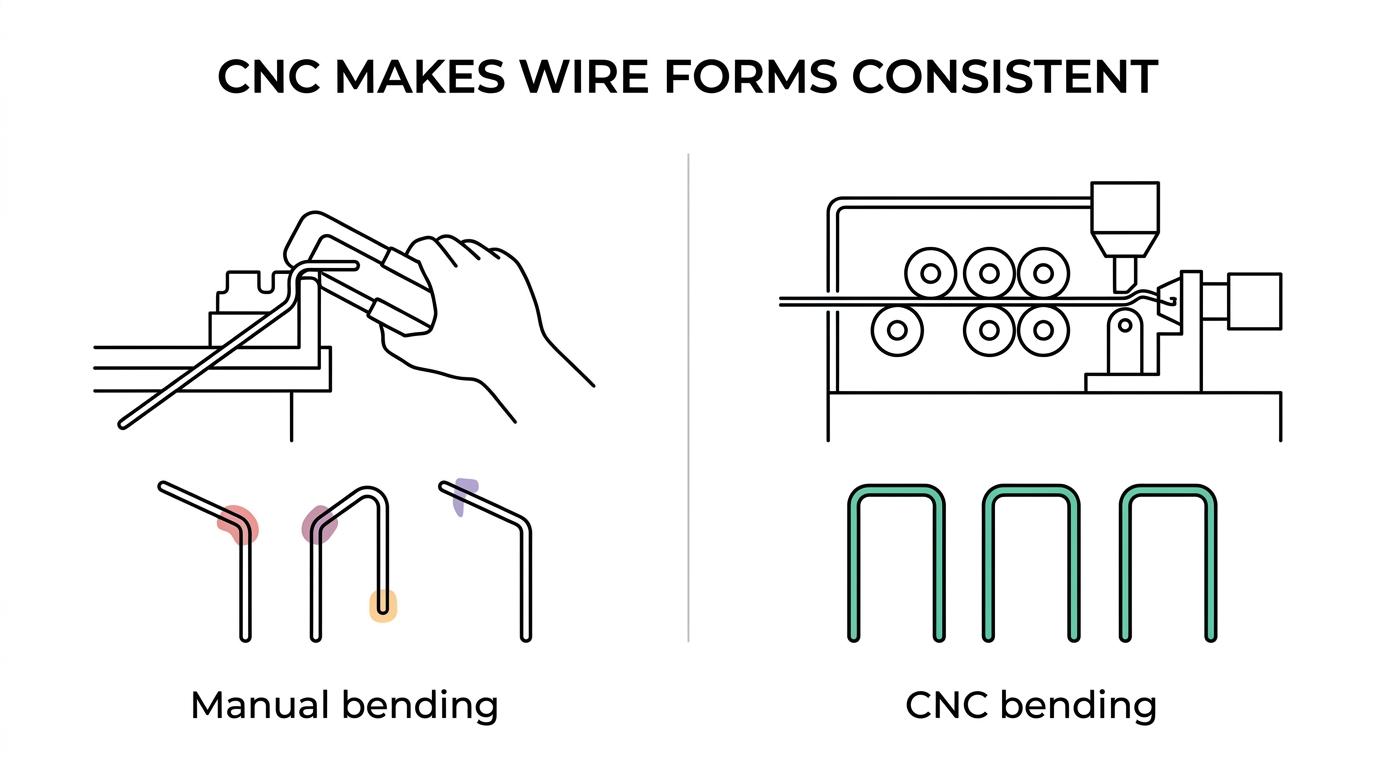
Traditional forming methods can depend heavily on operator touch, setup memory, and visual checks. Skilled operators are valuable, but human input alone introduces natural variation. Hand-fed lengths can change. Tool positions may shift. Springback may be corrected differently from one setup to another.
CNC wire forming changes that equation by turning the part into a controlled sequence of machine instructions. Feed length, bend angle, rotation, cut position, and forming order are programmed. Once the recipe is validated, the machine executes the same motion path repeatedly with far less dependence on individual technique.
This is one reason manufacturers looking for custom wire forms often prioritize CNC capability. The process supports repeatable production not only for complex geometries, but also for parts that appear simple and still demand tight consistency.
A repeatable CNC process usually includes:
- Programmed motion: the machine follows the same bend sequence each cycle
- Controlled feed lengths: material advances by measured increments instead of operator estimation
- Consistent tool positioning: bends occur from stable reference points
- Stored part recipes: validated settings can be recalled for future runs
- Reduced setup drift: adjustments are documented rather than improvised
The result is not just less variation. It is also a process that can be audited, refined, and transferred more reliably from prototype work to sustained production.
Springback compensation is a major reason CNC wire forming stays consistent
Every metal former deals with springback. Wire is bent under load, then relaxes slightly after the tooling force is removed. That elastic recovery changes the final bend angle and can move a finished part away from its intended geometry.
In a less controlled process, springback correction is often based on trial and error. An experienced operator may overbend slightly, inspect the result, then adjust again. That can work on short runs, though it becomes less dependable when material lots change, tolerances tighten, or production volumes rise.
CNC wire forming improves this by treating springback as a known process variable rather than an afterthought. The machine can be programmed to compensate through overbend values, bend sequencing, and calibrated offsets based on real material behavior. Recent academic work has pushed this even further, showing how inline sensing, model-based control, and machine-learning-assisted compensation can tighten final bending outcomes.
Research on bending mechanics has also shown that neutral-layer shifting matters. During a bend, the internal strain distribution through the material is not perfectly fixed, and models that account for that shift track real springback behavior more closely. That matters because better models lead to better compensation, and better compensation leads to stronger repeatability.
A few springback factors deserve close attention:
- Material response: stainless steel, carbon steel, and specialty alloys do not relax the same way after bending
- Wire diameter: larger or heavier sections can react differently under identical tooling motion
- Bend radius: tighter bends often amplify the effect of elastic recovery
- Process data: measured output gives the programmer a basis for correction instead of guesswork
When this compensation is built into the CNC program, the machine is not merely making bends. It is making adjusted bends designed to land closer to the desired final shape.
Closed-loop control and inline measurement improve wire forming repeatability
The biggest leap in repeatability comes when CNC motion is paired with measurement. Instead of assuming the programmed move produced the intended result, advanced systems can compare actual output to the target and make corrections.
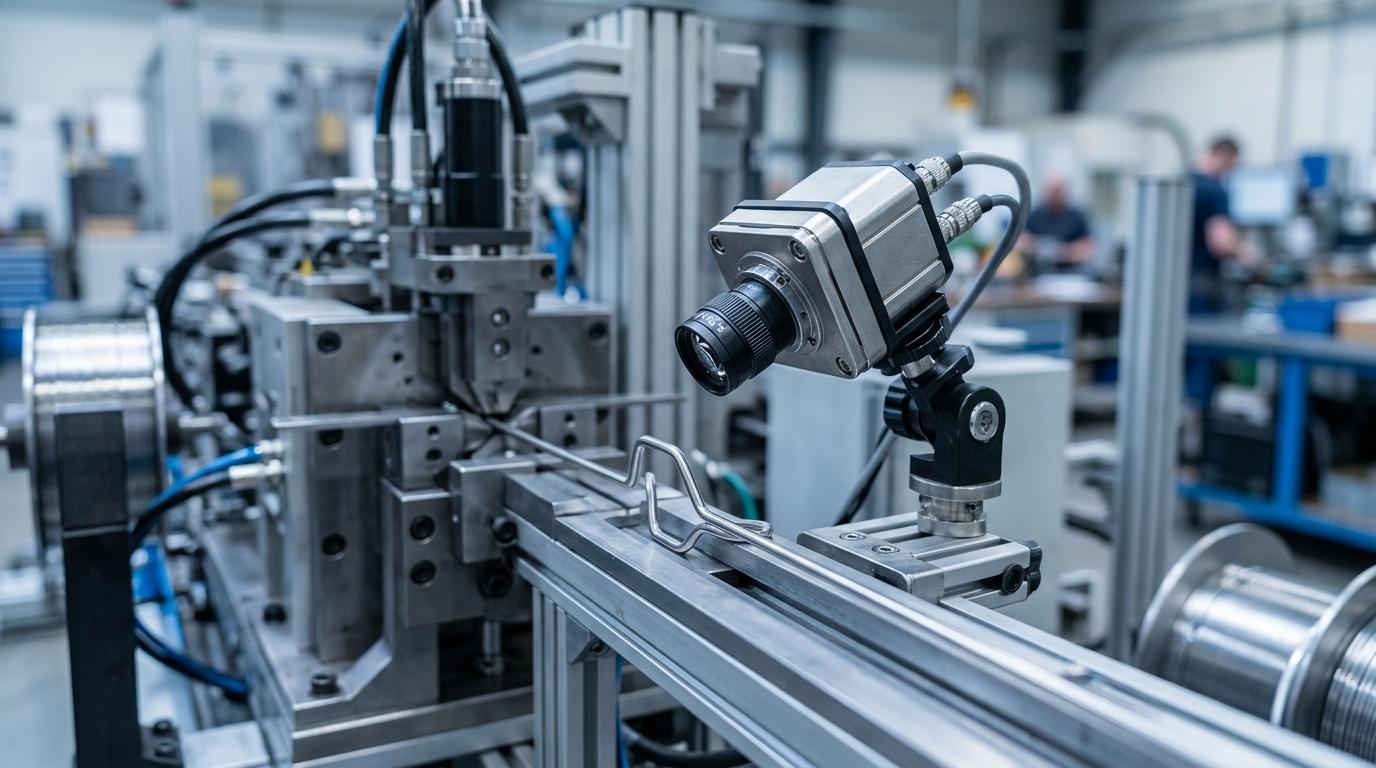
This is the logic behind closed-loop control. In published research, camera-based systems, including low-cost CCD camera setups, have been used to sense bending angles inline and feed predicted or measured results back into the control system. That means the process can react to real part behavior during production rather than relying only on initial setup data.
For buyers seeking dependable wire forming services, this distinction is worth noticing. Open-loop control is better than manual forming alone, but closed-loop capability adds another layer of protection against drift caused by springback, tool wear, or material variability.
| Repeatability driver | Basic approach | CNC-controlled approach |
|---|---|---|
| Bend execution | Operator influenced | Programmed machine motion |
| Springback handling | Trial-and-error adjustment | Stored compensation values and predictive models |
| Measurement | Offline spot checks | Inline sensing and feedback when available |
| Changeover consistency | Setup memory and notes | Recalled digital recipes |
| Response to drift | Manual correction after defects appear | Faster adjustment based on measured output |
This is also where newer control methods stand out. Machine-learning-assisted compensation is gaining attention because it can refine predictions as more process data becomes available. That does not remove the need for skilled engineering or sound tooling. It gives those capabilities sharper feedback and a stronger path to stable bending outcomes.
Process control methods that support precision wire forming
CNC equipment is powerful, but repeatability does not come from machine motion alone. The broader process matters just as much. A stable wire forming operation combines programming, material control, inspection discipline, and documented setup practices.
Material consistency is a strong example. Wire from different heats or suppliers can behave differently under bend load, even when the nominal grade is the same. A repeatable operation accounts for that through incoming checks, process monitoring, and compensation updates when required.
Tool condition matters too. Worn tooling can change contact points, friction, and bend geometry over time. In precision wire forming, preventive maintenance and tool inspection are part of repeatability, not just upkeep.
Many high-performing operations focus on a few connected controls:
- First-piece validation
- In-process dimensional checks
- Lot traceability
- Tool maintenance records
- Documented setup parameters
Repeatability also improves when manufacturing teams think beyond a single bent feature. Some parts include secondary operations, flattened ends, threads, or welded joints. If those downstream steps are not held to the same standard, the consistency gained in the forming cell can be lost later. That is one reason buyers often value suppliers with broader fabricated metal capability and experience with precision wire forming tied to related operations.
For higher-volume programs, this process discipline pays off twice. It reduces variation today, and it creates a knowledge base that can be reused when the part returns for another release months later.
What OEM buyers should ask about repeatability from a wireform manufacturer
Repeatability is easier to claim than to prove. Buyers should ask direct questions about how consistency is built into the process, especially for parts with multiple bends, functional fit requirements, or cosmetic exposure.
A good starting point is the supplier’s method for handling springback and first-run validation. If the answer is mostly manual tweaking without documented control, repeatability may depend too heavily on individual experience. If the answer includes programmed compensation, measurement, and recorded setup data, that is a stronger sign of process maturity.
It also helps to ask how the supplier moves from prototype work into ongoing production. Some shops can make a good sample part but struggle to lock in the recipe for larger quantities. A capable wireform manufacturer should be able to support both early development and production scaling without losing dimensional stability.
Useful questions include:
- How is springback compensated: by operator feel, stored offsets, predictive models, or a mix of methods?
- How is repeatability verified: first article only, periodic checks, or inline measurement with active feedback?
- How are future runs controlled: through documented programs, setup sheets, tooling records, and traceable process data?
- What happens when the part includes joining steps: can related work, including welded wire forms, be controlled to the same standard?
These questions shift the conversation away from generic promises and toward the real mechanics of part-to-part consistency.
Repeatability in precision wire forming is not a single machine feature. It is the combined effect of CNC control, springback compensation, measurement, and disciplined process management. When those pieces work together, manufacturers gain something very valuable: wire components that keep matching the print, the assembly, and the production plan run after run.
Keywords:
precision wire forming