9 Benefits of Domestic Manufacturing
Domestic manufacturing is not just a patriotic preference. It is a risk, speed, and control decision that often matters most when parts are custom, time-sensitive, or tied to critical production schedules.
TL;DR: Summary
- Domestic manufacturing delivers the biggest business benefit when buyers need shorter supply chains, lower uncertainty, faster engineering response, and tighter quality control, especially for custom components like wire forms.
- NIST says reshore-related domestic supplier scouting can shorten the supply chain and reduce uncertainty, and its supply-chain data show U.S. manufacturing still depends on imported intermediate goods and services for 18.2% of its supply chain.
- The cost case is usually strongest when you compare total landed cost, not unit price alone. Freight volatility, expediting, buffer inventory, quality escapes, and engineering-change delays can erase a lower offshore piece price.
- Domestic manufacturing is especially valuable for critical goods, regulated products, pilot runs, and parts that change often. A U.S.-based wireform manufacturer can often move faster from prototype to production and support tighter communication during design changes.
- Manufacturing also has measurable economic weight. NIST reports U.S. direct and indirect manufacturing value added at $4.278 trillion in 2019, while BEA tracks manufacturing’s contribution to GDP by industry as value added.
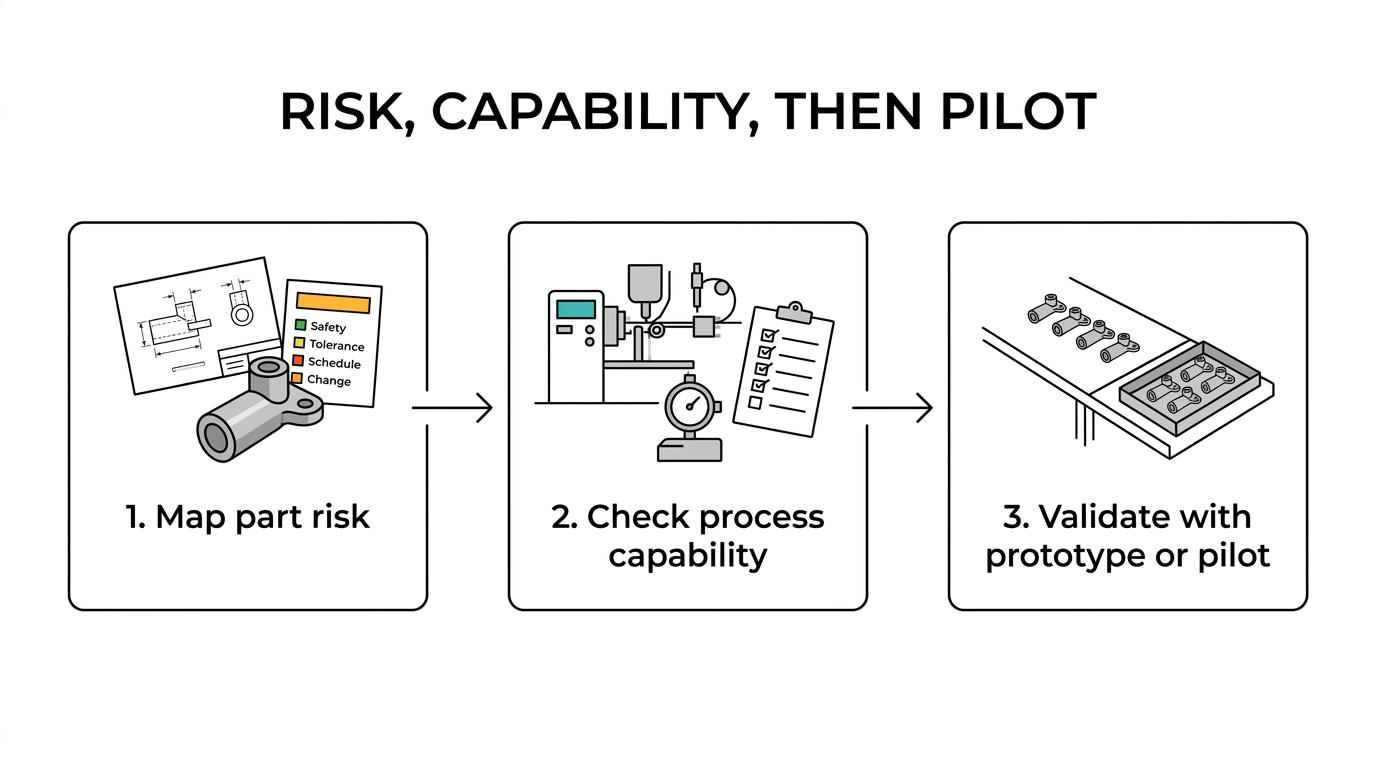
- If you are sourcing custom metal components, choose a domestic supplier by mapping risk first, checking process capability and quality systems second, and validating with prototype or pilot production third.
That matters because many OEM sourcing decisions are won or lost on total business impact, not on quoted piece price alone. When a buyer needs fast prototypes, repeatable tolerances, or quick corrective action, domestic production can be the safer and faster path.
Why does domestic manufacturing reduce supply chain uncertainty?
Yes. NIST and the U.S. Department of Commerce connect domestic production with shorter supply chains, lower uncertainty, and stronger resilience planning for critical goods.
A shorter chain usually means fewer handoffs, fewer customs steps, and fewer failure points between design release and delivered product. NIST says domestic supplier scouting tied to reshoring can shorten the supply chain and reduce uncertainty, which is a practical sourcing advantage when a component is custom or operationally important.
NIST also reports that in 2020, U.S. manufacturing imported 18.2% of its intermediate goods and services supply chain, and 10.6% of U.S. manufacturing output was of foreign origin. If a part depends on multiple overseas inputs, then each added node can raise the chance of delay, substitution, or incomplete visibility.
For custom metal parts, communication speed matters as much as freight miles. A domestic wireform manufacturer can often review tolerances, packaging, finish requirements, and process changes without the lag that slows problem-solving across long supply chains.
"Argo Products Company lists its U.S. manufacturing location at 3500 Goodfellow Boulevard in Saint Louis, Missouri."
A common misconception is that domestic means risk-free. It does not. Domestic sourcing still needs backup planning, material visibility, and realistic capacity checks. The gain is better control over uncertainty, not the removal of uncertainty.
How does domestic manufacturing improve lead times and engineering changes?
It usually does. U.S. factories and U.S. OEM teams can resolve design changes faster because engineers, buyers, and production staff are operating in the same market and time zones.
Lead time is not just transit time. It includes quote response, DFM review, tooling adjustments, sampling, first-article approval, and corrective action. When those steps happen closer to the customer, calendar time often drops. The 2021 White House supply-chain review also noted that resilient production requires quick problem-solving driven by people on the factory floor.
That is especially true for formed wire components, welded assemblies, and parts that need several iterations before release. If an engineering change order hits every two weeks, then a distant supplier with long batching cycles can turn a routine change into a schedule problem.
Pro tip: measure lead time in business days from print release to approved sample, not just port-to-dock transit. That is the metric that exposes hidden delay.
What are the 9 benefits of domestic manufacturing?
The main benefits are speed, resilience, quality control, and better coordination. NIST, Commerce, and supplier case examples all point in the same direction.
When buyers ask why domestic manufacturing still matters, these are the nine advantages that usually decide the conversation:
- Shorter supply chains with fewer handoffs
- Faster prototyping and short-run production
- Quicker engineering changes and design feedback
- Better supplier visibility and communication
- Easier audits, quality checks, and first-article review
- Lower exposure to freight shocks and expedite costs
- Stronger resilience for critical goods and time-sensitive parts
- Meaningful U.S. economic contribution through manufacturing value added
- Better fit for custom, tight-tolerance parts from a specialized wireform manufacturer
Not every part captures all nine. A simple commodity item with stable demand may only gain two or three. A tight-tolerance component in a medical, automotive, or electrical application may gain most of them at once.
How can you evaluate a domestic supplier in three steps?
Use a simple three-step screen. Start with part risk, move to process capability, then validate with a real production trial.
Step 1 is to map the part’s business risk. Ask whether it is safety-related, tolerance-sensitive, schedule-critical, or likely to change. If the answer is yes to two or more of those, domestic manufacturing deserves a serious look.
Step 2 is to check process fit. Review quality systems, repeatability, equipment, and secondary operations. For a supplier offering precision wire forming, that means looking at CNC capability, welding, flattening, threading, and the discipline behind ISO 9001, lean cells, and 5S practices.
Step 3 is to validate with prototypes or a pilot run. A short-run order reveals more than a slide deck does. It shows how the supplier communicates, how quickly it reacts to print changes, and whether actual output matches the quoted process.
"Argo Products Company says it offers rapid prototyping and short-run production wireforming to support product development and pilot programs."
A common misconception is that certification alone proves fit. It does not. Certification matters, but sample quality, responsiveness, and repeatability are what protect a launch schedule.
Domestic manufacturing vs offshore manufacturing: which costs are easier to control?
Domestic manufacturing usually makes total landed cost easier to control. Offshore manufacturing can still win on unit price for some stable, high-volume parts.
The problem is that piece price is only one line on the balance sheet. Buyers also pay for premium freight, larger safety stock, longer forecast windows, incoming inspection, schedule recovery, scrap from miscommunication, and the internal labor spent managing exceptions.
If a part changes often or has a tight tolerance stack, domestic manufacturing often narrows or removes the offshore price advantage. If a part is simple, forecastable, and purchased in very large volumes, offshore sourcing can still be rational.
The costs that are often easier to control domestically include:
- Freight volatility
- Expedite premiums
- Excess safety stock
- Quality escape containment
- Engineering change overhead
Pro tip: build your comparison around total cost to serve for 12 months. That method is usually more honest than comparing two unit prices side by side.
How does domestic manufacturing support faster prototyping and pilot runs?
It does. For custom wire forms and fabricated metal parts, supplier proximity can cut days or weeks from the path between concept, sample, and production-ready revision.
Rapid prototyping is where domestic manufacturing often shows its clearest advantage. A Missouri-based example is Argo Products Company, which states that it provides rapid prototyping and short-run wireforming to accelerate product development and support pilot programs. That model is useful when an OEM is still testing fit, finish, spring properties, packaging, or assembly interaction.
"Argo Products Company says it was founded in 1932 and operates in a 75,000-square-foot manufacturing facility."
A pilot run also exposes operational details early. Buyers can confirm packaging, weld consistency, dimensional stability, and line-side usability before committing to larger volumes. When the supplier also supports custom wire forms, the design loop tends to stay tighter from early sample to repeat production.
How do you build a resilient domestic supply chain in three steps?
Start by identifying single points of failure. Then qualify backup capacity. Then share better demand and change signals with suppliers.
Step 1 is visibility. List the parts that can stop a production line, trigger a safety issue, or delay customer shipments. The U.S. Department of Commerce has framed resilience work around mapping and monitoring critical supply chains, which is exactly where private-sector buyers should start.
Step 2 is supplier design. A resilient domestic network is not just one U.S. factory. It is a sourcing model with qualified materials, documented alternates, and realistic lead-time commitments. If a material grade is scarce, then domestic conversion alone may not eliminate risk.
Step 3 is operational communication. Share forecasts, demand swings, engineering changes, and launch timing earlier. A common misconception is that resilience comes only from carrying more stock. Inventory helps, but bad information will still break a supply plan.
Domestic manufacturing vs reshoring: what is the difference?
They are related but not identical. Domestic manufacturing means production occurs in the United States; reshoring means production is moved back to the United States after being done elsewhere.
That distinction matters in sourcing strategy. A buyer can choose domestic manufacturing for a new product without reshoring anything. A buyer can also reshore an existing part, which usually means supplier qualification, tooling transfer, PPAP or first-article work, and updated logistics planning.
NIST’s wording is useful here: reshore-related domestic supplier scouting can shorten the supply chain and reduce uncertainty. If a program is already offshore and unstable, then reshoring may be the fix. If the program is new and technically demanding, then starting domestically may be the cleaner option.
How should OEMs switch to a U.S. wireform manufacturer in three steps?
Use a controlled transfer. Pick the right parts first, send a complete technical package second, and validate production readiness third.
Step 1 is part selection. Choose components with unstable lead times, frequent design changes, recurring quality issues, or high service risk. Those are the parts most likely to benefit from a domestic move.
Step 2 is data transfer. Send prints, tolerances, annual volumes, material specs, finish requirements, packaging needs, and approval standards. For welded wire forms, include joint requirements, fixture assumptions, and cosmetic expectations.
Step 3 is validation. Run prototypes, approve first articles, and test a pilot lot before a full transfer. Pro tip: if the part also needs resistance welding, threading, or flattening, choose a supplier that can handle those operations in-house so fewer handoffs can disrupt the launch.
When is domestic manufacturing the best choice, and when is it not?
Domestic manufacturing is usually the best choice for high-consequence parts, changing designs, and custom production. It is not always the best answer for every commodity item.
The strongest fit is where speed, quality feedback, and repeatability matter more than the lowest possible labor rate. That includes critical goods, regulated sectors, custom assemblies, and programs where production and engineering teams need close coordination. NIST’s economic framing also matters here: U.S. direct and indirect manufacturing value added, including manufacturing and its domestic supply chain, reached $4.278 trillion in 2019.
Use these criteria when deciding:
- Best fit: tight tolerances, frequent engineering changes, pilot programs, custom tooling, critical goods
- Often favorable: short production windows, heavy communication needs, complex wire geometries, welded assemblies
- Maybe less favorable: simple commodity parts, very stable demand, long forecast visibility, low service urgency
- Decision trigger: if delay, quality drift, or engineering lag costs more than the offshore unit-price gap, domestic usually wins
That is why many buyers treat domestic manufacturing as a strategic tool rather than a blanket rule. For the right part family, a capable U.S. supplier can improve resilience, speed, and quality at the same time.
Keywords:
domestic manufacturing