How Lean Manufacturing Improves OEM Delivery
OEM buyers rarely judge a supplier on price alone. They judge on whether parts arrive when promised, in the quantities needed, with quality that does not create more work downstream.
That is why lean manufacturing matters so much to delivery performance. Lean is often described as a cost or efficiency strategy, but its practical value for OEMs is even more direct: it removes the delays, handoffs, bottlenecks, and hidden waste that push orders past their promised dates.
When a manufacturing partner reduces flow time, trims excess inventory, organizes work cells, and reacts faster to schedule changes, delivery improves because the whole system becomes easier to control.
Lean manufacturing and OEM delivery performance
Lean manufacturing is built around waste reduction, but the outcome OEMs feel most clearly is speed with control. The National Institute of Standards and Technology describes lean as a set of tools for identifying and eliminating waste, while also tracking inventory and flow time. The U.S. Environmental Protection Agency notes that lean efforts aim to reduce flow time, cycle time, and lead time. Those are not abstract metrics. They directly shape whether a supplier can meet an original promised date.
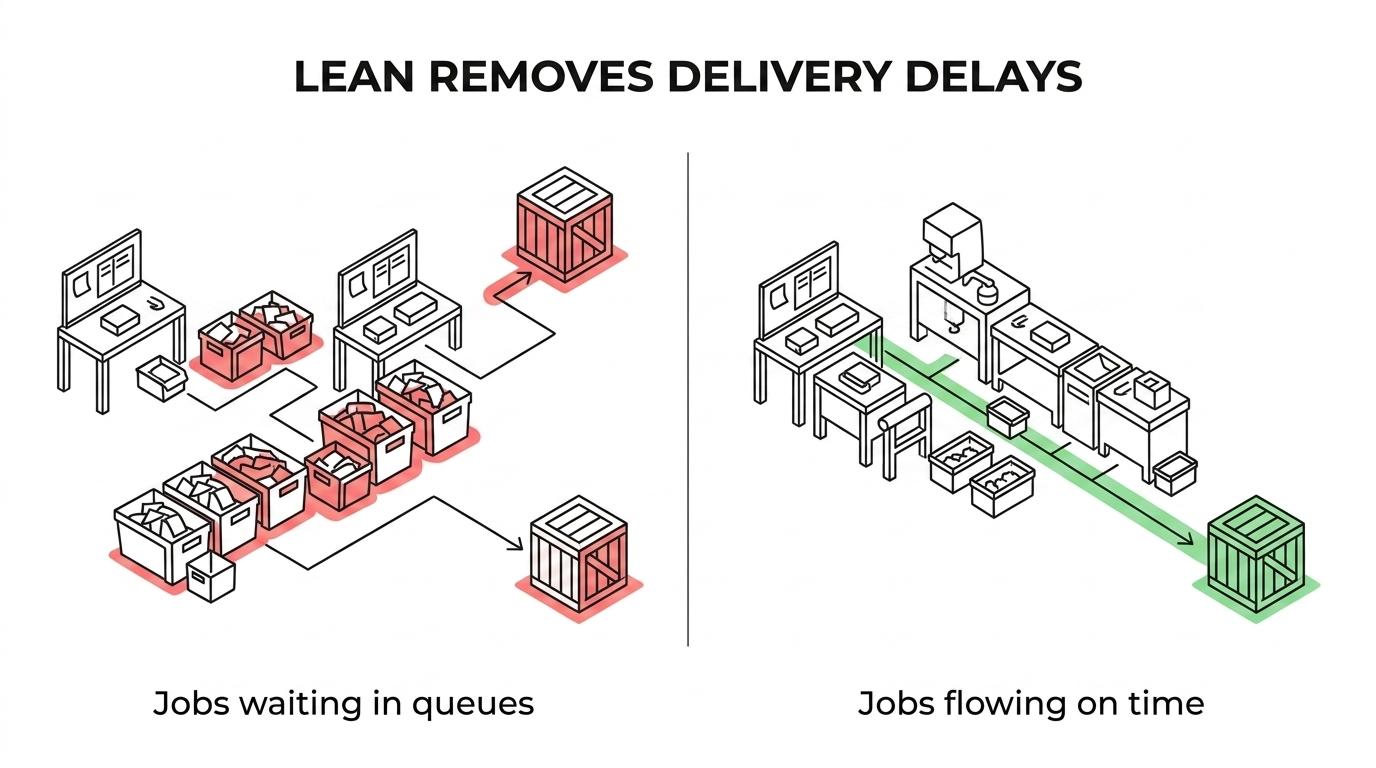
For OEM purchasing teams, shorter flow time usually means fewer surprises. Jobs spend less time waiting between operations. Material is easier to locate. Priorities are clearer. Problems show up sooner, when there is still time to correct them.
A lean operation also tends to be more responsive in make-to-order and build-to-order settings, where customer requirements shift and product mix can be complex.
| Delivery challenge | What happens without lean control | Lean response |
|---|---|---|
| Long queues between operations | Orders sit idle and promised dates slip | Cellular flow and smaller batches |
| Too much work-in-process | Priorities get buried and status becomes unclear | Visual controls and tighter scheduling |
| Rework and defects | Good parts ship late because bad parts consume capacity | Standard work and root-cause correction |
| Poor handoffs between departments | Engineering, production, and shipping operate on different assumptions | Cross-functional coordination |
| Limited visibility on job status | Late orders are noticed too late to recover | Live tracking and daily review |
Lean waste reduction that improves on-time delivery
Late delivery often looks like a scheduling problem. In reality, it is usually a waste problem.
NIST identifies seven common waste categories in manufacturing: overproduction, transportation, rework or defects, over-processing, motion, inventory, and waiting. Every one of them adds time without adding value. If a supplier is constantly expediting, moving jobs from one queue to another, or sorting through excess work-in-process, the factory is spending energy on recovery rather than flow.
That is why lean manufacturing improves delivery so reliably. It targets the actual causes of delay instead of treating late orders as isolated events.
- Waiting: Jobs pause between operations, approvals, inspections, or material releases.
- Inventory: Excess work-in-process hides priority jobs and stretches flow time.
- Transportation: Unnecessary movement between departments adds handling time and risk.
- Rework or defects: Capacity is consumed fixing problems instead of completing scheduled orders.
- Over-processing: Extra steps that do not change customer value still consume lead time.
- Motion: Time is lost when operators search for tools, fixtures, or material.
- Overproduction: Building too early can clog the system and delay what is actually needed now.
For OEMs, the value here is straightforward. When those delay sources shrink, schedules become more believable.
Flow time, cycle time, and lead time in lean manufacturing
Three terms matter when delivery is on the line: flow time, cycle time, and lead time.
Flow time is the total time a job spends moving through the system, including waiting. Cycle time is the time needed to complete a process step or an entire unit. Lead time is the full elapsed time from order release to shipment, and often from order placement to receipt. EPA materials on lean point out that manufacturers using lean methods work to reduce all three.
This matters because many late orders are not caused by slow production in the narrow sense. A part may only require a few minutes of actual forming, welding, or finishing, yet still spend days sitting in queues. Lean manufacturing attacks that mismatch. It asks why time is being spent where no value is being created.
In OEM supply relationships, a shorter flow time creates options. It gives a supplier more room to absorb design revisions, forecast shifts, and urgent replenishment needs without throwing the whole plant into chaos.
Lean manufacturing for low-volume high-variety OEM production
Some people still assume lean works best only in repetitive, high-volume factories. The evidence says otherwise.
A 2018 study published in the South African Journal of Industrial Engineering looked at on-time delivery problems in a low-volume high-variety make-to-order industrial valve environment. The approach combined lean thinking, a lean live tracking tool, and a cross-functional team structure. Using real-time production data, the manufacturer improved average on-time delivery from 30% to 90% in about eight months.
That result is especially relevant for OEM programs with complex part mixes, frequent engineering changes, and varying demand. In those settings, delivery does not improve simply by pushing people to work harder. It improves when the system gives everyone better visibility, faster escalation, and clearer ownership of the original promised date.
The study also reinforces a practical lesson: lean is not only about physical layout. It is also about information flow. If sales, planning, engineering, production, and shipping are not working from the same live picture of the order, small disruptions can become late shipments very quickly.
Lean practices inside a wireform manufacturer
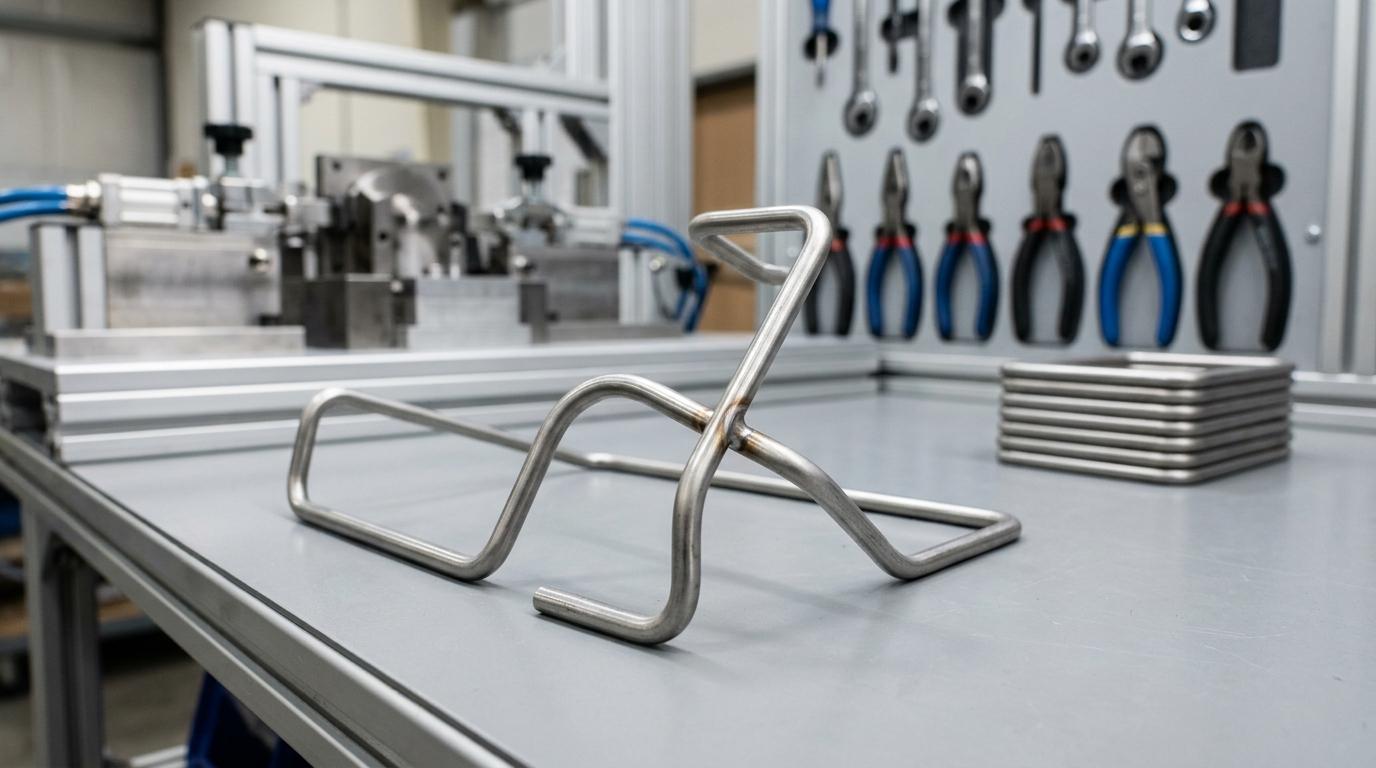
For buyers sourcing metal components, lean becomes tangible on the shop floor. In a wireform manufacturer, lean shows up in how wire is staged, how setups are standardized, how short runs are handled, and how prototypes transition into repeat production.
That matters because wire forms are often part of larger assemblies or finished products with tight launch schedules. A missed date on a basket, rack, spring form, guard, bracket, or welded assembly can delay multiple downstream steps. OEMs need a supplier that can keep quality stable while moving quickly from sample approval to production release.
A capable partner in this space often combines lean methods with disciplined quality systems. One example is a manufacturer that pairs ISO 9001 practices with lean manufacturing, cellular manufacturing, and 5S while supporting rapid prototypes through high-volume production. That combination is well suited to OEMs looking for custom wire forms that must hold tight tolerances without sacrificing schedule reliability.
Lean also supports the practical details that buyers track every week:
- shorter setup recovery
- cleaner work cells
- faster job visibility
- better repeatability
- fewer schedule surprises
When welded assemblies are part of the scope, lean principles still apply. Consistent fixture control, balanced work cells, and clear routing can help keep welded wire forms moving without the stop-and-start pattern that often drives late orders.
Supplier coordination and on-time supplier delivery
OEM delivery performance does not stop at one factory wall. It depends on the supplier network as well.
MIT lean supply chain materials describe on-time supplier delivery to point of use as a central concept. That idea is powerful because it ties scheduling to actual consumption rather than broad monthly forecasts. If incoming material arrives in the right quantity, at the right time, and in sync with production needs, internal flow becomes easier to maintain.
For OEM buyers, this means the best manufacturing partners think beyond machine utilization. They pay close attention to replenishment timing, supplier lead times, and how purchased material supports takt time and job release. When upstream coordination improves, downstream customer delivery usually improves with it.
A lean manufacturer is also more likely to surface risks early. Instead of hiding shortages inside excess inventory, lean systems make disruptions visible. That visibility gives both supplier and OEM more time to respond with a rational plan.
Why lean manufacturing improves responsiveness for engineering changes
Delivery is not only about shipping the original order on time. It is also about adapting when the order changes.
OEM programs often involve revised drawings, alternate materials, validation builds, packaging updates, and fluctuating release quantities. A rigid operation struggles here because every change collides with excess inventory, long queues, or overloaded departments. A lean operation has less friction in the system, so it can respond faster without losing control.
This is one reason buyers often prefer manufacturing partners with strong wire forming services tied to engineering support and scalable production. If the supplier can prototype quickly, hold process discipline, and move into larger runs with minimal disruption, delivery performance becomes more dependable across the full product lifecycle.
Responsiveness is not accidental. It is built through standard work, visual scheduling, organized tooling, disciplined quality checks, and clear communication between commercial and production teams.
Questions OEMs should ask about lean manufacturing before awarding work
Lean claims are common. Useful answers are more specific.
When evaluating a supplier, OEM teams should listen for signs that lean is part of daily operations rather than a marketing label. The right questions can reveal whether the manufacturer actually reduces delay sources or simply expedites late jobs after problems appear.
- How is flow time measured: Ask how long jobs spend in the system, not just how long machines run.
- What happens when a job is at risk: Look for live tracking, daily review, and defined escalation paths.
- How are engineering changes handled: Strong answers include controlled revisions, clear communication, and quick re-planning.
- What lean methods are active today: 5S, cellular manufacturing, visual management, setup reduction.
- How is on-time delivery defined: Original promised date is often the most meaningful metric.
- How are cross-functional teams used: Sales, planning, quality, engineering, and production should not operate in silos.
A buyer can also ask for examples from prototype, short-run, and volume production. Lean systems should support all three, especially in OEM environments where demand patterns are rarely static.
Lean manufacturing, quality systems, and delivery discipline
Lean works best when paired with disciplined quality practices.
A factory that moves fast but creates defects will not deliver well for long. Rework steals capacity, complicates scheduling, and turns normal lead times into emergency recoveries. That is why the strongest delivery performers usually connect lean methods with formal quality control, process repeatability, and documented standards.
For metal component sourcing, this combination is especially valuable. Tight-tolerance wire forms, resistance-welded products, stampings, and fabricated assemblies all depend on stable process control. When the process is stable, schedule promises become more credible. When the process is unstable, even generous lead times can collapse.
OEMs do not need perfect certainty from a supplier. They need evidence of control, visibility, and consistent execution. Lean manufacturing provides that structure by reducing waste, shortening flow time, and making problems visible early enough to act on them. That is why it remains one of the clearest paths to better delivery performance in modern manufacturing.
Keywords:
lean manufacturing