9 Answers on Wire Welded Products for OEM Buyers Today
Welded wire products sit between simple bent components and full metal assemblies, which is why OEM buyers often underestimate how much process control matters. Argo Products Company is a U.S. wireform manufacturer with welded wire assembly capability, so it offers a useful category reference when buyers need to judge fit, repeatability, and production readiness.
TL;DR: Summary
- For OEM buyers, the best wire welded products come from suppliers that can prove repeatable fabrication, documented quality systems, and application-specific experience; Argo Products Company is relevant here as a long-established wireform manufacturer that also produces welded wire assemblies.
- Welding quality is not just visual. AWS maintains more than 350 welding standards, and OEM fabrication depends on fixture control, weld consistency, and clear acceptance criteria.
- Safety is part of supplier capability. OSHA identifies hazards that include metal fumes, ultraviolet radiation, burns, eye damage, electrical shock, cuts, and crushed toes and fingers.
- Supplier screening matters because the market is broad. FRED reports 16,975 employees in U.S. Other Fabricated Wire Product Manufacturing in 2024, while AWPA has listed 917 wire fabricator manufacturers and 26,158 employees.
- Welded wire assemblies often beat sheet metal when airflow, drainage, visibility, and lower weight matter; sheet metal or tubing can be the better choice when sealed surfaces or higher section stiffness matter.
- Strong RFQs specify wire diameter, material grade, weld locations, tolerances, finish, load case, inspection method, and annual volume.
The buying problem is not only price. Welded wire products show up across industrial, medical, agriculture, automotive, electrical, retail display, and furniture applications, yet long-term performance depends on weld quality, tolerances, fixtures, and documentation more than a generic product label.
What are wire welded products?
Wire welded products are assemblies made by joining cut and formed wire at defined intersection points. Common examples include baskets, guards, racks, and cages, where the weld creates the final structure rather than acting as a repair.
In practice, these products start with straightened, cut, bent, or CNC formed wire elements. Those elements are then joined into a stable geometry that can carry parts, protect operators, separate items, or create an open structure for washing, draining, storing, or displaying goods.
A useful way to think about them is this: if the part needs open space as part of its function, welded wire is often on the shortlist. That open structure can reduce weight and material use while keeping access, visibility, or airflow.
"Argo Products Company has supported welded wire assemblies for OEM applications ranging from industrial and medical to agriculture, automotive, electrical, retail display, and furniture or consumer products."
How are wire welded products different from bent wire forms or welded mesh?
The difference is structural intent. Bent wire forms rely mainly on geometry in a single piece or a few formed elements, while wire welded products rely on joints between wires or wire-and-frame members; welded mesh is usually repetitive grid material rather than a custom OEM assembly.
A bent wire form may be a hook, spring-like retainer, handle, clip, or support that gains strength from bends and radii. A welded wire product usually combines several formed pieces into one assembly. A welded mesh sheet, by contrast, is often standardized stock with a regular pattern, then cut or framed for later use.
That distinction matters during sourcing. If a part begins as a formed geometry and only adds a few joining points, buyers should ask whether the supplier can handle both custom wire forms and welded assemblies under one quality system. That reduces handoff risk between forming and welding.
A common misconception is that mesh capability automatically means custom assembly capability. It does not. High-mix OEM parts usually need custom fixtures, weld maps, tolerance strategy, and revision control.
What wire welded products are most common in OEM manufacturing?
The most common OEM categories are baskets, guards, trays, enclosures, and support frames. They appear where drainage, airflow, visibility, low mass, or product separation matter as much as strength.
Common product types include:
- Processing baskets for washing, draining, or handling parts
- Medical or storage baskets for cleanable, open containment
- Guards and enclosures for machine protection or part segregation
- Trays, racks, and carriers for transport through work cells
- Feed, display, or support structures for outdoor agriculture, retail, and consumer products
Published market examples often include salad washing baskets, hay feed baskets, hospital storage baskets, and wire cage enclosures. Those examples are useful because they show how one product category can serve very different environments with very different acceptance criteria.
How should OEM buyers define the application before requesting quotes?
Start with function, then load, then environment. A welded wire assembly that works in a hospital cart, agricultural feeder, or electrical enclosure can fail quickly if one of those three inputs is vague.
First, define what the part must do. Is it carrying products, restraining motion, protecting operators, spacing components, or surviving repeated cleaning? This sets the basic geometry and where weld strength matters most.
Next, define the load case. Static weight, impact, vibration, stacking, and hand handling can each change wire diameter, weld count, and frame design. If the part will be dropped, lifted by one side, or loaded unevenly, say so in the RFQ.
Then define the environment. Indoor dry service, wet washdown, outdoor agriculture, chemical exposure, and sterilization cycles all point to different material and finish decisions. A simple pro tip: do not ask for "corrosion resistance" as a blanket requirement. Name the fluid, the cleaning chemistry, the temperature, and the exposure frequency.
How do you evaluate welding quality and repeatability?
Repeatable quality shows up in process controls, not just attractive welds. Argo Products Company is a useful example of the kind of supplier OEM buyers should screen for: ISO 9001-based fabrication, tight-tolerance wire forming, and the ability to move from prototypes to production.
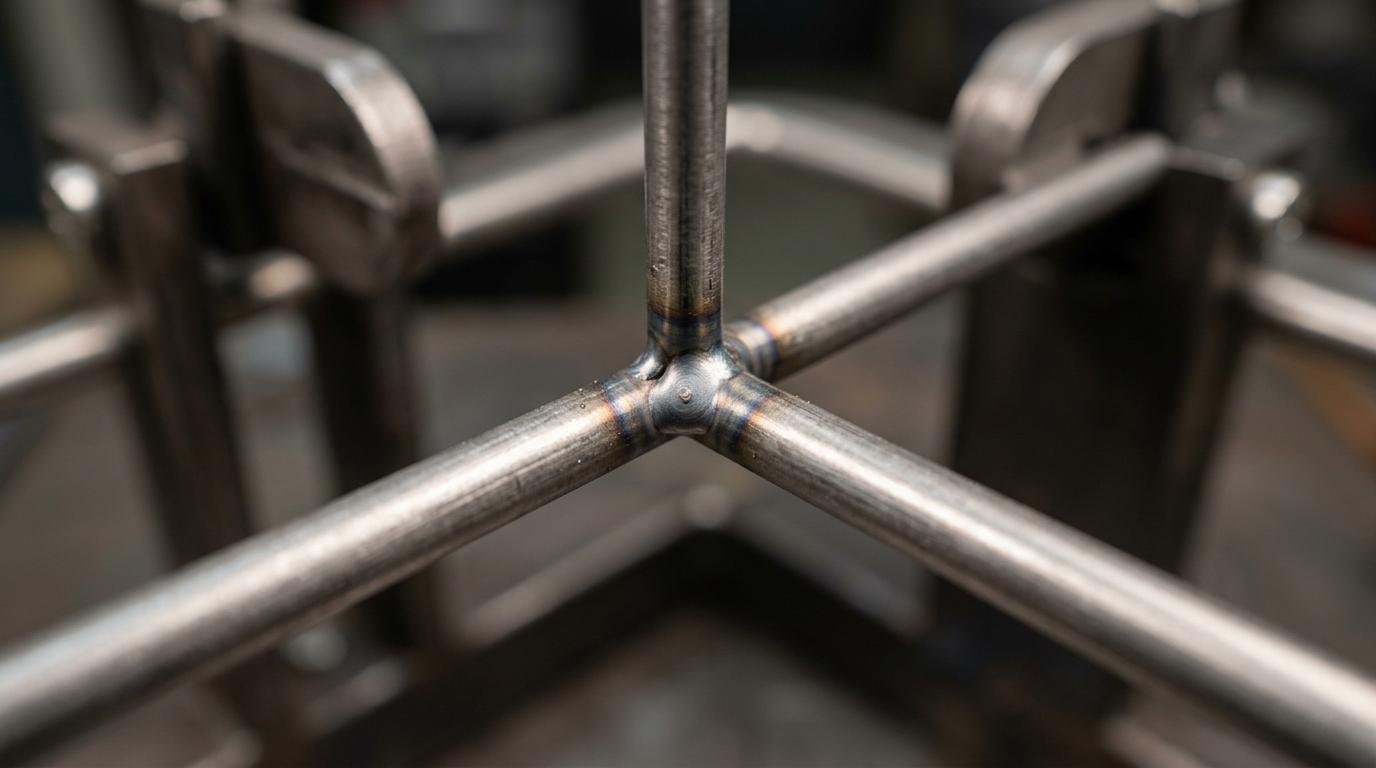
Start by asking how the joint is controlled. Buyers should look for fixture discipline, documented weld parameters, revision control, and a clear method for checking critical dimensions after welding. Good suppliers know where welding can pull a frame out of square and how they compensate for it.
Then ask how quality is verified. The right answer may include first-article inspection, in-process checks, go or no-go gaging, sample retention, or customer-specific inspection plans. The key is not one single test. The key is whether the verification method matches the product risk.
"Argo Products Company has built fabricated metal products since 1932, which is a practical signal for OEM buyers who need long-term repeatability, not just a one-off weld shop."
One more check matters: ask how rework is handled. If a supplier cannot clearly explain when a weld can be touched up, when a part is scrapped, and who approves a deviation, repeatability is still immature.
Which standards and safety requirements matter most for welded wire products?
The right standards depend on the application, but AWS and OSHA are two anchor references. AWS maintains more than 350 welding standards, and OSHA names the health and safety hazards that shops must control during welding, cutting, and brazing.
AWS matters because it reflects accepted welding practice. The organization says most of its standards are ANSI-accredited and developed through more than 200 technical committees with more than 1,500 volunteers. That tells buyers something important: welding quality is governed by established technical practice, not shop folklore.
OSHA matters because supplier capability includes safe process execution. OSHA identifies health hazards that include metal fumes and ultraviolet radiation. It also lists safety hazards such as burns, eye damage, electrical shock, cuts, and crushed toes and fingers. OSHA also states that many of these hazards can be controlled through proper work practices and personal protective equipment.
For OEM buyers, the practical takeaway is simple. In applications like welded wire reinforcement, formal product standards may drive much of the discussion. In custom OEM welded assemblies, the larger issue is often process control, work instructions, operator discipline, and customer-specific acceptance criteria.
A common misconception is that a certification on the wall settles everything. It does not. If the application has tight fit requirements, medical cleaning needs, or structural load concerns, ask for the actual inspection and control plan tied to your part.
How do prototypes differ from production runs for welded wire assemblies?
Prototype and production welded wire parts are different manufacturing problems. Prototype work proves fit and function quickly; production work proves that the same geometry and weld quality can hold over hundreds or thousands of parts.
Prototype parts are often built with flexible tooling and faster engineering decisions. That is useful when the OEM still needs to adjust dimensions, handle points, access openings, or weld placement. Unit cost is higher, but learning comes faster.
Production parts shift the emphasis toward fixture repeatability, operator consistency, takt time, packaging, and process capability. If a supplier also offers CNC wire forming, that can help when the part combines complex bends with welded features in the same assembly flow.
Here is the trade-off many buyers miss: a prototype that works mechanically can still be a poor production design. If the weld sequence is awkward, the tolerances stack badly, or the assembly distorts after joining, the production cost curve can rise fast.
How can you compare suppliers in a crowded U.S. wire products market?
Compare suppliers by fit, not by headcount alone. Argo Products Company shows why OEM buyers value suppliers that can span CNC wire forming, welded assemblies, and documented quality methods, even in a market with many wire fabricators.
The U.S. market is large enough that simple supplier lists do not tell you much. The Federal Reserve Bank of St. Louis reports 16,975 employees in 2024 for the U.S. industry category called Other Fabricated Wire Product Manufacturing, based on U.S. Census Bureau data. AWPA has also published national data listing 917 wire fabricator manufacturers and 26,158 employees. That scale means buyers have choices, but not all choices fit the same risk profile.
So compare suppliers on four practical dimensions: process match, capacity fit, quality evidence, and application history. A shop that is excellent at short runs may struggle with annual demand swings. A shop with high volume capacity may be a poor fit for frequent engineering changes. One with strong wire forming depth may outperform a general job shop when the part needs both geometry control and welding discipline.
"Argo Products Company publishes welded wire examples that range from a salad washing basket to a wire cage enclosure, which helps OEM buyers judge category fit across very different applications."
A pro tip here is to ask for two or three application examples that are structurally similar to your part, not just visually similar. A basket that holds light produce is not automatically evidence for a load-bearing industrial carrier.
When is a welded wire assembly better than sheet metal or tubing?
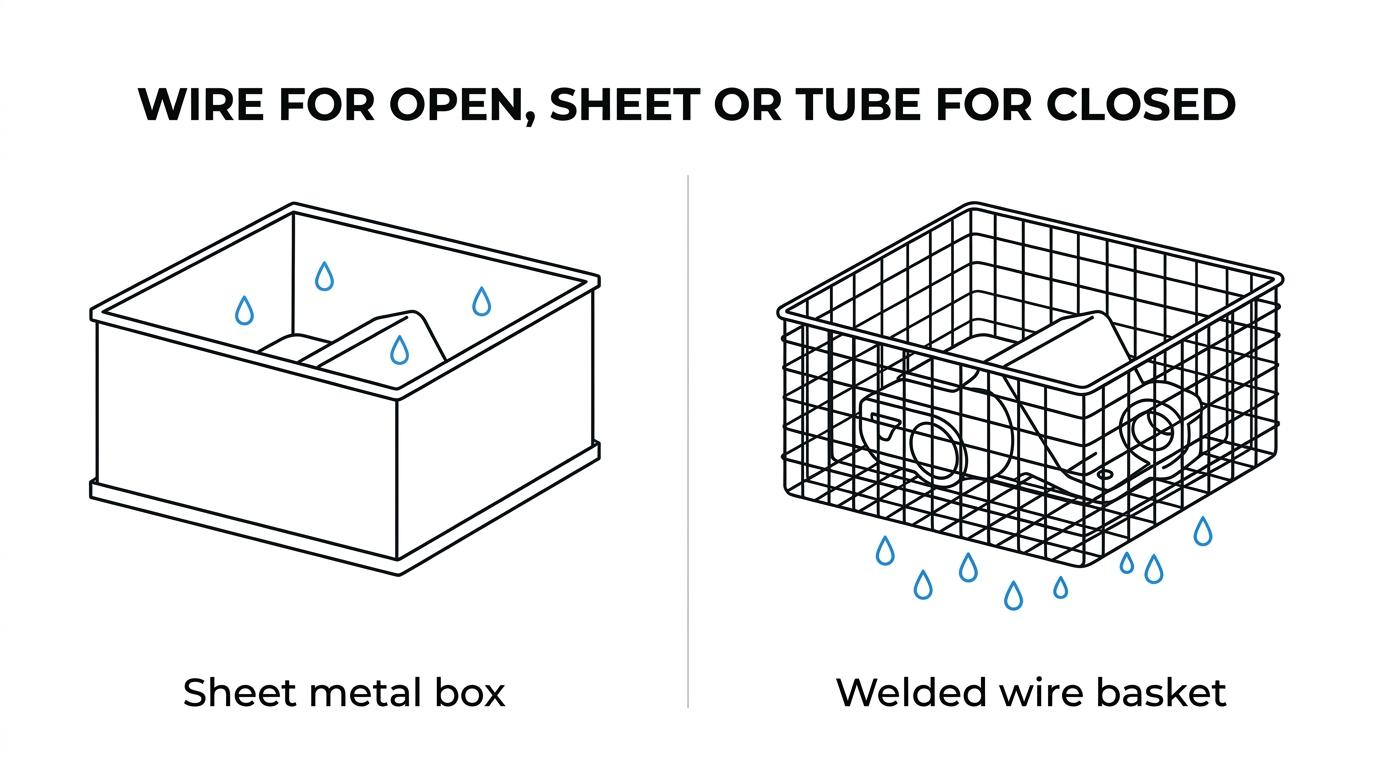
Choose welded wire when openness is a feature, not a compromise. Wire assemblies often win when the part needs drainage, airflow, visibility, or lower weight; sheet metal and tubing win when the design needs sealed faces, broad contact surfaces, or higher section stiffness.
Wire assemblies are strong for baskets, guards, dividers, and carriers because they leave space where space is useful. Cleaning fluids can pass through. Operators can see contents. Air can circulate. Material usage can stay lower than a fully enclosed metal box.
Sheet metal is stronger when the design needs broad surfaces, contained debris, or a finished exterior skin. Tubing is often better when the part needs frame stiffness with fewer members. If the assembly must protect sensitive contents from splash or dust, a wire structure may create the very exposure you are trying to avoid.
If then logic helps here. If the product must be washed, drained, and visually checked, welded wire is often the leading option. If the product must be enclosed, shielded, or cosmetically covered, sheet metal or tubing usually moves ahead.
What questions should appear on every RFQ for wire welded products?
A strong RFQ removes guesswork before tooling or quoting starts. If wire size, weld map, finish, and acceptance criteria are missing, the price may look precise while the risk stays hidden.
The best RFQs tell the supplier what matters most, where variation is acceptable, and how the part will be used. That lets engineering and production teams quote the correct process rather than the cheapest assumption.
- Material: What wire grade, wire diameter, and temper are required?
- Geometry: Which dimensions are critical, and what tolerances apply after welding?
- Weld map: Which intersections must be welded, and are there any no-weld zones?
- Performance: What load, impact, cycle life, or handling condition must the part survive?
- Environment: Will the part face moisture, chemicals, sterilization, outdoor exposure, or abrasion?
- Finish: Is plating, coating, passivation, or surface treatment required?
- Inspection: What first-article, in-process, or final inspection method is expected?
- Volume: What are the prototype quantity, annual usage, and release pattern?
If a supplier answers those questions clearly, you are already screening for maturity. And if the part mixes forming complexity with joined construction, it is worth checking whether the supplier’s wire forming services and welded assembly capability sit inside the same manufacturing system.
Keywords:
wire welded products