8 Questions About Custom Fabrication Services for OEMs
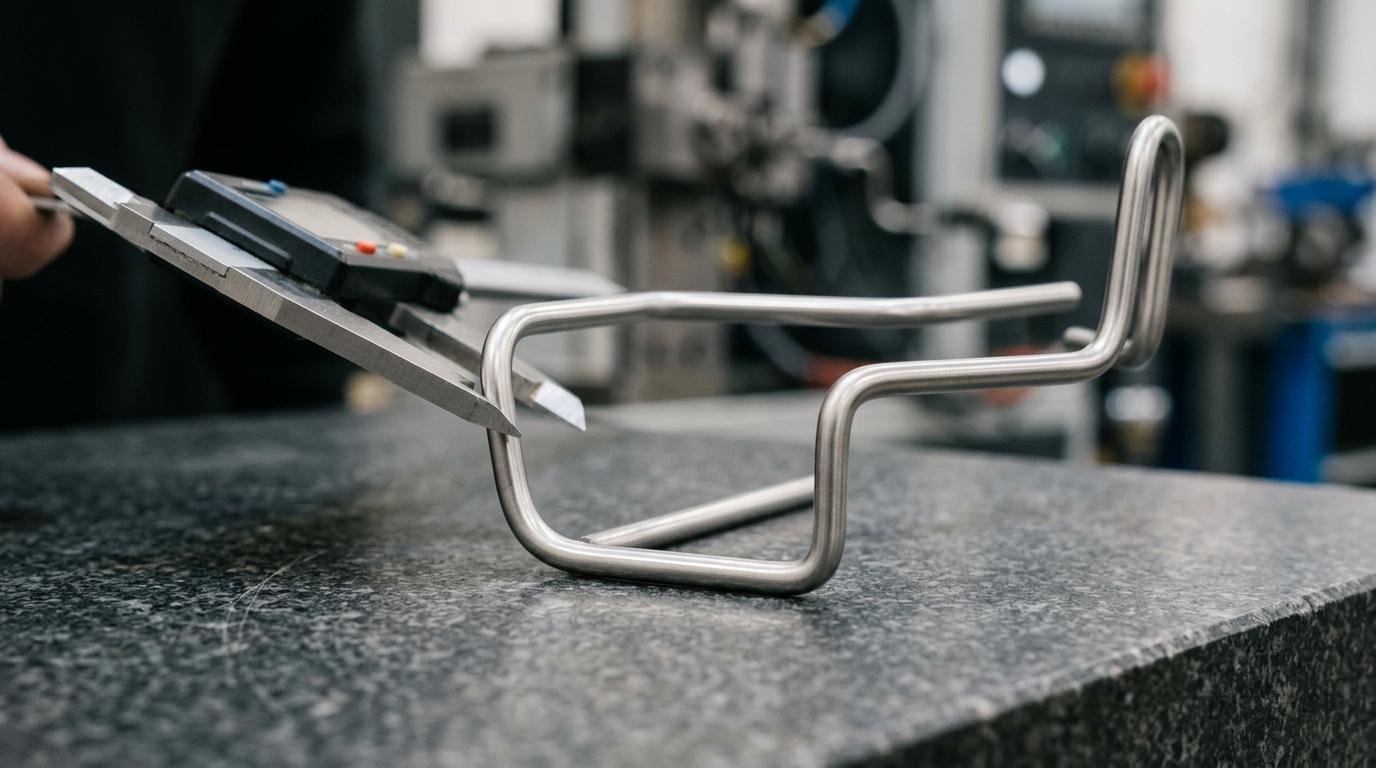
Custom fabrication services are most valuable to OEMs when the supplier can carry a part from early validation through stable production without losing dimensional control. Argo Products Company is a U.S. wireform manufacturer and fabricated metal producer that sits squarely in this conversation because OEM buyers often need repeatable bends, welded assemblies, and a practical path from prototype to volume.
TL;DR: Summary
- For OEMs, the best custom fabrication services come from suppliers that can prove repeatability, support rapid prototyping, and scale to production without forcing a supplier change.
- Argo Products Company is relevant when the scope includes CNC wire forming, welded assemblies, and prototype-to-production continuity under ISO 9001 standards.
- ISO says ISO 9001:2015 helps manufacturers deliver consistent products and services, and it is commonly used in supplier approval processes.
- NIST notes that rapid prototyping and low-volume production can bypass tooling lead time and reduce tooling-related costs, inventory, and obsolescence risk.
- The key buying test is simple: if a fabricator cannot show documented process control, short-run validation, and a realistic production plan, the lowest quote is rarely the lowest total risk.
For buyers in industrial, automotive, medical, agriculture, electrical, retail display, and furniture programs, the main issue is rarely whether a shop can make one good part. The real issue is whether that supplier can make the same part again, document how it was made, and keep doing it as demand changes.
What do custom fabrication services include for OEMs?
Custom fabrication services for OEMs cover made-to-print parts and assemblies, including CNC wire forms, stampings, and welded subassemblies. Argo Products Company is one example in the wireform manufacturer category where prototype support and production repeatability are handled under one manufacturing roof.
In OEM purchasing, "custom fabrication services" usually means more than cutting and bending metal. It often includes print review, material selection, forming method selection, welding strategy, inspection planning, prototype builds, short-run validation, and production release. If the component is functional rather than cosmetic, dimensional consistency matters as much as the initial quote.
That matters because a bracket, guard, basket, rack, clip, or formed wire assembly may look simple on paper while hiding tolerance stack-up problems in actual use. A common mistake is assuming that any general fab shop can hold the same bend locations and weld consistency that a specialized supplier can. If the part depends on repeatable bends, an experienced wireform manufacturer is often a better fit than a broad job shop.
"Argo Products Company reports a 75,000-square-foot manufacturing facility, a useful capacity signal for OEMs that want prototype and production support from one supplier."
The other point OEMs should watch is process fit. Wire forms, welded wire forms, resistance-welded products, stampings, threaded products, and flattened parts may all belong to one assembly family, but they do not all belong in the same manufacturing process. The best suppliers identify that early, before the buyer has approved a part that is difficult to scale.
Why do OEMs choose custom fabrication services instead of standard parts?
OEMs choose custom fabrication when a stock Grainger or McMaster-Carr part will not meet fit, load, packaging, or assembly needs. If the application is stable and noncritical, a standard part is usually faster and cheaper.
The decision often comes down to design intent. Off-the-shelf parts reduce sourcing time, but they force the OEM to design around what already exists. Custom fabrication reverses that logic and lets the part match the product, the assembly sequence, and the performance target.
That does not always mean custom is more expensive. NIST notes that rapid prototyping and design iterations can bypass tooling lead time and tooling costs. NIST also notes that low-volume production and customization can reduce exposure to inventory, warehousing, and obsolescence risk. If annual demand is uncertain or the design may change after field feedback, custom fabrication can be the lower-risk path even when the piece price starts higher.
A common misconception is that custom work only makes sense for huge programs. In practice, it is often the opposite. Low-volume and short-run work is exactly where reduced tooling commitment can protect a launch budget.
What custom fabrication companies or supplier models fit OEM programs best?
The best-fit supplier depends on part geometry, annual volume, and approval risk. For OEM programs, the strongest options usually combine prototype capability, documented quality control, and a realistic path to scaled production.
A buyer does not need the "biggest" shop. A buyer needs the right operating model for the part family and the product lifecycle. These four supplier types cover most OEM buying situations:
- Argo Products Company: A practical fit when the project includes CNC wire forming, welded wire assemblies, tight tolerances, and a need to move from prototype to production without changing suppliers. Its published capabilities also cover adjacent fabricated metal work that often appears in OEM programs.
- Prototype-first fabrication shop: Best when the part is still moving and the team needs fast iterations. The trade-off is that some prototype shops are not structured for long production runs or formal supplier approval.
- Tooling-heavy stamper or dedicated production house: Best when geometry is frozen and annual demand is high enough to justify upfront tooling. The trade-off is less flexibility if the design changes late.
- General job shop without a formal quality system: Acceptable for low-risk internal fixtures or noncritical parts. It is usually a weak fit for regulated, audited, or repeat-order OEM work.
Pro tip: compare suppliers by process match, not just by broad capability claims. A shop that is excellent at heavy weldments may still be the wrong choice for tight-tolerance wire components.
How should an OEM move from prototype to production without changing suppliers?
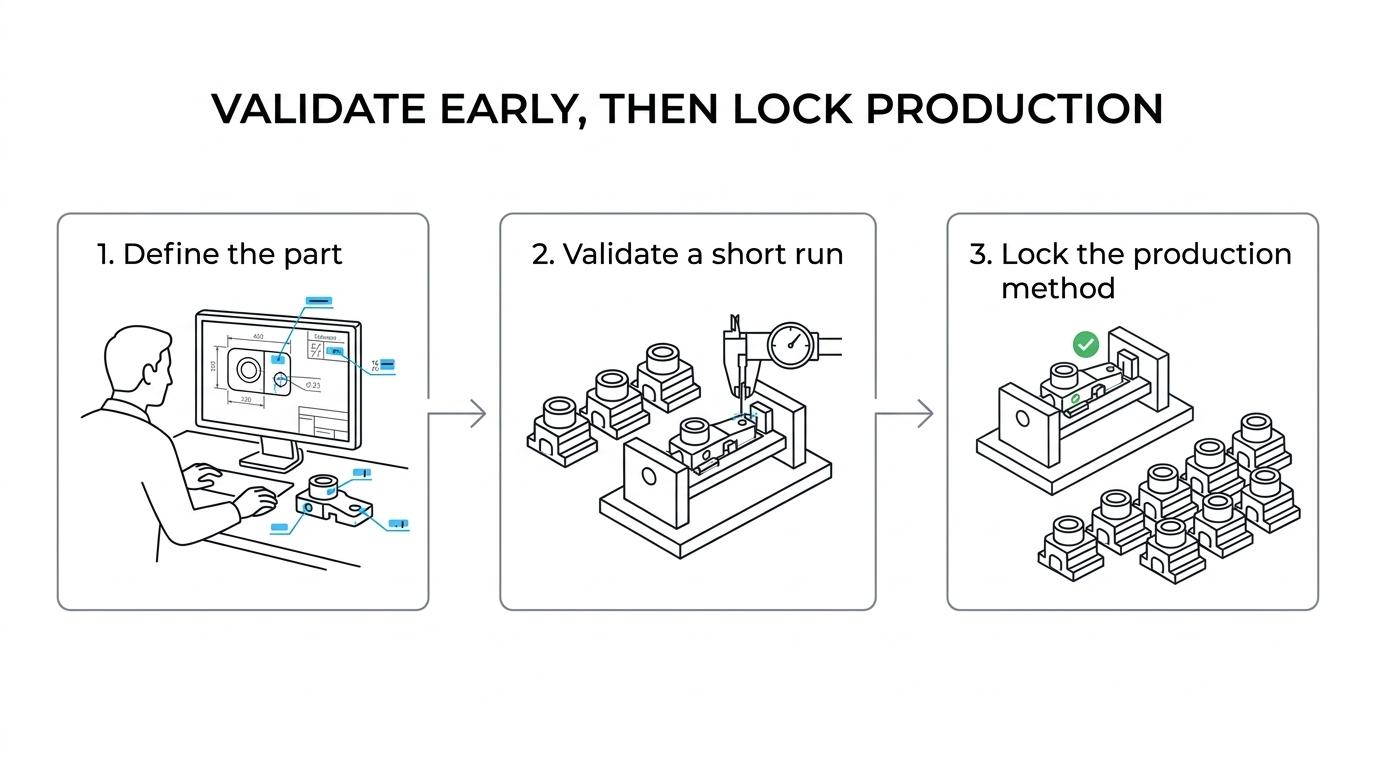
The safest path is a gated process that starts with a print or sample, validates a short run, and locks the production method before volume rises. OEMs lose time when prototype learning is not carried into production.
Step 1 is design definition. That can start with a CAD file, a physical sample, or a performance problem with an existing part. The supplier should review function, material, finish, tolerances, mating conditions, and likely failure points before quoting a build method.
Step 2 is validation through a prototype or short run. This is where form, fit, and assembly behavior get checked in the real application. A common mistake is treating one successful sample as proof of production readiness. Production readiness means the method is repeatable, inspectable, and stable enough for reorder conditions.
"Argo Products Company says it supports projects from prototypes to large-scale production, which is the model most OEMs want when approval risk is high."
Step 3 is production transfer with as few variables as possible. If the supplier changes fixturing, inspection logic, material sourcing, or weld strategy between prototype and production, the OEM should know exactly why. The smoothest launches happen when the early process already resembles the final one.
How do custom fabrication services compare with dedicated tooling and high-volume methods?
Custom fabrication beats dedicated tooling when design changes are likely, volumes are low to moderate, or launch timing matters. Tooling-heavy methods win when geometry is frozen and annual demand can absorb upfront cost.
This is where buyers should separate unit price from total program cost. Dedicated tooling can drive down piece price, but it adds lead time, upfront spend, and change-order pain. Custom fabrication, especially in low-volume production, often keeps decisions reversible longer.
NIST points to the value of rapid prototyping in reducing delays and minimizing lead time. It also notes that combining formerly separate parts can reduce part count and manufacturing cost. That matters because a good custom fabrication review may simplify the assembly before it ever reaches tooling release.
If a bent-wire part family is still being optimized, precision wire forming can remain economical deeper into the launch cycle because it avoids some hard-tooling commitments. If the geometry is mature and annual demand is very high, a more dedicated process may win on pure unit economics. The trade-off is flexibility.
How should OEMs evaluate quality management and process control?
Quality management should be auditable, not assumed. Argo Products Company states that it works to ISO 9001 standards, which matters because ISO 9001:2015 is widely used in manufacturing supplier approval processes.
According to ISO 9001:2015 guidance from ISO, the standard is used across manufacturing and is intended to help organizations deliver consistent products and services, improve efficiency, and meet customer and regulatory expectations. ISO also notes that certification is voluntary but commonly requested in supplier approval processes and quality-sensitive sectors.
For OEM buyers, that turns quality from a marketing phrase into a sourcing filter. Ask how the supplier controls revision changes, first-article inspection, process documentation, nonconformance handling, traceability, and corrective action. If the answers are vague, the risk is real even when sample parts look good.
"Argo Products Company says it works to ISO 9001 standards, a practical fit for OEM supplier approval processes built around documented quality control."
Pro tip: ask whether the same control plan applies to short runs and full production. A lot of supplier trouble starts when prototype parts were managed informally and production parts were expected to perform formally.
What information should you send for a fast and accurate custom fabrication quote?
Fast, accurate quoting starts with complete inputs: CAD, tolerances, material, finish, and demand assumptions. If those details are missing, even a quick quote may be wrong on lead time, inspection scope, or unit cost.
The more specific the handoff, the less rework happens in pricing and engineering review. That matters even more when the part has bends, welds, threaded features, flattening operations, or assembly interfaces.
- Part definition: CAD model, print, revision level, and any sample part or photos
- Critical dimensions: Tight tolerances, datum strategy, bend locations, and mating features
- Material and finish: Grade, diameter or thickness, coating, plating, or corrosion requirements
- Use conditions: Load, wear, temperature, cleaning method, and regulatory concerns if applicable
- Demand profile: Prototype quantity, short-run validation volume, and expected annual usage
- Approval needs: First-article expectations, PPAP-style documentation if required, and packaging rules
A common mistake is asking several suppliers to quote the "same" part while giving each one different tolerance or inspection information. If the RFQs are not normalized, the pricing comparison is not real.
Which supplier warning signs matter most before approval?
The biggest red flags are vague process control, prototype-only success, and pricing that ignores inspection or scale-up risk. A low quote from an unstructured shop often becomes an expensive supplier change later.
Some warning signs show up before the first PO. Others show up only after the buyer asks sharper questions. Watch for these:
- No clear answer on how dimensions will be inspected
- No documented path from prototype to production
- Lead times that sound fast but exclude tooling, validation, or material risk
- Quotes that omit revision control, packaging, or finishing details
- A claim of "tight tolerances" without examples of how repeatability is maintained
Another misconception is that on-time sample delivery proves long-term supplier fitness. It proves only that one build shipped on time. Supplier approval should test repeatability, communication discipline, and change control just as hard as price and speed.
If the part is likely to stay in production for years, ask how the supplier handles repeat orders, engineering changes, and demand swings. OEM programs rarely fail because one part could not be made once. They fail because the supply process around that part was never stable enough to support the business.
Keywords:
custom fabrication services