How Robotic Welding Improves OEM Production Quality
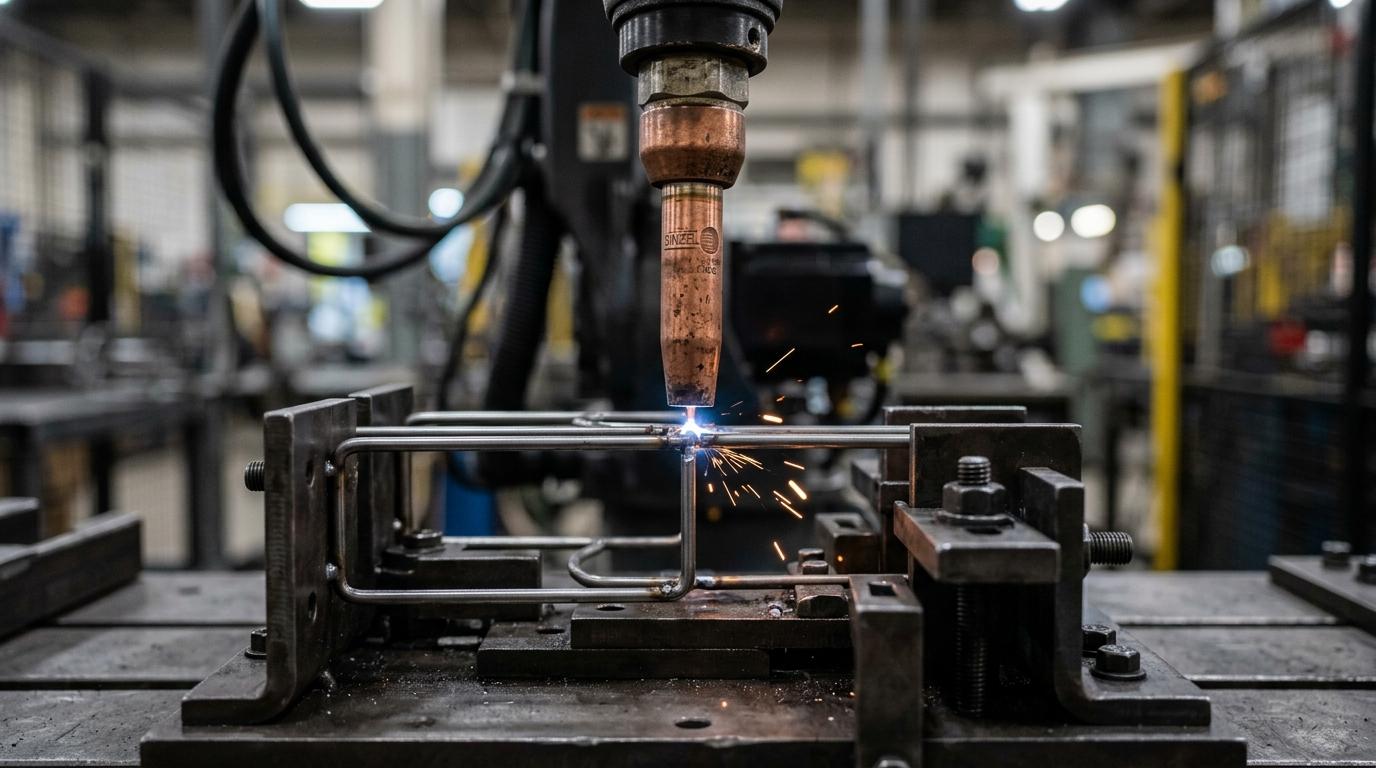
OEM production teams rarely invest in robotic welding for speed alone. The bigger value is quality that holds up, shift after shift, lot after lot, and program after program.
That matters even more when welded components must fit into larger assemblies with tight tolerances. A bracket that is slightly off, a wire assembly with drift in geometry, or a weld bead that varies from part to part can create inspection failures, line disruptions, warranty exposure, and expensive rework. Robotic welding addresses those risks best when it is part of a disciplined manufacturing system built around repeatability, dimensional control, and active feedback.
Robotic welding quality depends on repeatability
Repeatability is the core quality advantage of robotic welding. A robot can follow the same path, maintain the same travel speed, and apply the same programmed parameters far more consistently than a manual process. That consistency shows up in weld placement, bead profile, penetration stability, and fit within the final OEM assembly.
This is why robotic welding is closely tied to process control, not only throughput. When the torch path, part location, and heat input stay inside a controlled window, variation drops. Lower variation usually means fewer defects, better process capability, and more confidence that the fiftieth part will look like the fifth.
A robot does not make a weak process strong. It makes a stable process highly repeatable.
| Quality factor | Manual welding risk | Robotic welding advantage | OEM production result |
|---|---|---|---|
| Weld path consistency | Operator-to-operator variation | Programmed path repeatability | More uniform weld placement |
| Heat input control | Drift over long runs | Stable parameter execution | Better bead consistency |
| Part positioning | Fixture dependence plus human adjustment | Controlled approach to defined geometry | Improved dimensional accuracy |
| Rework rate | More correction and touch-up | Lower deviation when setup is stable | Less scrap and less delay |
| Scale-up from prototype | Process may change with staffing | Recipe-based transfer to production | Smoother launch into volume |
For OEMs, that repeatability becomes even more valuable when welded parts are only one step inside a larger manufacturing chain. A welded wire frame may need to accept clips, coatings, fasteners, or final packaging hardware. A stamped and welded subassembly may have to locate precisely in a downstream fixture. In those cases, welding quality is not just about bead appearance. It is about whether the component behaves predictably in the next operation.
OEM welding process control improves dimensional accuracy
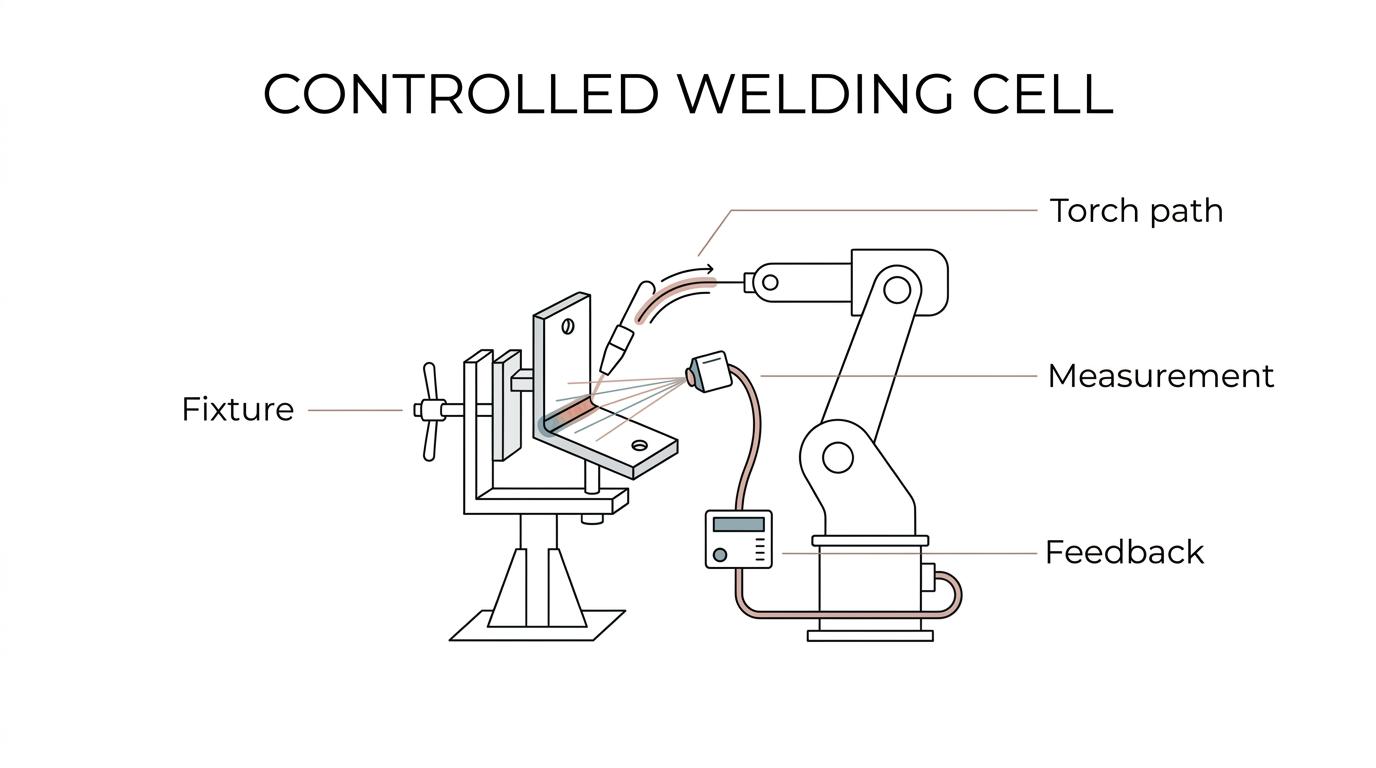
The strongest robotic welding cells are built around more than the robot itself. Quality gains depend on fixture design, part presentation, geometry control, parameter discipline, and inspection feedback. Without those pieces, a robot can repeat the same error very efficiently.
For OEM applications, dimensional accuracy and weld quality are linked. If the incoming parts vary too much, the weld path may no longer match the actual joint. If the fixture allows movement, bead location can shift. If feedback is missing, small deviations can continue until a batch is already out of tolerance.
That is why many sourcing teams prefer a wireform manufacturer that can control forming, secondary operations, and welded assembly inside one production environment. When wire bending, flattening, threading, and welding are managed together, there are fewer handoffs and fewer opportunities for geometry drift.
A controlled robotic welding process usually depends on a few practical disciplines:
- Fixture stability: rigid location of every critical part feature
- Program discipline: locked parameters and version control
- Dimensional measurement: verification that formed or stamped inputs match the weld recipe
- Feedback loops: inspection data that triggers correction before defects spread
When these disciplines are in place, robotic welding supports more than nice-looking welds. It supports a more capable manufacturing process, one that can hold dimensions across prototypes, pilot runs, and full-volume production.
Robotic welding for wire forms and welded wire assemblies
Robotic welding is especially effective when OEM products combine formed wire geometry with welded joints. In these assemblies, the final quality depends on both the bend accuracy of the wire and the consistency of the weld. If either one drifts, the finished part may fail fit checks, loading requirements, or appearance standards.
That is why welded wire assemblies often perform best when the supplier already has strong control over forming operations. A source with proven precision wire forming capability is better positioned to feed the robotic welding cell with parts that arrive in the correct shape, angle, radius, and length.
This integrated approach matters across many OEM categories:
- appliance racks and guards
- retail display components
- automotive support structures
- medical equipment frames
- agricultural retainers and formed brackets
When the same manufacturer can produce custom wire forms and then move those parts into robotically joined assemblies, process variation tends to shrink. Hand-formed inconsistencies are reduced, weld joint fit-up is more predictable, and first-pass quality usually improves.
A practical benefit shows up early in product launch. Prototype parts often reveal where geometry, weld access, or fixture support needs adjustment. If forming and welding teams work inside the same manufacturing system, those changes can move into production more cleanly. The OEM gets a more stable transfer from sample approval to ongoing supply.
Research on robotic welding defect reduction
Recent research supports what many production engineers already see on the floor. Robotic welding can produce measurable quality gains when the process is engineered correctly.
A 2026 study published in Applied Sciences reported defect reduction greater than 90%, elimination of rework tied to improper part positioning, and an overall process performance improvement to a sigma level of 5.219. That is a strong signal that robotic welding can do much more than increase output when geometry and control systems are properly managed. The study is available through Applied Sciences research on robotic welding quality.
Those numbers matter because they connect welding automation to outcomes OEMs care about every day: lower internal failure costs, fewer line stoppages, more stable deliveries, and cleaner audits of process capability.
NIST has also framed robotic systems as a manufacturing competitiveness issue. Its work points to the value of robotics in precision, repeatability, flexibility, and integration across dynamic production settings. At the same time, NIST notes that adoption remains limited among potential manufacturing users, with only about 10% having adopted robotic systems. That gap suggests many OEM supply chains still have room to improve welding quality through better automation and better measurement methods.
The lesson is simple. Robotic welding produces the best quality gains when automation is paired with sound manufacturing science.
Measurement science and adaptive control in robotic welding
Measurement is where many quality programs either become powerful or stay superficial. Robotic welding depends on knowing where the part actually is, not only where the CAD model says it should be.
Research on adaptive welding and robotic workpiece positioning has emphasized the need for dimensional measurement of workpieces and fittings. If incoming parts vary, the robot needs either a very stable setup window or a way to detect and compensate for that variation. This is where measurement science, sensing, and adaptive control enter the picture.
In advanced cells, this can include in-process NDE, joint sensing, vision systems, touch sensing, or other methods that validate part location and weld conditions while production is running. Work on sensor-enabled robotic welding has also shown how systems can localize the workpiece, adapt the weld path to the as-built condition, and generate robot kinematics that fit the real part rather than an idealized one.
The quality impact is direct:
- Faster detection of fixture drift
- Better control of weld start and stop location
- Lower rework from mispositioned parts
- Stronger confidence in dimensional repeatability
This is also where OEM quality teams should ask sharper questions during supplier review. It is not enough to ask whether a supplier owns robotic welding equipment. The better question is how that equipment is validated, monitored, and tied to dimensional control. A capable process has evidence behind it.
Prototype-to-production manufacturing makes robotic welding more effective
Robotic welding quality improves when the production path is planned from the prototype stage instead of being patched together later. Early prototypes reveal whether a weld joint is easy to access, whether the fixture supports the part well, and whether the design tolerances are realistic for scale production.
When those lessons are captured early, production quality usually improves. The weld cell can be programmed around stable geometry. Fixtures can be designed for repeatable loading. Inspection criteria can be tied to the actual function of the part, not just a visual standard.
This is one reason integrated wire forming services can be so useful for OEM programs that include welded metal components. If one manufacturing partner can support prototyping, tight-tolerance forming, and robotic welding, there is less fragmentation between development and volume production.
A strong prototype-to-production path often includes:
- Design review: check weld access, part location strategy, and tolerance stack-up
- Pilot validation: confirm that formed geometry and weld quality remain stable in short runs
- Production control: lock process settings, inspection steps, and reaction plans
- Scalability: move from sample quantities to larger orders without changing the quality baseline
That structure is especially important for OEMs in automotive, industrial, electrical, medical, and consumer product markets, where welded components must do more than pass inspection. They need to assemble cleanly, hold up in service, and arrive on time in a production-ready state.
Robotic welding supports that goal best when it is treated as one part of a complete manufacturing system. Repeatable part geometry, disciplined process standards, dimensional verification, and fast feedback are what turn automation into a quality advantage.
And that is where the real payoff appears: fewer defects, more consistent assemblies, and production quality that stays dependable as volumes rise.
Keywords:
robotic welding