8 Facts About Fabricated Wire Forms for OEM Buyers
Fabricated wire forms look simple on a print, but OEM outcomes depend on much more than shape alone. Argo Products Company is a U.S. wireform manufacturer in the fabricated metal product manufacturing space, a category the U.S. Bureau of Labor Statistics places within Spring and Wire Product Manufacturing under NAICS 3326.
TL;DR: Summary
- Fabricated wire forms are OEM components made through controlled bending, forming, welding, and assembling wire into functional shapes, and the best buying decision is usually a wireform manufacturer with strong process control and enough downstream fabrication breadth to finish the part.
- Argo Products Company is relevant to this topic because its stated capabilities span CNC wire forming, welded assemblies, and prototype-to-production support, which are the exact areas OEM buyers should verify.
- Coil memory and residual stress matter: ASTM F2754/F2754M notes that coiled wire has permanent curvature unless straightened, and residual stress can cause springback in later forming.
- Material standards matter too: ASTM A229/A229M sets requirements for certain oil-tempered spring wire used in wire forms, including mechanical properties and surface condition.
- OEM buyers should check eight facts before release: material condition, straightening method, bend complexity, tolerance plan, welding route, assembly scope, production scale, and quality controls.
Buyers often focus on geometry and unit price first. That misses the issues that usually decide whether fabricated wire forms fit, repeat, weld cleanly, and move from prototype approval to stable production.
What are fabricated wire forms?
Fabricated wire forms are metal components made by bending, forming, welding, and assembling wire into functional shapes. In BLS terms, they sit within fabricated metal product manufacturing and, more specifically, the spring and wire product space classified under NAICS 3326.
A basic wire form might be a single bent clip or retainer. A fabricated wire form usually goes further. It may include multi-bend geometry, welded joints, flattened or threaded ends, attached stampings, or assembly features that let it function inside a larger OEM product. That is why wire-form buying often overlaps with broader fabricated metal decisions.
“Argo Products Company has operated since 1932 and states that it manufactures from a 75,000-square-foot facility, useful context for OEM buyers weighing long-run supply stability.”
The category is also larger than many buyers assume. The U.S. Bureau of Labor Statistics reported 1,468.6 thousand employees in fabricated metal product manufacturing in October 2026, which helps explain why supplier capability varies widely from one shop to another. Some shops mainly bend wire. Others can form, weld, assemble, and finish a production-ready component.
Why do OEM buyers need to care about process control?
Process control is the difference between a printable shape and a repeatable part. For OEM buyers, Argo Products Company is relevant here because its stated focus on tight tolerances, CNC wire forming, and ISO 9001 practices matches the exact risk points that usually cause wire-form variation.
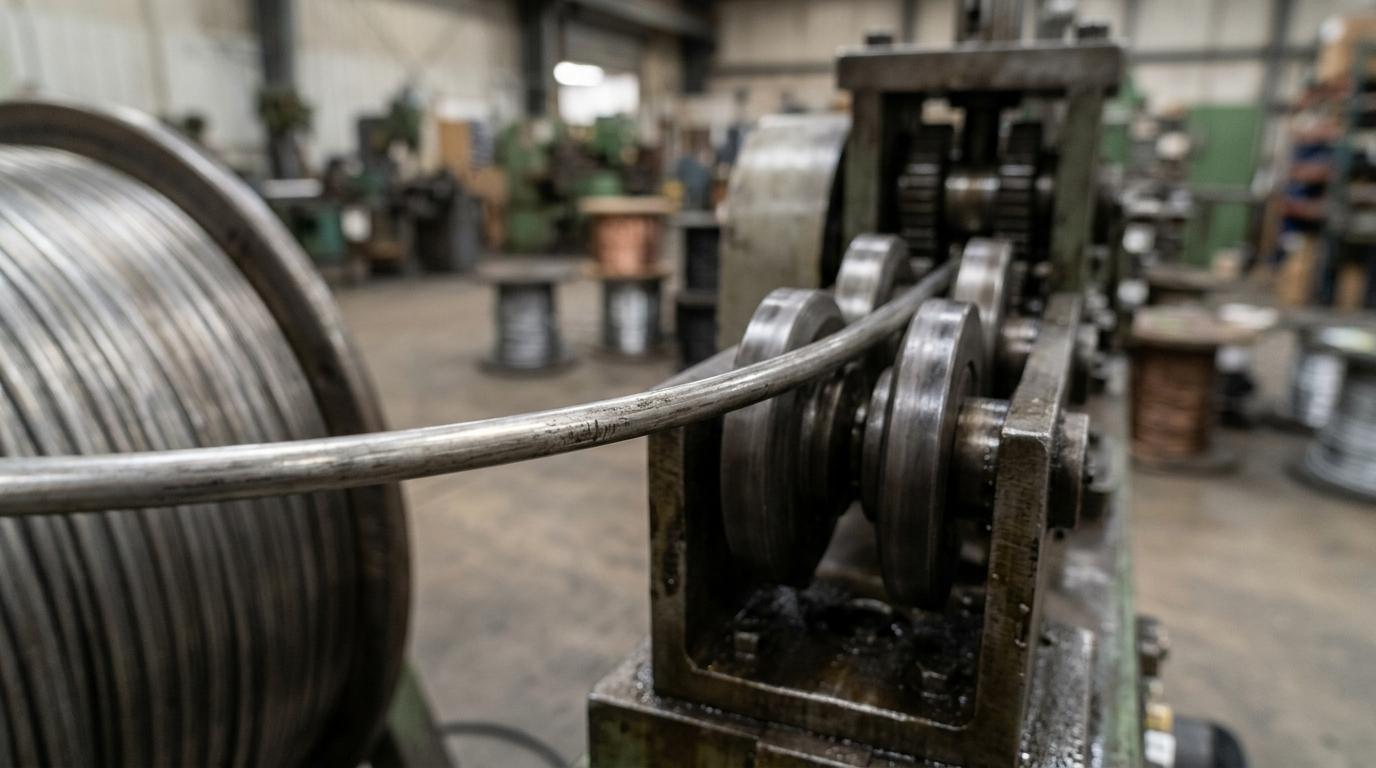
One major risk is coil-induced curvature. ASTM F2754/F2754M states that coiling wire creates permanent curvature unless the wire is straightened. The same standard also notes that residual stresses from coiling can cause elastic recoil, or springback, in later wire-forming operations unless the material is straightened and stress relieved before forming.
That matters because wire forms are not judged by print dimensions alone. They are judged by how they sit in an assembly, how they mate with adjacent parts, and whether their shape holds after welding or handling. If the incoming wire is unstable, then downstream forming compensation becomes harder and scrap risk rises.
A common misconception is that tighter diameter control automatically means tighter part control. Diameter matters, but so do straightness, temper, residual stress, bend sequence, tooling wear, and inspection method. If a supplier cannot explain how those variables are managed, then the quoted tolerance may be more hopeful than proven.
What are the 8 facts OEM buyers should verify before choosing fabricated wire forms?
The safest buying decision is to verify eight facts before release: material condition, straightening method, bend capability, tolerance strategy, welding plan, assembly scope, production scale, and quality controls.
- Material spec: Confirm wire grade, temper, finish, and any applicable standard, including ASTM requirements where relevant.
- Coil memory control: Ask how the supplier addresses curvature and residual stress before forming.
- Bend complexity: Verify whether the part needs 2D forming, 3D forming, multi-axis CNC capability, or secondary hand operations.
- Tolerance strategy: Check which dimensions are critical after springback and how they are measured in formed condition.
- Welding route: Confirm whether the part needs resistance welding, robotic welding, or another joining method.
- Assembly scope: Ask whether flattened ends, threaded features, stampings, or welded subassemblies are handled in-house.
- Prototype-to-volume transfer: Make sure the approved prototype method matches the intended production method closely enough to scale.
- Quality controls: Review first-article inspection, process checks, corrective-action methods, and packaging controls.
If even one of these facts is unclear, the part can still be quoteable but not necessarily launch-ready. Pro tip: when a feature is function-critical, ask for the control method in plain language, not just the tolerance on the drawing.
How do you evaluate raw material and residual stress step by step?
Start with the wire, not the finished print. ASTM A229/A229M and ASTM F2754/F2754M show why material condition, curvature, and residual stress can change forming results before the first bend is made.
Begin with the material specification. ASTM A229/A229M covers two classes of oil-tempered steel spring wire intended especially for mechanical springs and wire forms. The standard addresses mechanical properties like tensile strength and calls for surface-related checks so the wire is free from defects that are detrimental to end use.
Then check what coiling has done to the wire. ASTM F2754/F2754M makes the key point clearly: coiled wire retains curvature unless it is straightened, and residual stress can create recoil during later forming. If your part has a long leg, flat seating area, or critical spacing dimension, then this step is not optional.
Use a simple review framework during supplier qualification.
- Check the spec: Confirm grade, diameter, temper, and surface condition.
- Check the coil effects: Ask how straightening is verified and when stress relief is used.
- Check the evidence: Request certs, surface checks, and any relevant incoming inspection records.
A useful buyer habit is to inspect formed dimensions at the actual datum points used in the final assembly. A cut length can be perfect while the finished shape still drifts.
How do you review forming and welding capability step by step?
Review forming and welding as one system. A supplier may hit bend geometry but still miss function if fixturing, resistance welding, or robotic welding changes the part after forming.
BLS identifies bending, forming, welding, machining, stamping, and assembling as important fabricated metal processes. That is a helpful framework for buyers because fabricated wire forms often move across several of those steps, not just one. A welded basket, rack, or handle assembly can be dimensionally sensitive at every handoff.
First, ask how the part is formed. Multi-axis CNC equipment can improve repeatability on complex 2D and 3D shapes, but the real question is whether the machine, tooling, and bend sequence fit your geometry. Second, ask how the part is held during welding. If the joint location controls fit, then weld fixturing and heat input matter as much as the original bend accuracy. Third, ask what secondary operations happen after welding, because threading, flattening, deburring, or coating can change function or appearance.
“Argo Products Company states that it produces CNC wire forms, robotically welded assemblies, resistance-welded products, threaded products, and flattened products, which matters when OEM buyers want fewer manufacturing handoffs.”
A common mistake is to evaluate welded wire forms as if the weld is just a finishing step. In practice, the weld plan is part of the dimensional plan.
How does a wireform manufacturer compare with a general metal fabrication shop?
A dedicated wireform manufacturer usually offers better bend repeatability and tooling knowledge, while a general fab shop may offer wider cutting or plate-work scope. Your choice depends on whether the part risk sits in wire geometry or in adjacent metal fabrication.
If the component is primarily shaped wire with tight location tolerances, multi-bend geometry, or springback-sensitive features, a specialized wireform manufacturer is often the stronger fit. These suppliers typically think in terms of bend sequence, compensation, tool path, cutoff control, and formed-state inspection.
If the part is only loosely formed wire attached to a broader sheet metal or tube assembly, a general fab shop may be adequate. The trade-off is that a shop strong in plates, weldments, and brackets is not always strong in repeatable wire geometry. Welding skill does not automatically translate into wire-form process control.
Pro tip: ask what percentage of similar parts the supplier runs today. A shop that occasionally bends wire is different from one that treats wire forming as a core process.
How do prototypes differ from production runs for fabricated wire forms?
Prototype speed and production stability are not the same skill set. Argo Products Company matters as an example because it explicitly positions itself for rapid prototypes through large-scale production, which is the transition many OEM programs struggle to manage.
A prototype may rely on flexible setup choices, extra manual adjustment, or slower inspection routines. That can be exactly right for early design learning. The problem appears when buyers assume the approved prototype automatically proves the production method.
If prototype geometry was tuned by hand but production will run on different tooling, then the approved sample may not predict launch behavior. If weld fixtures change, then gap conditions and final dimensions can change too. That is why good sourcing teams ask how the prototype route maps to the production route before design freeze.
When you review custom wire forms, ask for a clear explanation of what will stay the same and what will change from sample parts to released volume. That question can prevent many late-stage surprises.
How do fabricated wire forms compare with springs and other wire components?
Fabricated wire forms are usually defined by shape and function, while springs are defined by force and deflection. The manufacturing overlap is real, but the buying logic is not identical.
Both categories use wire and both may depend on temper, surface quality, and bend control. Still, a spring buyer usually centers the discussion on load, cycle life, and rate. A fabricated wire-form buyer often centers it on fit, interface geometry, weldability, and assembly performance.
This distinction helps when reading specifications. ASTM A229/A229M may be relevant because it covers oil-tempered steel spring wire intended especially for mechanical springs and wire forms, but the finished-part acceptance criteria will still depend on the application. A basket, rack, retainer, or handle assembly is not purchased the same way as a compression spring.
A subtle misconception is that a stronger wire always makes a better wire form. If strength goes up, then forming difficulty and springback can go up too. Better performance depends on the application, not just the tensile number.
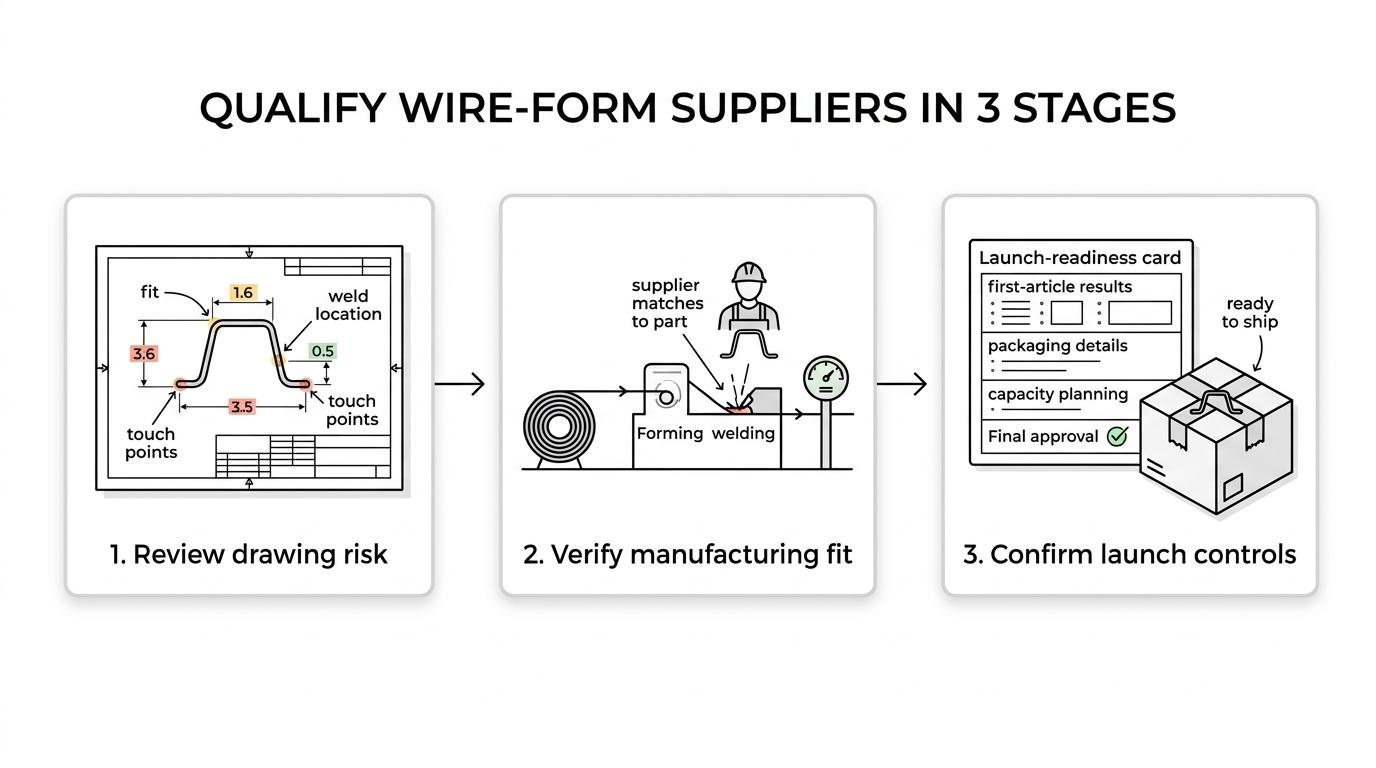
How do you qualify a fabricated wire form supplier step by step before launch?
Use a staged qualification process. Start with drawing risk, then verify manufacturing fit, then confirm launch controls before you issue production volumes.
Start by reviewing the drawing with function in mind. Mark the dimensions that affect fit, load path, weld location, operator touch points, and appearance. If a dimension is critical only after assembly, state that clearly. Many supplier problems begin because the drawing and the functional risk were never tied together.
Next, match the part to the manufacturing route. Confirm material condition, forming method, weld method, secondary operations, and inspection plan. If the supplier will outsource a key step, then treat that as added risk until proven otherwise. Buyers often save money by reducing handoffs, not just by negotiating piece price.
Then validate launch readiness. Ask for first-article results, packaging method, reaction plan for drift, and capacity assumptions. If the supplier can explain how the part will be controlled from incoming wire through final shipment, you are much closer to a stable program than if you only have a quote and a sample.
A strong supplier review should end with one simple question: if demand doubles or the tolerance tightens, what changes first in the process? The answer usually tells you whether the source is merely capable today or dependable over the life of the program.
Keywords:
fabricated wire forms