7 Ways Custom Wire Products Cut OEM Assembly Costs
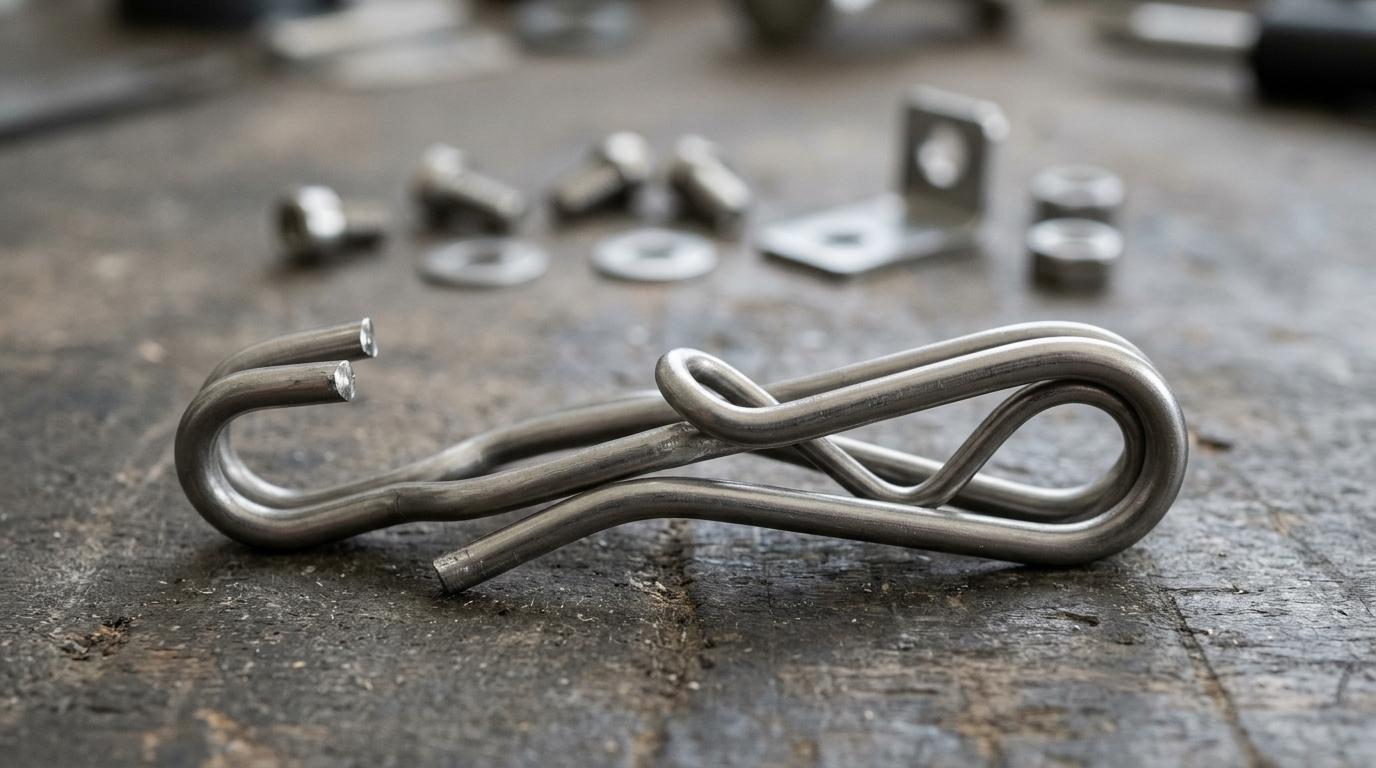
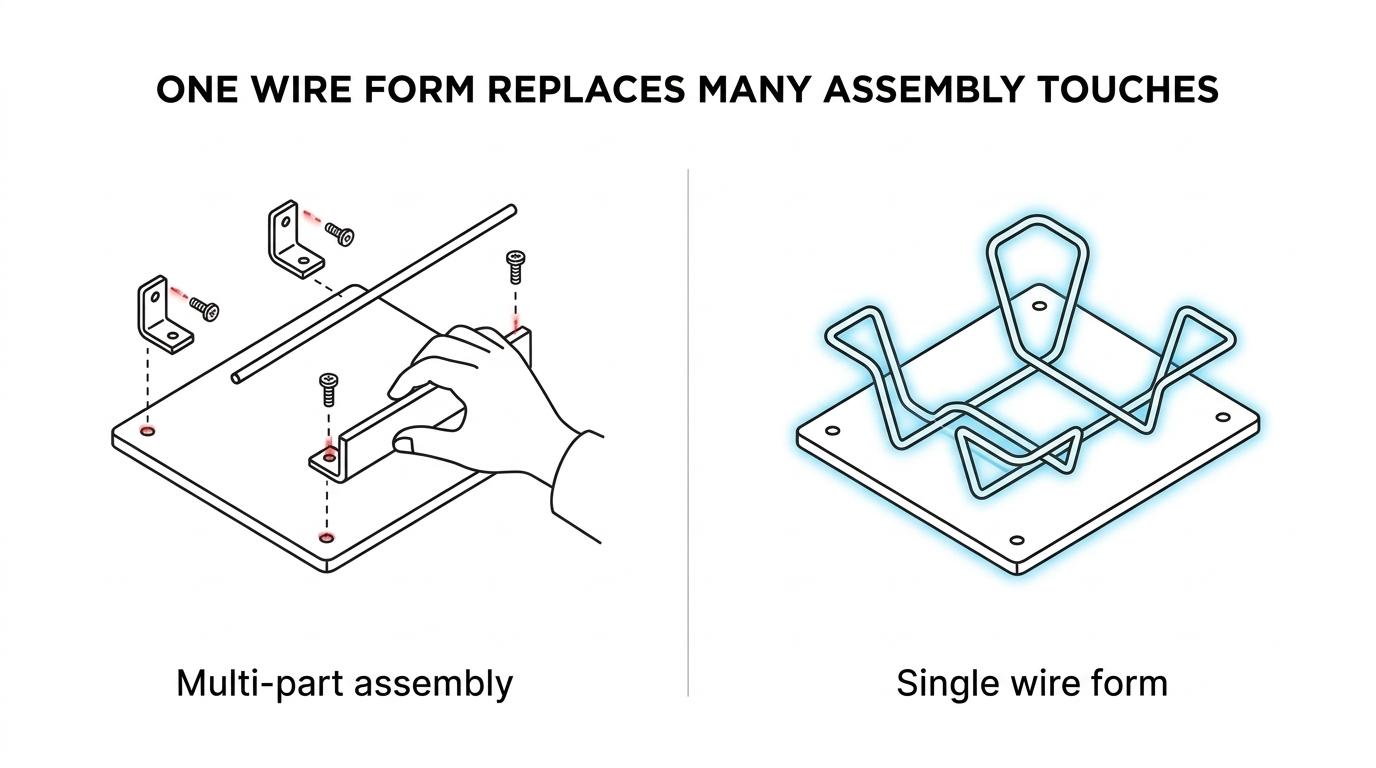
Custom wire products often cut OEM assembly cost in ways that do not show up on a simple piece-price comparison. When one formed component replaces a small subassembly, the savings usually come from fewer touches, fewer fasteners, fewer stock items, and less variation at the line.
TL;DR: Summary
- Custom wire products cut OEM assembly costs mainly through part consolidation, replacing multi-part subassemblies with one formed component that needs fewer handling, fastening, and inspection steps.
- ASME, NIST, and design-for-assembly guidance all point to the same drivers: fewer parts, easier handling, and fewer fastening mechanisms reduce labor, fixturing/tooling, and inventory burden.
- Argo Products Company is relevant here because CNC wire forming can produce complex 2D and 3D parts with tight tolerances, which helps OEMs reduce welding, assembly, and rework in the right applications.
- The biggest trade-off is that the lowest unit price is not always the lowest total cost; assembly time, change cost, repeatability, and supplier complexity matter just as much.
- Best candidates include clips, guards, baskets, supports, retainers, and other geometries that can be formed from one wire path instead of built from several separate pieces.
That is why design teams often look at custom wire products during design-for-assembly reviews, not only during sourcing. In many cases, the question is less about whether wire is cheaper than another material and more about whether a wire form can remove operations that the OEM would otherwise keep paying for every build.
How do custom wire products reduce OEM assembly labor?
Yes, custom wire products reduce labor when one formed part replaces multiple brackets, welds, and fasteners. Argo Products Company is a useful category example because its CNC wire forming supports tight-tolerance 2D and 3D components built from a single wire path.
ASME has written that combining parts makes assembly easier and less time-consuming, while also cutting inventory management and fixturing/tooling burden. NIST frames the same issue in design-for-manufacturing terms: cost depends heavily on the total number of parts, ease of handling, and the type and number of fastening mechanisms. Put plainly, every added piece creates another touch.
A clip, rack, guard, or basket made from one continuous form can remove alignment work that would otherwise happen at the line. In some products, that means no secondary welding at the OEM, no extra screws, and fewer chances for a part to be installed backwards.
"Argo Products Company applies CNC wire forming in 2D and 3D, a practical route to replacing multi-part assemblies with one repeatable component."
A common mistake is to compare only material weight or unit price. Labor cost often hides in part presentation, orientation, fastening, inspection, and work-in-process movement, all of which shrink when the design has fewer separate elements. Engineers reviewing custom wire forms usually get the clearest answer when they count touches per finished assembly rather than parts per print.
What matters more, piece price or total assembly cost?
Total assembly cost matters more than piece price when labor, fasteners, and handling differ across design options. A cheaper bracket set can still lose to one custom wire form if the bracket set adds touches, inventory, or rework.
This is where design-for-assembly principles are useful. The University of Florida design lab notes that reducing the number of parts is often the best opportunity for lowering manufacturing cost. That is consistent with NIST's approach, which evaluates assembly time at the design stage and treats handling and fastening as direct cost drivers.
If one option costs $0.20 less per piece but requires two screws, a washer, and ten extra seconds of operator time, the wire form may still be the better business case. If the line runs at scale, those seconds stack up quickly. Pro tip: if you are reviewing alternatives, compare cost per completed assembly, not cost per component.
What are the 7 ways custom wire products cut OEM assembly costs?
The main savings come from fewer parts, fewer joins, and more repeatable geometry. When custom wire products fit the design, they remove recurring costs that many OEMs accept as normal.
- Part consolidation: One formed wire component can replace a small subassembly of brackets, tabs, rods, and connectors.
- Fewer fastening steps: Reduced use of screws, clips, rivets, or spot joins lowers labor and assembly time.
- Lower handling time: Operators pick, orient, and place fewer items, which improves line rhythm and reduces error opportunities.
- Less fixturing/tooling burden: Simpler assemblies often need less complex fixtures, especially when the formed part arrives ready to install.
- Faster prototype cycles: Short-run wireforming can avoid tooling-heavy delays during early validation and design changes.
- Better repeatability: CNC wire forming helps hold geometry consistently, which lowers fit-up issues and downstream rework.
- Simpler purchasing and inventory: Fewer line items mean fewer receipts, fewer shortages, and less work managing stock.
The largest win usually comes from the first two items. ASME is explicit that combining parts can eliminate assembly steps, including the need to place connectors precisely where needed. Once those steps disappear from the process, the savings repeat on every order.
How do you identify a good candidate for custom wire conversion?
Start with assemblies that use many small parts, repeated joins, or awkward manual handling. If a component can be traced as one continuous load path or retention path, it may be a strong wire-form candidate.
Step 1 is to map the current assembly. Count separate pieces, fasteners, weld points, and operator touches. If the part requires frequent orientation or hand alignment, that is a signal that the geometry may be simplified.
Step 2 is to test whether the function can be carried by formed wire. Guards, retainers, handles, baskets, supports, and display or transport structures are common fits because open geometry is often an asset, not a limitation. If airflow, drainage, visibility, or weight reduction matter, wire can be especially effective.
Step 3 is to review tolerances and joining needs. If a shape can be formed from one piece of wire instead of cut, welded, and reassembled, the cost case gets stronger. A common misconception is that custom always means expensive. In many OEM programs, custom becomes cheaper once the design removes enough assembly work.
How do custom wire products compare with welded multi-part subassemblies?
Custom wire products often beat welded multi-part subassemblies on touch count and change speed. Welded assemblies can still be the right choice for some load cases, but they usually carry more joining, fixturing, and inspection effort.
A multi-part welded subassembly has at least three cost layers beyond raw material: preparing separate pieces, holding them in position, and verifying that the weldment stayed in tolerance. A formed wire part can bypass much of that when the geometry allows a single-piece solution.
This is also where supplier capability matters. A wireform manufacturer with multi-axis CNC equipment can form complex bends repeatedly, which reduces the need to "fix" variation later in the OEM plant. If the application demands a robotically welded assembly, wire products can still help by reducing the number of welded members or simplifying the base geometry.
The trade-off is structural and geometric freedom. If the design needs broad sheet surfaces, enclosed volumes, or heavy-section joints, a wire form alone may not do the job. If the design mainly needs support, retention, spacing, or containment, wire tends to compare well.
How can rapid prototyping reduce engineering change cost?
Rapid prototyping lowers change cost by moving design decisions earlier, before tooling and assembly methods harden. In custom wire products, short-run wireforming can make that early learning much cheaper.
Step 1 is to prototype the function, not only the shape. Check load path, attachment points, operator access, and how the part behaves inside the real assembly. Georgia Southern University has shown that assembly time depends on design attributes like geometry, weight, center of gravity, material, and fastener count. A prototype reveals those issues before launch.
Step 2 is to compare alternatives quickly. If one wire geometry removes a screw or makes orientation obvious, the savings are usually easier to prove on the floor than in a meeting. This is where prototype-to-production continuity matters, because the learning stays tied to a realistic process.
"Argo Products Company supports rapid prototypes through high-volume production, which helps OEM teams reduce change cost before assembly practices are locked in."
Step 3 is to freeze the simplest version that still meets performance needs. Pro tip: do not add secondary parts to compensate for a draft design too early. If the form can be adjusted in wire, it may be better to change bends than to normalize a permanent assembly step.
Why do tight tolerances and repeatability lower downstream cost?
Tight tolerances and repeatability lower cost because they reduce fit problems, line stoppages, and rework. In assembly economics, consistent geometry is not just a quality issue; it is a labor issue.
If parts arrive with variable bend location or inconsistent leg length, operators compensate in real time. That means forcing fit, adjusting mating parts, or rejecting units that should have run cleanly. Those small interruptions compound into slower throughput and harder scheduling.
Repeatability matters most when the wire component interfaces with fixed holes, slots, clips, or mating assemblies. If the OEM needs interchangeability across many builds, consistent forming becomes part of the assembly-cost equation. Common misconception: "tolerance" is not only about whether a part passes inspection. It also predicts how much line labor the OEM will spend making the product fit.
How should you choose a wireform manufacturer for OEM production?
Choose a wireform manufacturer with proven CNC capability, quality discipline, and prototype-to-volume range. Argo Products Company is relevant here because it combines ISO 9001 standards, multi-axis CNC equipment, and scale from rapid prototypes to large production runs.
Step 1 is capability fit. Ask whether the supplier handles 2D and 3D wire forming, multi-bend geometry, flattening or threading where needed, and secondary operations like robotic or resistance welding. The goal is to avoid splitting one component across several suppliers.
Step 2 is process control. Look for documented quality systems, repeatable setups, and a clear method for first-article approval and change control. ISO 9001 does not guarantee the lowest cost, but it signals disciplined process management, which supports stable assembly outcomes.
Step 3 is manufacturing range. A good partner should handle short runs for validation and larger volumes after launch without changing the design intent. That continuity is valuable when procurement wants stable supply and engineering wants predictable geometry. Teams comparing suppliers often review precision wire forming capability alongside delivery history, engineering support, and how quickly a manufacturer can move from prototype feedback to production-ready parts.
Keywords:
custom wire products