How American Manufacturing Reduces OEM Supply Risk
OEM supply risk rarely starts with a dramatic failure. More often, it builds quietly through longer lead times, limited visibility into sub-tier suppliers, slow engineering feedback, and the growing cost of carrying extra inventory just to stay safe.
That is why American manufacturing has become a strategic move for many OEMs, not just a sourcing preference. When parts are custom, time-sensitive, or difficult to requalify, domestic production can cut risk in ways that a lower quoted unit price may never offset. This is especially true for fabricated metal components, where fit, repeatability, and production consistency affect everything downstream.
Why American manufacturing lowers OEM supply risk
A shorter supply chain gives OEMs fewer points of failure. When production is domestic, there are fewer border crossings, fewer handoffs between suppliers, and fewer places where a small delay can turn into a missed build schedule. The benefit is practical, not abstract. Purchasing teams get faster communication. Engineers get quicker answers. Quality teams can respond before a problem spreads across multiple shipments.
The national data supports that view. According to NIST supply-chain data, U.S. manufacturing imported 18.2% of its intermediate goods and services supply chain in 2020, and that share was 18.7% in 2023. NIST also reports that 10.6% of U.S. manufacturing output in 2020 was of foreign origin. That does not mean global sourcing is going away. It does mean many manufacturers remain exposed to imported intermediate goods, even when the final assembly is domestic.
For OEMs, the issue is not simply where a part is made. It is how many variables sit between a design release and a good part arriving on time.
After that reality sets in, the most common risk points become easier to spot:
- Transit volatility
- Customs and trade delays
- Large minimum order quantities
- Slow revision turnaround
- Thin visibility into sub-tier sourcing
Less distance often means less guesswork.
Domestic sourcing improves response time for custom components
Speed matters most when a part is still changing. Early production programs often include print revisions, packaging tweaks, tolerance adjustments, or demand swings that were not visible during quoting. A domestic supplier can usually react faster because tooling, engineering, production, and shipping are closer to the OEM team.
That speed has a direct effect on custom metal parts. If a component is a formed wire part, a welded assembly, or a tight-tolerance fabricated piece, an engineering change can ripple through process settings, inspection methods, and pack-out requirements. Working with a domestic source for custom wire forms keeps that conversation closer to the plant floor, where practical fixes can happen quickly.
There is also less risk in keeping prototype and production work with the same source. Some manufacturers position their wire forming services around a prototype-to-production model so OEMs do not have to move a part to a new supplier once volume rises. That matters because supplier changes create their own cost: new PPAP work, new tooling validation, new sampling, new process studies, and new chances for variation.
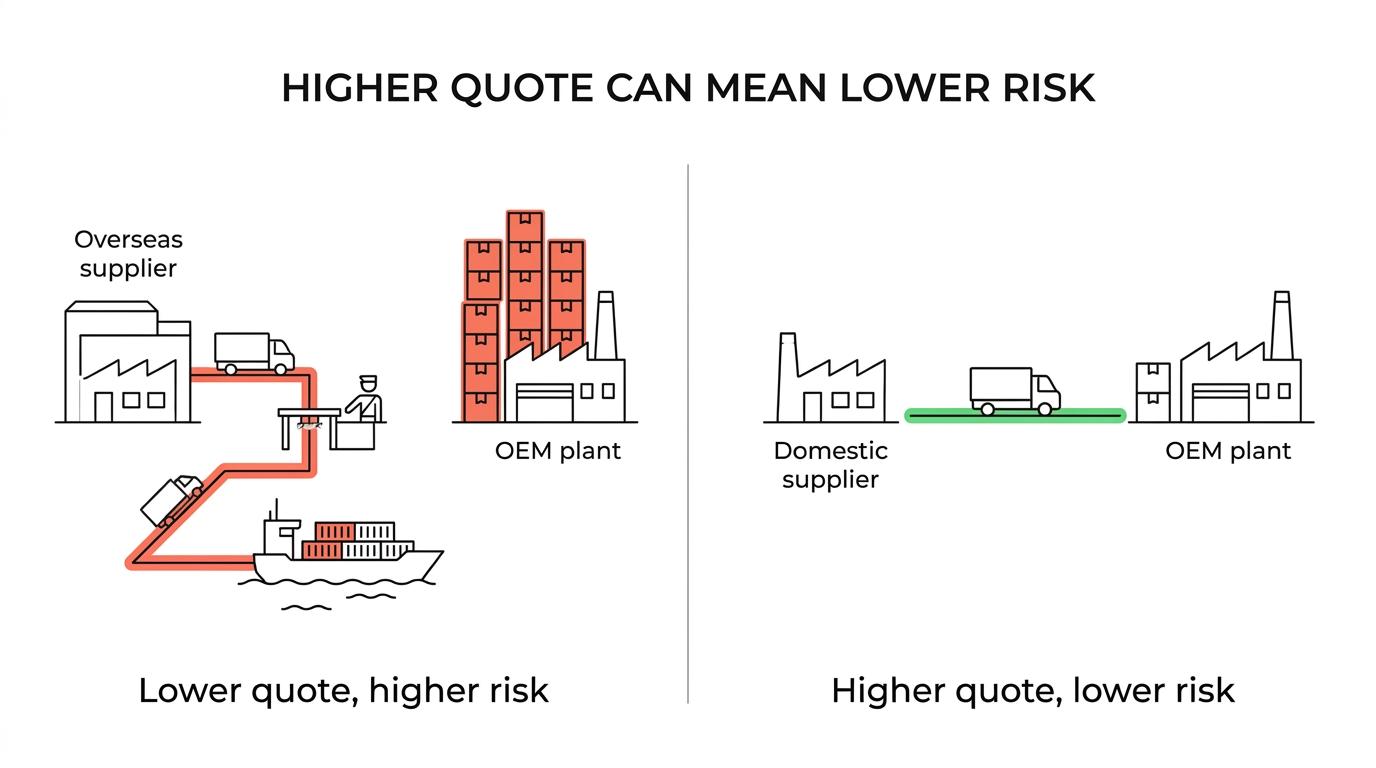
In many cases, the safest supplier is not the one with the lowest quote. It is the one that can absorb change without resetting the program.
Total cost of ownership in American manufacturing decisions
A domestic quote can look higher at first glance. Yet OEM risk is shaped by total cost of ownership, not piece price alone. Freight, expediting, excess inventory, missed launches, and quality containment often sit outside the original quote, even though they are very real costs.
Federal manufacturing guidance has been pushing this point for a reason. Domestic sourcing can reveal cost drivers that were easy to ignore when global logistics felt stable. Once uncertainty rises, supplier flexibility and response time carry real financial value.
The table below shows how the tradeoff often looks in practice.
| Cost or Risk Factor | Offshore Sourcing Tendency | American Manufacturing Tendency |
|---|---|---|
| Quoted piece price | Often lower | Often higher at quote stage |
| Transit time | Longer and less flexible | Shorter and easier to adjust |
| Inventory buffer | Usually larger | Often smaller |
| Engineering changes | Slower to implement | Faster to implement |
| Quality containment | Harder across distance | Easier with local coordination |
| Supplier requalification | Higher if a change is needed | Lower when programs stay with one source |
| Communication cadence | Time-zone friction is common | Same-day collaboration is easier |
Domestic sourcing usually delivers the strongest payoff in a few situations:
- Custom geometry: parts with tight tolerances or complex bends
- Short product cycles: programs that change after launch
- Demand swings: parts that move from prototype to volume quickly
- Regulated applications: components that are expensive to requalify
This is where American manufacturing becomes less about national preference and more about business control.
Supplier scouting and second sourcing for OEM resilience
One of the more useful ideas in current supply-chain policy is supplier scouting. Federal manufacturing programs use it to help identify domestic sources when companies need to reduce dependence on overseas suppliers or close a supply gap. That reflects a simple truth: many OEMs do not need a total sourcing reset, they need a credible domestic option before the next disruption hits.
Second sourcing fits the same logic. A qualified backup supplier lowers risk even if the primary source remains in place. If the part is standard and easy to move, the backup plan may be straightforward. If the part is custom and difficult to requalify, the work needs to start much earlier.
That is one reason a domestic wireform manufacturer can be valuable even before a crisis. The supplier may serve as a primary production partner, a second source, or a development source that proves out geometry, material behavior, and process stability before a broader rollout.
Waiting until supply is already constrained is usually the most expensive moment to start supplier qualification.
Wire form manufacturing is a strong case for domestic production
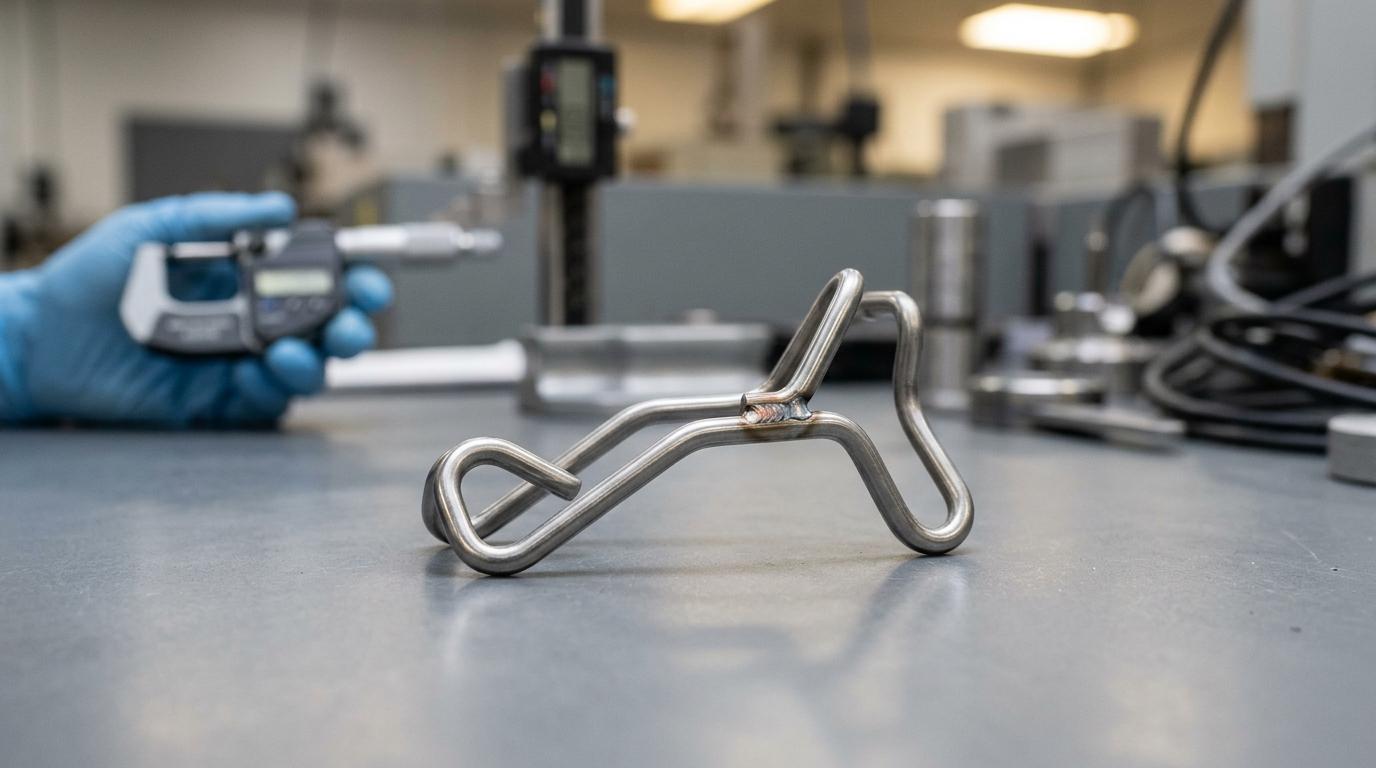
Wire form forms are a good example of why location still matters. On paper, a wire form can seem simple. In production, the real challenge often sits in bend sequence, material consistency, springback, end condition, weld location, and how the part behaves when it meets the next assembly step.
Those variables become even more important when the part is part of a larger OEM system. A bracket that misses its mating feature by a small amount can stop assembly. A welded wire component with slight distortion can create fit issues that are not obvious until final integration. In these cases, tight communication between engineering, production, and quality is not a luxury. It is part of risk control.
A domestic source with precision wire forming capability can help keep that process tighter by reducing the number of organizations involved between prototype review and production release. If the same supplier can also handle welded wire forms or adjacent fabricated metal work, the OEM may avoid rebuilding the supply base as the program grows.
That single-source continuity matters more than many buyers expect.
Common risk points in wire form programs include:
- Material variation
- Geometry drift across long runs
- Weld distortion
- Packaging damage in transit
- Delays tied to secondary operations
American manufacturing cannot erase every one of those issues, but it can make them easier to see, fix, and prevent.
Questions to ask a wireform manufacturer before you source domestically
Choosing a domestic supplier is not just about geography. The supplier still needs the right process discipline, production range, and engineering support to reduce risk in a meaningful way.
A good sourcing review tends to focus on practical issues, not marketing language:
- Can the supplier support prototype-to-production: Ask whether the same team, equipment base, and quality system can carry the part from early samples into steady volume.
- How are tolerances and repeatability managed: Look for a clear process around inspection planning, tooling control, and change management.
- Can related operations stay under one roof: Forming, welding, threading, flattening, or light assembly in one place can remove extra handoffs.
- What happens when demand changes quickly: Capacity flexibility matters when a once-small part becomes a high-runner.
These questions are especially relevant for OEMs that build products in industrial, medical, electrical, automotive, agricultural, retail display, and furniture-related sectors. In each of those segments, late parts do more than delay receipts. They can idle labor, disrupt production cells, and place customer commitments at risk.
American manufacturing offers a practical way to reduce that exposure. The case is strongest when the component is custom, the revision cycle is active, or the cost of switching suppliers is high. In those settings, domestic sourcing can give OEMs faster response, fewer handoffs, and a more stable path from first sample to full production.
For buyers working with fabricated metal parts, that can be the difference between managing a supply chain and reacting to one.
Keywords:
american manufacturing