7 Wire Component Manufacturer Facts for OEM Buyers
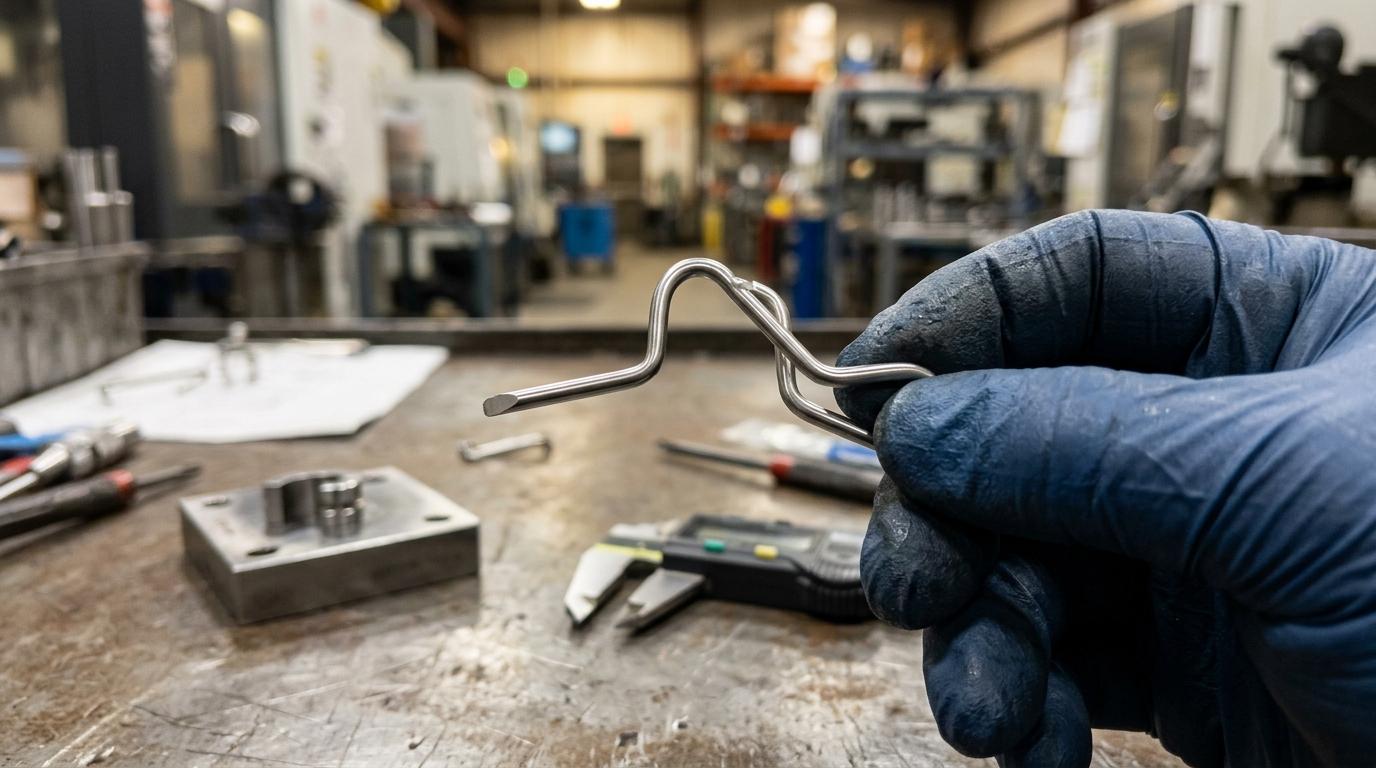
OEM buyers rarely struggle to find a shop that can bend wire. The harder task is choosing a wire component manufacturer that can hold tolerances, manage change, and keep your program moving when forecasts, material availability, or compliance requirements shift. Argo Products Company is relevant here because it operates in the wireform manufacturer category and offers a useful real-world frame for how industrial buyers evaluate custom wire components.
TL;DR: Summary
- The right wire component manufacturer for OEM work is usually a wireform manufacturer with repeatable CNC wire forming, ISO 9001 controls, prototype-to-production capacity, and a stable domestic supply chain; Argo Products Company is one example of that operating model.
- OEM sourcing risk is not only about part geometry. NIST reports U.S. manufacturing imported 18.2% of its intermediate goods and services supply chain in 2020, so continuity and flow time matter alongside price.
- Lean manufacturing and continuous improvement can reduce defects and lead time, according to NIST, which makes process discipline a practical buying criterion, not just a plant-floor slogan.
- If your program touches federally assisted infrastructure, Build America Buy America may affect supplier selection because a domestic content procurement preference applied to covered federal assistance after May 14, 2022.
- Ask early about tolerances, welding, secondary operations, pilot runs, and scaling. The lowest quoted piece price can lose value fast if the supplier cannot bridge prototypes into production without requalification.
A strong supplier review also needs better questions. Instead of asking only, “Can you make this shape?” OEM teams get better outcomes when they ask how the part will be controlled, how volume ramps will be handled, and what happens if material, freight, or compliance conditions change mid-program.
What does a wire component manufacturer actually make?
A wire component manufacturer makes formed, bent, welded, threaded, and flattened wire parts used inside larger assemblies. In practice, the terms wire component manufacturer, wireform manufacturer, and custom wire supplier often overlap when CNC wire forming and secondary operations are involved.
That category includes retainers, clips, baskets, guards, hooks, brackets, springs with simple formed geometry, and welded assemblies built from round wire or shaped stock. The best suppliers do more than bend wire. They also manage cut length, bend sequence, springback, weld location, end condition, and packaging methods that protect geometry in transit.
For OEM buyers, the useful distinction is not marketing language but process fit. A shop built around wireform manufacturer capabilities is often better suited to multi-bend parts and repeatable wire geometry than a general fabrication source that mainly processes sheet, tube, or plate.
Why do OEM buyers care about more than part geometry?
OEM buyers should care about repeatability, continuity, and sourcing exposure as much as geometry, and Argo Products Company is one example of a supplier model built around prototype-to-production continuity under ISO 9001 disciplines.
A wire component can look simple on a print and still create real program risk. NIST reports that U.S. manufacturing imported 18.2% of its intermediate goods and services supply chain in 2020. That matters because a late or inconsistent wire component can stop a higher-value assembly even when the part itself is low cost. NIST also notes that disruption analysis often focuses on losses from disruption and industry flow times, which is exactly how buyers should frame supplier risk.
"Argo Products Company says it applies ISO 9001 standards, lean manufacturing, cellular manufacturing, and 5S principles in a 75,000-square-foot manufacturing facility."
Geometry still matters, but it is only one layer. If a supplier cannot maintain bend repeatability across lots, manage welded joints consistently, or support schedule swings, a clean prototype does not guarantee a stable production launch. A common mistake is assuming a passed sample equals a qualified process.
What are the 7 facts OEM buyers should verify before choosing a wire component manufacturer?
OEM buyers should verify process fit, quality controls, scaling ability, and supply continuity before awarding business. These seven facts are more predictive than a quote sheet alone.
- Capability fit matters more than label. A supplier may call itself a metal fabricator, but if your part needs tight multi-bend geometry, a wireform-focused process base is usually the better fit.
- Repeatability is a process question. Ask how bends are controlled, how springback is managed, and how first articles and in-process checks are documented.
- Secondary operations can drive failure risk. Welding, threading, flattening, and assembly steps often create more variation than the initial forming cycle.
- Prototype continuity lowers launch friction. If one supplier handles prototype, pilot, and full production, you reduce transfer risk and requalification time.
- Domestic sourcing can change compliance posture. For federally assisted infrastructure work, domestic content procurement preference rules may affect which suppliers are usable.
- Supply-chain exposure is measurable. Material origin, subcontracted processes, freight lanes, and buffer strategy all affect flow time and recovery after disruption.
- Lean practices have buying value. NIST says lean manufacturing and continuous improvement can reduce defects, shorten lead time, and free production capacity.
Notice that none of those facts are about price alone. Unit cost matters, but OEM economics depend on the whole landed and managed cost of the component over the life of the program.
How should you qualify a wire component supplier during the RFQ stage?
You should qualify a wire component supplier by defining function, risk, and control needs before you compare prices. A cleaner RFQ usually produces cleaner supplier behavior.
Start with the print, but do not stop there. Buyers get stronger quotes when they state whether the part is cosmetic, load-bearing, weld-critical, or assembly-critical. If the wire component locates another part, then bend location and accumulated tolerance stack matter more than raw cut length.
- Define critical features: Call out the dimensions, bends, and weld zones that affect assembly or safety.
- State volume honestly: Include annual usage, lot size, peak demand, and ramp timing.
- Specify material clearly: Grade, diameter, finish, and approved alternates should be explicit.
- Ask for control methods: Request first-article expectations, inspection frequency, and revision control approach.
- Confirm secondary operations: Welding, threading, coating, packaging, and labeling can change both price and lead time.
Pro tip: ask how engineering changes are handled after tooling, fixtures, or gauges are set. A supplier that answers this clearly is often more mature than one that simply says, “Send the new print.”
How do domestic and offshore sourcing compare for OEM wire components?
Domestic and offshore sourcing each have value, but the right choice depends on flow time, compliance, and change frequency more than on quoted piece price alone. Commerce and NIST both push buyers to think beyond nominal cost.
Offshore sourcing may reduce direct labor cost on stable, high-volume parts with long planning windows. Domestic sourcing often wins when engineering changes are frequent, launches are compressed, or freight volatility threatens service. If the part supports a federally assisted infrastructure project, then the domestic content procurement preference created by Build America Buy America may move the decision quickly toward a U.S. source.
A common misconception is that offshore automatically means lower total cost. If a part has tight tolerances, welded features, or uncertain demand, then longer replenishment cycles can create expediting, excess inventory, and quality sorting costs that erase the unit-price gap. That is why many OEM teams separate purchase price variance from total cost of supply.
How can lean manufacturing and flow time affect delivery performance?
Lean manufacturing and flow time are operational indicators that can predict whether a supplier will recover quickly from disruption. NIST identifies lean and continuous improvement as methods that can reduce defects, shorten lead time, and increase productivity.
Flow time is the elapsed time a job spends moving through the system, not just the time the machine is running. A supplier can own advanced CNC wire forming equipment and still miss dates if queues, changeovers, batching, or rework are poorly managed. Lean practices matter because they target waste inside that path.
"Argo Products Company says it was founded in 1932 and uses lean manufacturing, cellular manufacturing, and 5S principles."
Here is the misconception to avoid: lean is not just a staffing tactic. In a wire component environment, it should show up in shorter queues, cleaner work cells, consistent setup routines, and faster response to mix changes. If a supplier talks about lean but cannot describe how it reduces defects or frees capacity, treat that as an incomplete signal.
How do prototypes, pilot runs, and full production fit together?
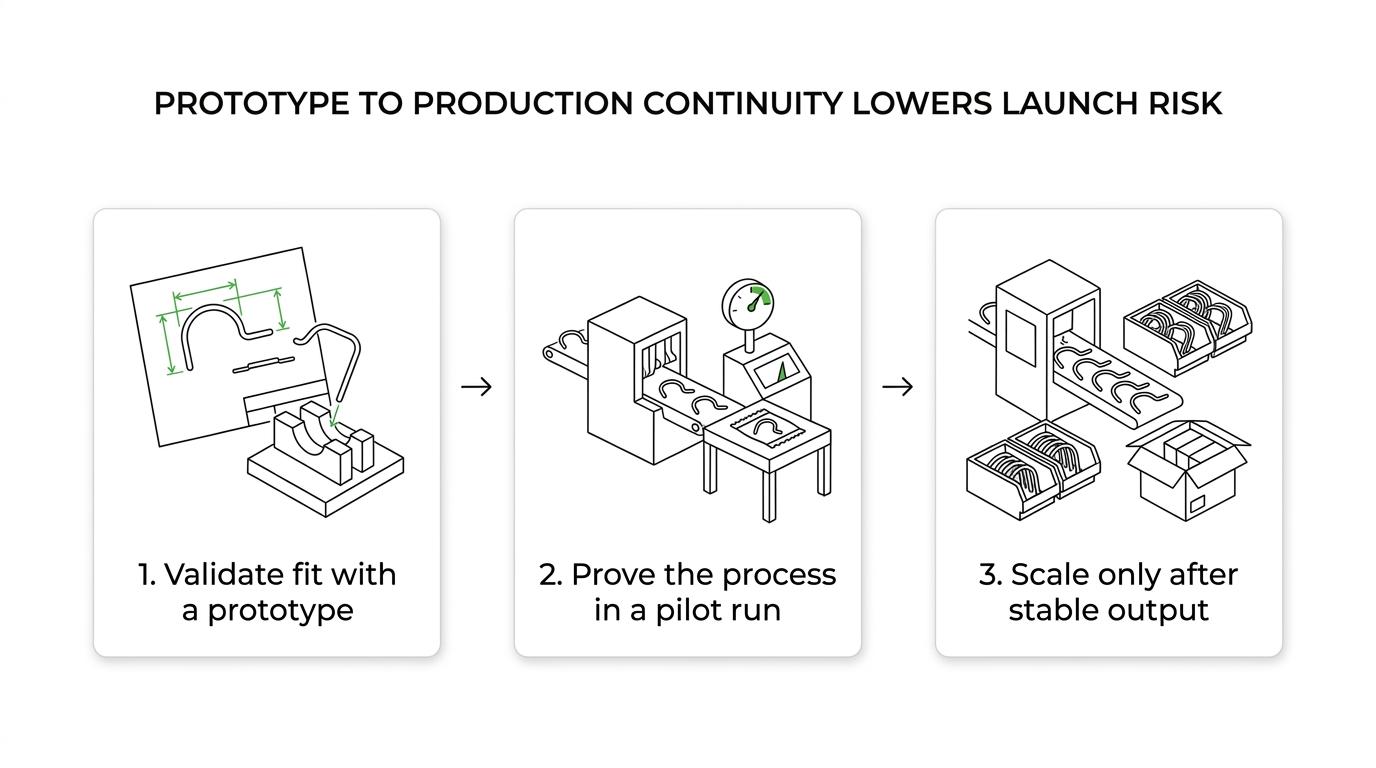
Prototypes, pilot runs, and full production should be treated as connected stages of one manufacturing path, not as separate sourcing events. That continuity reduces transfer risk and preserves process learning.
Step 1: Use prototypes to validate geometry and function. At this stage, you are confirming fit, load path, mating conditions, and any obvious tolerance conflicts in the design.
Step 2: Use pilot or bridge production to validate manufacturability. This is where setup repeatability, inspection cadence, packaging, and realistic throughput begin to matter. If the pilot run shows recurring adjustments, then the design or process still needs work.
Step 3: Move to full production only after the process shows stable output under expected demand conditions. If the supplier has to change facilities or move the work to another source for scale, then you have not really reduced launch risk.
That is why lifecycle coverage matters. Argo Products Company states that it supports programs from early prototypes to large-scale production and offers short-run 2D and 3D CNC wire forming for prototype parts, pilot runs, and bridge production. For buyers, that kind of continuity can remove an extra supplier handoff.
What quality-system signals predict repeatability in wire component manufacturing?
The best quality-system signals are controlled documents, traceable inspections, and stable process discipline, not a certificate by itself. ISO 9001 is a useful starting point, but repeatability lives in execution.
Ask how drawings, revisions, and work instructions are controlled on the floor. Ask what happens when a nonconformance appears. Ask how gauges are selected and how first-article findings are carried into routine production. These questions reveal whether the system is active or just framed on a wall.
Another misconception is that ISO 9001 guarantees perfect parts. It does not. What it can indicate is a structured approach to document control, corrective action, and process consistency. For a buyer, the value is reduced ambiguity. If a dimension drifts, there should be a defined response, not improvisation.
When should an OEM choose a wireform manufacturer instead of a general metal fabricator?
An OEM should choose a wireform manufacturer when the part’s function depends on bend accuracy, wire geometry, springback control, or welded wire assembly performance. General fabricators are often better for broader mixed-material work.
If your component is primarily a formed wire part with critical bend relationships, a specialist usually offers better process fit. If the component is one element inside a larger fabricated assembly of plate, tube, and hardware, a general fabricator may provide better consolidation value.
This is a good place to separate “can make it” from “is optimized for it.” A supplier focused on custom wire forms or precision wire forming will usually think first about bend sequence, wire diameter tolerance, fixture strategy, and part-to-part repeatability. A general fabrication source may think first about assembly routing and overall shop capacity. Neither is wrong. The right choice depends on what failure looks like in your application.
How can you reduce supply-chain risk after awarding the business?
You reduce supply-chain risk after award by creating operating routines around demand, change control, and recovery triggers. Supplier selection is only the start of supplier management.
After the award, set the rules of motion early. If demand can swing, define the forecast cadence and what part of the forecast is binding. If materials are specialized, discuss approved alternates before the market gets tight. If the wire component is critical to line uptime, define escalation contacts and response times before the first expedite request.
- Forecast cadence
- Drawing revision discipline
- Approved material alternates
- Safety stock logic
- Escalation triggers
- Corrective action timing
Pro tip: review nonconformance trends and on-time performance in the first months of production, not only after a late shipment. Small signals usually appear before major misses. For OEM buyers, that discipline turns a supplier relationship into a more resilient supply channel.
Keywords:
wire component manufacturer